Month: July 2018

Binary Search Tree Traversal | BST Traversal

Binary Search Tree-


Before you go through this article, make sure that you have gone through the previous article on Binary Search Trees.


Binary search tree (BST) is a special kind of binary tree where each node contains-

  • Only larger values in its right subtree.
  • Only smaller values in its left subtree.


In this article, we will discuss about Binary Search Tree Traversal.


BST Traversal-


  • A binary search tree is traversed in exactly the same way a binary tree is traversed.
  • In other words, BST traversal is same as binary tree traversal.


Read More- Binary Tree Traversal


Example-


Consider the following binary search tree-
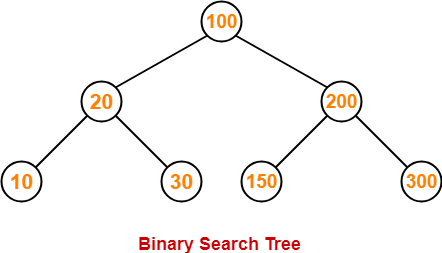


Now, let us write the traversal sequences for this binary search tree-


Preorder Traversal-


100 , 20 , 10 , 30 , 200 , 150 , 300


Inorder Traversal-


10 , 20 , 30 , 100 , 150 , 200 , 300


Postorder Traversal-


10 , 30 , 20 , 150 , 300 , 200 , 100


Important Notes-


Note-01:


  • Inorder traversal of a binary search tree always yields all the nodes in increasing order.


Note-02:


Unlike Binary Trees,

  • A binary search tree can be constructed using only preorder or only postorder traversal result.
  • This is because inorder traversal can be obtained by sorting the given result in increasing order.


To gain better understanding about Binary Search Tree Traversal,

Watch this Video Lecture


PRACTICE PROBLEMS BASED ON BST TRAVERSAL-


Problem-01:


Suppose the numbers 7 , 5 , 1 , 8 , 3 , 6 , 0 , 9 , 4 , 2 are inserted in that order into an initially empty binary search tree. The binary search tree uses the usual ordering on natural numbers.

What is the inorder traversal sequence of the resultant tree?

  1. 7 , 5 , 1 , 0 , 3 , 2 , 4 , 6 , 8 , 9
  2. 0 , 2 , 4 , 3 , 1 , 6 , 5 , 9 , 8 , 7
  3. 0 , 1 , 2 , 3 , 4 , 5 , 6 , 7 , 8 , 9
  4. 9 , 8 , 6 , 4 , 2 , 3 , 0 , 1 , 5 , 7


Solution-


This given problem may be solved in the following two ways-


Method-01:


  • We construct a binary search tree for the given elements.
  • We write the inorder traversal sequence from the binary search tree so obtained.


Following these steps, we have-
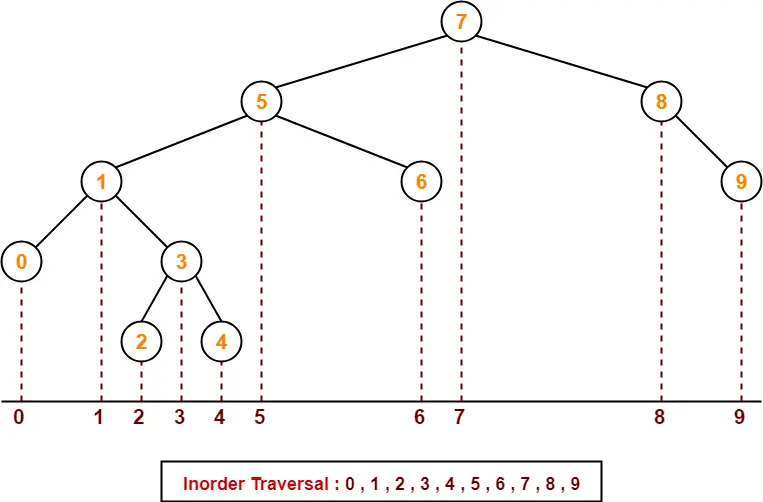


Thus, Option (C) is correct.


Method-02:


We know, inorder traversal of a binary search tree always yields all the nodes in increasing order.


Using this result,

  • We arrange all the given elements in increasing order.
  • Then, we report the sequence so obtained as inorder traversal sequence.


Inorder Traversal :

0 , 1 , 2 , 3 , 4 , 5 , 6 , 7 , 8 , 9


Thus, Option (C) is correct.


Problem-02:


The preorder traversal sequence of a binary search tree is-

30 , 20 , 10 , 15 , 25 , 23 , 39 , 35 , 42

What one of the following is the postorder traversal sequence of the same tree?

  1. 10 , 20 , 15 , 23 , 25 , 35 , 42 , 39 , 30
  2. 15 , 10 , 25 , 23 , 20 , 42 , 35 , 39 , 30
  3. 15 , 20 , 10 , 23 , 25 , 42 , 35 , 39 , 30
  4. 15 , 10 , 23 , 25 , 20 , 35 , 42 , 39 , 30


Solution-


In this question,

  • We are provided with the preorder traversal sequence.
  • We write the inorder traversal sequence by arranging all the numbers in ascending order.


Then-

  • Postorder Traversal : 30 , 20 , 10 , 15 , 25 , 23 , 39 , 35 , 42
  • Inorder Traversal : 10 , 15 , 20 , 23 , 25 , 30 , 35 , 39 , 42


Now,

  • We draw a binary search tree using these traversal results.
  • The binary search tree so obtained is as shown-
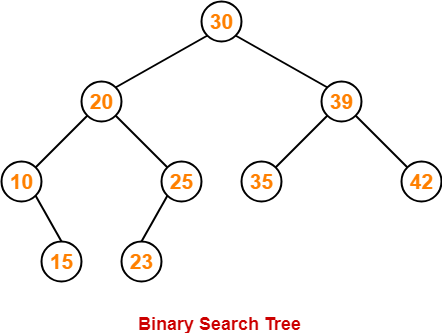


Now, we write the postorder traversal sequence-


Postorder Traversal :

15 , 10 , 23 , 25, 20, 35, 42, 39, 30


Thus, Option (D) is correct.


To watch video solutions and practice more problems,

Watch this Video Lecture


Download Handwritten Notes Here-


Next Article- Binary Search Tree Operations


Get more notes and other study material of Data Structures.

Watch video lectures by visiting our YouTube channel LearnVidFun.
Binary Search Tree | Example | Construction

Binary Tree-


Before you go through this article, make sure that you gone through the previous article on Binary Trees.


We have discussed-

  • Binary tree is a special tree data structure.
  • In a binary tree, each node can have at most 2 children.
  • In a binary tree, nodes may be arranged in any random order.


In this article, we will discuss about Binary Search Trees.


Binary Search Tree-


Binary Search Tree is a special kind of binary tree in which nodes are arranged in a specific order.


In a binary search tree (BST), each node contains-

  • Only smaller values in its left sub tree
  • Only larger values in its right sub tree


Example-


Number of Binary Search Trees-


Example-


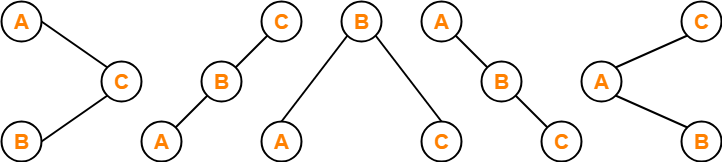
Number of distinct binary search trees possible with 3 distinct keys

= 2×3C3 / 3+1

= 6C3 / 4

= 5


If three distinct keys are A, B and C, then 5 distinct binary search trees are-


Binary Search Tree Construction-


Let us understand the construction of a binary search tree using the following example-


Example-


Construct a Binary Search Tree (BST) for the following sequence of numbers-

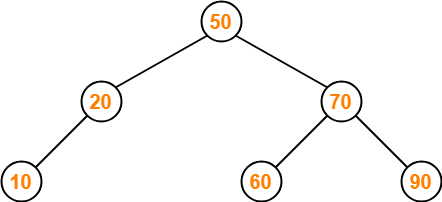
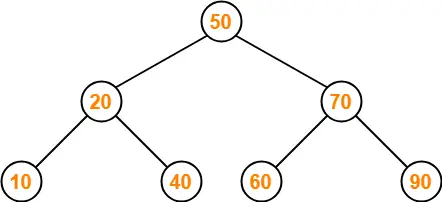
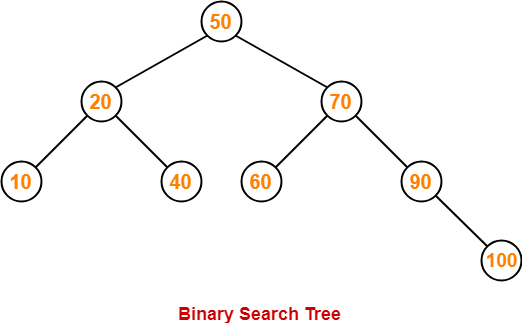
50, 70, 60, 20, 90, 10, 40, 100


When elements are given in a sequence,

  • Always consider the first element as the root node.
  • Consider the given elements and insert them in the BST one by one.


The binary search tree will be constructed as explained below-


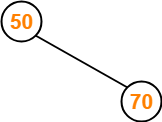
Insert 50-


Insert 70-


  • As 70 > 50, so insert 70 to the right of 50.


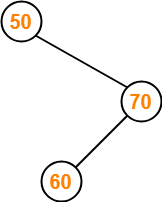
Insert 60-


  • As 60 > 50, so insert 60 to the right of 50.
  • As 60 < 70, so insert 60 to the left of 70.


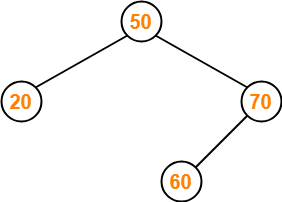
Insert 20-


  • As 20 < 50, so insert 20 to the left of 50.


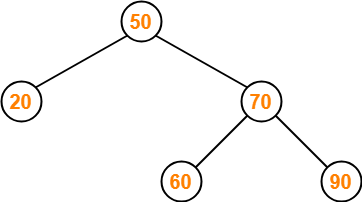
Insert 90-


  • As 90 > 50, so insert 90 to the right of 50.
  • As 90 > 70, so insert 90 to the right of 70.


Insert 10-


  • As 10 < 50, so insert 10 to the left of 50.
  • As 10 < 20, so insert 10 to the left of 20.


Insert 40-


  • As 40 < 50, so insert 40 to the left of 50.
  • As 40 > 20, so insert 40 to the right of 20.


Insert 100-


  • As 100 > 50, so insert 100 to the right of 50.
  • As 100 > 70, so insert 100 to the right of 70.
  • As 100 > 90, so insert 100 to the right of 90.


This is the required Binary Search Tree.


To gain better understanding about Binary Search Trees,

Watch this Video Lecture


PRACTICE PROBLEMS BASED ON BINARY SEARCH TREES-


Problem-01:


A binary search tree is generated by inserting in order of the following integers-

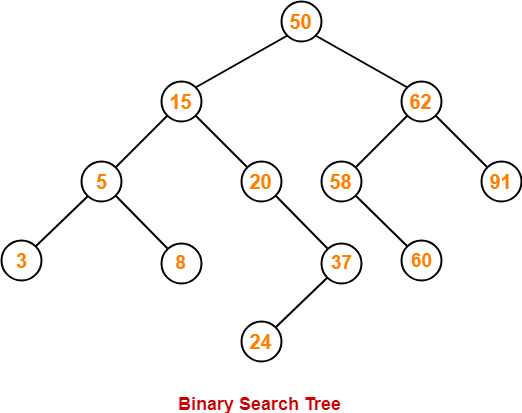
50, 15, 62, 5, 20, 58, 91, 3, 8, 37, 60, 24


The number of nodes in the left subtree and right subtree of the root respectively is _____.

  1. (4, 7)
  2. (7, 4)
  3. (8, 3)
  4. (3, 8)


Solution-


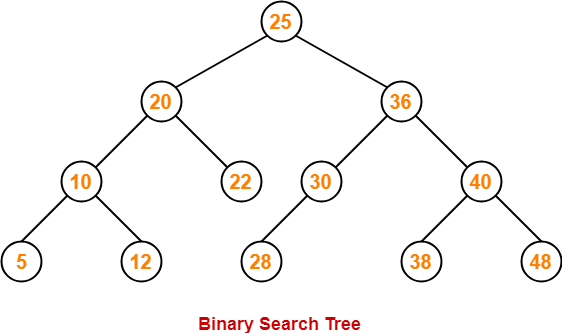
Using the above discussed steps, we will construct the binary search tree.

The resultant binary search tree will be-


Clearly,

  • Number of nodes in the left subtree of the root = 7
  • Number of nodes in the right subtree of the root = 4


Thus, Option (B) is correct.


Problem-02:


How many distinct binary search trees can be constructed out of 4 distinct keys?

  1. 5
  2. 14
  3. 24
  4. 35


Solution-


Number of distinct binary search trees possible with 4 distinct keys

= 2nCn / n+1

2×4C4 / 4+1

= 8C4 / 5

= 14


Thus, Option (B) is correct.


Problem-03:


The numbers 1, 2, …, n are inserted in a binary search tree in some order. In the resulting tree, the right subtree of the root contains p nodes. The first number to be inserted in the tree must be-

  1. p
  2. p+1
  3. n-p
  4. n-p+1


Solution-


Let n = 4 and p = 3.


Then, given options reduce to-

  1. 3
  2. 4
  3. 1
  4. 2


Our binary search tree will be as shown-


Clearly, first inserted number = 1.

Thus, Option (C) is correct.


Problem-04:


We are given a set of n distinct elements and an unlabeled binary tree with n nodes. In how many ways can we populate the tree with given set so that it becomes a binary search tree?

  1. 0
  2. 1
  3. n!
  4. C(2n, n) / n+1


Solution-


Option (B) is correct.


To watch video solutions and practice more problems,

Watch this Video Lecture


Download Handwritten Notes Here-


Next Article- Binary Search Tree Traversal


Get more notes and other study material of Data Structures.

Watch video lectures by visiting our YouTube channel LearnVidFun.

GATE Important Topics for CSE

GATE Important Topics for CSE Students-


In this article, all the topics of the following subjects which are extremely important from the GATE examination point of view for computer science students have been brought out.

  1. C, Data Structure and Algorithms
  2. Theory of Automata and Computation
  3. Compiler Design
  4. Digital Logic
  5. Database Management System
  6. Computer Organization and Architecture
  7. Operating System
  8. Computer Networks


Based on the analysis of previous years GATE exam papers, important topics from these subjects are-


C, Data Structure and Algorithms-


  • These are the most important subjects from the GATE examination point of view.
  • About 25% of the complete paper is from these subjects.
  • If you are good in these subjects, it will surely provide a boost to your preparation and will increase your chances of cracking the exam.


C Programming-


  • C programming questions are mostly based on finding the output of programs consisting of some pointers, static variables, arrays, strings, functions etc.
  • So, you must practice solving different kinds of questions.
  • It is highly recommended to start practicing now if you are not good at programming.


Data Structure-


Practice problems related to-

  • Tree like finding number of leaf nodes, number of non leaf nodes, total number of nodes, height of the tree etc
  • Binary trees
  • Binary Search trees
  • Preorder, Inorder and Postorder Traversal
  • Spanning trees and minimum spanning tree
  • AVL trees and balancing them after insertion and deletion
  • Properties of Heap
  • Deletion and Insertion of items in heap
  • Different problems on stack, queue and linked list (Understand their concepts very well)


Algorithms-


Practice problems related to-

  • Finding time complexity of given code (Very-very Important)
  • Properties of Complexity and relation between them
  • Searching and Sorting
  • Dynamic Programming Approach
  • Divide and Conquer Approach
  • Greedy Approach
  • Basic problems like knapsack problem, matrix chain multiplication, Longest Common Sub sequence, Job Sequence and Compressing mechanism
  • Basic Theory of P-NP problems


Theory of Automata and Computation-


Practice questions related to-

  • Finding minimum number of states in DFA
  • NFA to DFA Conversion
  • Closure properties of Finite Automata
  • Finding regular expressions
  • Mealy Moore Machine
  • Simplification of Context Free Grammar
  • Pushdown Automata
  • Closure Properties of Pushdown Automata
  • Finding category of any language or grammar
  • Concepts related to expressive power of different languages
  • Basic Problems related to NP Completeness
  • Properties of Recursive and Recursive Enumerable Languages
  • Turing Machine making and expressive power of different types of Turing Machine


Finite Automata covers approximately 50% questions from Theory of Automata and Computation. So, give it more time than others.


Compiler Design-


Practice questions related to-

  • Parsing and all its techniques (You will always find at least one question from this topic LL(1), LR(1), SLR, LALR, CLR)
  •  Finding First and Follow
  • Precedence and Associativity of operators
  • Finding value from expression tree
  • Ambiguous Grammar


Digital Logic-


Practice questions related to-

  • K-Maps (Very high chances of very simple question)
  • Multiplexers
  • Demultiplexers
  • Encoder
  • Decoder
  • Flip Flops
  • Finding modulus of counters
  • Floating point representation
  • Integer representation
  • IEEE Format, Range and Precision


Digital logic contains very simple questions. If you practice them, you can solve all the questions very easily. So, don’t lose your marks here.


Database Management System (DBMS)-


Practice questions related to-

  • Normalization (No GATE paper is completed without Normalization)
  • Finding normal form (comes 70% times in GATE paper)
  • Finding candidate keys
  • Decomposition of Relation (Lossless Join and Dependency preservation have more chances to appear)
  • SQL Queries (Select clause with properties of having, group by, any, all, exits)
  • Relational Algebra
  • Joins (High probability of tricky questions from Joins)
  • Finding view serializability and conflict serializability
  • Finding Recoverable and Cascade Schedule
  • Lock based, Two phase, Time Stamp and Graph based protocol with their properties like deadlock freedom and starvation freedom
  • Formation and structure of B and B+ Trees
  • Primary and Clustering Index
  • Number of blocks required in indexing of different type
  • Collision Resolution
  • Minimum and Maximum number of nodes in B and B+ Trees


Computer Organization and Architecture-


Practice questions related to-

  • Addressing Modes (Theory as well as Numerical Problems)
  • Program counter after some instruction
  • Number of one address and two address instructions
  • Values after shift and rotate instructions
  • Horizontal and vertical programming
  • Pipelining (Speed up of pipeline, Time taken to complete instruction in pipeline and non-pipeline architectures, Hazards in pipeline, Hazards removal, Branch penalty etc)
  • Cache memory organization
  • Mapping Techniques
  • Multilevel caches
  • Write through and write back technique


Questions are more tricky in this subject. So, you need to practice more on different types of questions.


Operating System-


Practice questions related to-

  • Finding turn around time and waiting time of different scheduling policies. There are more chances for numerical questions to appear from this topic.
  • Banker’s Algorithm to check whether given sequence is safe or not.
  • Synchronization (Very high chances for questions from this topic)
  • Semaphores and classical problems of synchronization (this will help you to solve other questions)
  • Memory Management (page table size, number of pages, logical address, physical address, page size, inverted page table, virtual memory, TLB etc.)


Computer Networks-


Practice questions related to-

  • Addressing (Subnet Address, Supernet Address, Broadcast Address, Range of Network, No. of hosts, Classless Addressing, Non continuous Addresses, Finding first host and last host)
  • Flow Control and Error Control Policies (Window Size, Number of Sequence bits, Frame size, Bandwidth, Round trip time, Utilization)
  • Properties of Circuit Switching and Packet Switching
  • Routing Protocols
  • Hamming distance and CRC
  • Congestion control policies like slow start, congestion avoidance, congestion detection
  • IP Header
  • TCP and UDP Header Format
  • Theory related to Ethernet and token ring
  • Basics of different types of protocols like FTP, HTTP, DHCP, ARP, RARP, SMTP, ICMP, POP
  • Basic concepts of cryptography and firewalls


Best of luck for your preparation!


Tree Traversal | Binary Tree Traversal

Binary Tree-


Before you go through this article, make sure that you gone through the previous article on Binary Trees.


We have discussed-

  • Binary tree is a special tree data structure.
  • In a binary tree, each node can have at most 2 children.


In this article, we will discuss about Binary Tree Traversal.


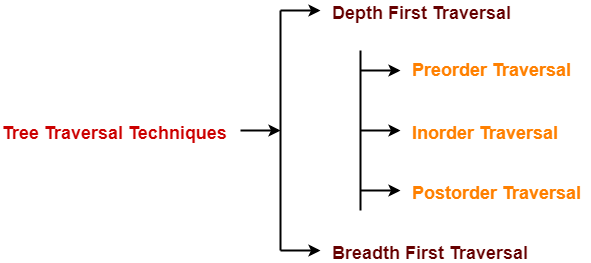
Tree Traversal-


Tree Traversal refers to the process of visiting each node in a tree data structure exactly once.


Various tree traversal techniques are-


Depth First Traversal-


Following three traversal techniques fall under Depth First Traversal-

  1. Preorder Traversal
  2. Inorder Traversal
  3. Postorder Traversal


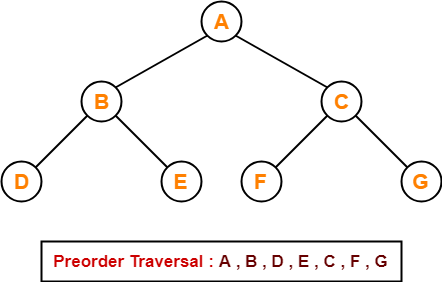
1. Preorder Traversal-


Algorithm-


  1. Visit the root
  2. Traverse the left sub tree i.e. call Preorder (left sub tree)
  3. Traverse the right sub tree i.e. call Preorder (right sub tree)


Root  Left  Right


Example-


Consider the following example-


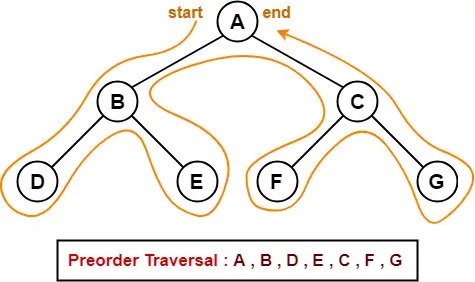
Preorder Traversal Shortcut


Traverse the entire tree starting from the root node keeping yourself to the left.


Applications-


  • Preorder traversal is used to get prefix expression of an expression tree.
  • Preorder traversal is used to create a copy of the tree.


2. Inorder Traversal-


Algorithm-


  1. Traverse the left sub tree i.e. call Inorder (left sub tree)
  2. Visit the root
  3. Traverse the right sub tree i.e. call Inorder (right sub tree)


Left  Root  Right


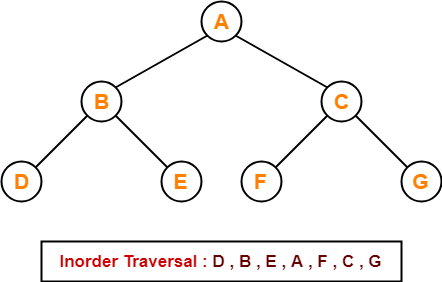
Example-


Consider the following example-


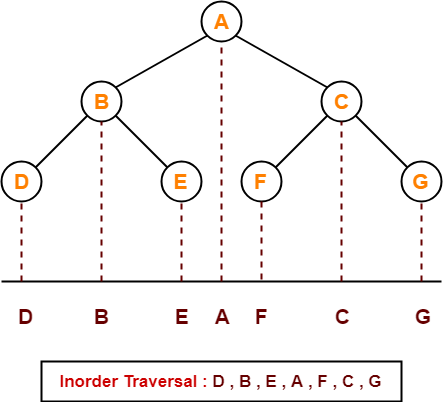
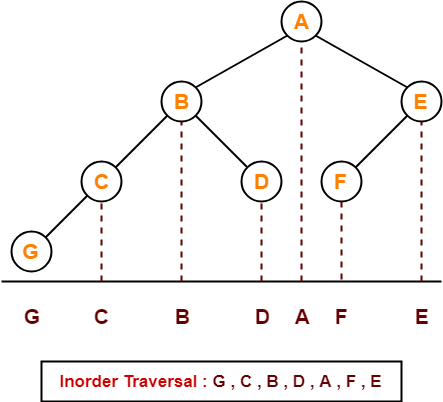
Inorder Traversal Shortcut


Keep a plane mirror horizontally at the bottom of the tree and take the projection of all the nodes.


Application-


  • Inorder traversal is used to get infix expression of an expression tree.


3. Postorder Traversal-


Algorithm-


  1. Traverse the left sub tree i.e. call Postorder (left sub tree)
  2. Traverse the right sub tree i.e. call Postorder (right sub tree)
  3. Visit the root


Left  Right  Root


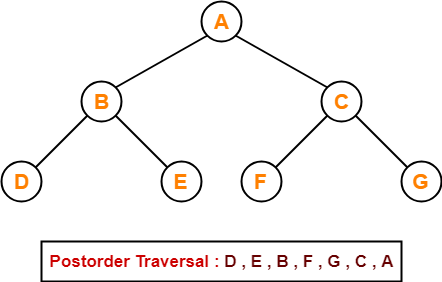
Example-


Consider the following example-


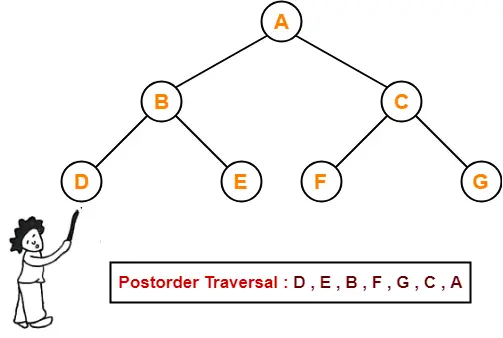
Postorder Traversal Shortcut


Pluck all the leftmost leaf nodes one by one.


Applications-


  • Postorder traversal is used to get postfix expression of an expression tree.
  • Postorder traversal is used to delete the tree.
  • This is because it deletes the children first and then it deletes the parent.


Breadth First Traversal-


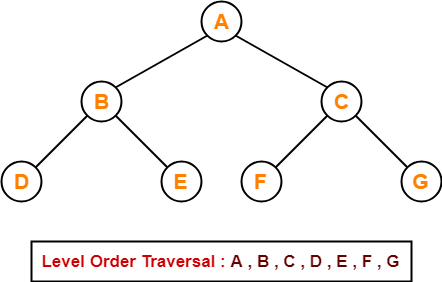
  • Breadth First Traversal of a tree prints all the nodes of a tree level by level.
  • Breadth First Traversal is also called as Level Order Traversal.


Example-


Application-


  • Level order traversal is used to print the data in the same order as stored in the array representation of a complete binary tree.


To gain better understanding about Tree Traversal,

Watch this Video Lecture


Also Read- Binary Tree Properties


PRACTICE PROBLEMS BASED ON TREE TRAVERSAL-


Problem-01:


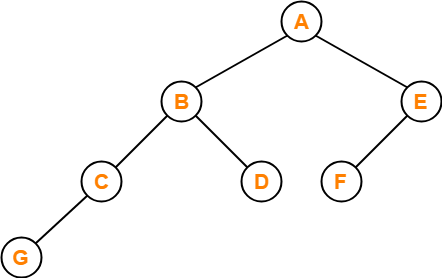
If the binary tree in figure is traversed in inorder, then the order in which the nodes will be visited is ____?


Solution-


The inorder traversal will be performed as-


Problem-02:


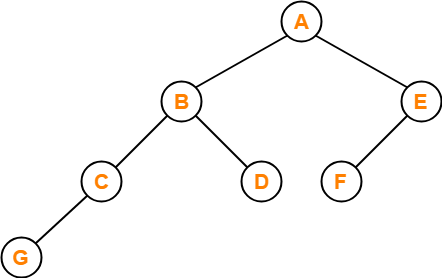
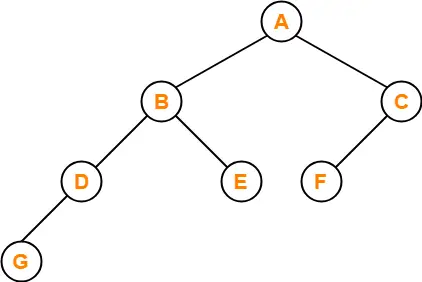
Which of the following sequences denotes the postorder traversal sequence of the tree shown in figure?


  1. FEGCBDBA
  2. GCBDAFE
  3. GCDBFEA
  4. FDEGCBA


Solution-


Perform the postorder traversal by plucking all the leftmost leaf nodes one by one.

Then,

Postorder Traversal :  G , C , D , B , F , E , A


Thus, Option (C) is correct.


Problem-03:


Let LASTPOST, LASTIN, LASTPRE denote the last vertex visited in a postorder, inorder and preorder traversal respectively of a complete binary tree. Which of the following is always true?

  1. LASTIN = LASTPOST
  2. LASTIN = LASTPRE
  3. LASTPRE = LASTPOST
  4. None of these


Solution-


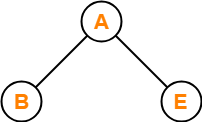
Consider the following complete binary tree-


Preorder Traversal  : B , A , E

Inorder Traversal     : B , A , E

Postorder Traversal : B , E , A


Clearly, LASTIN = LASTPRE.

Thus, Option (B) is correct.


Problem-04:


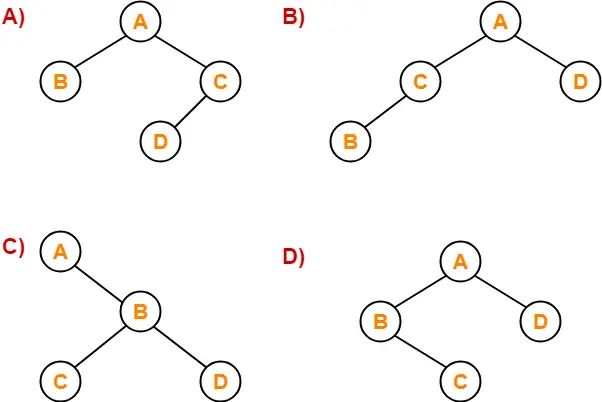
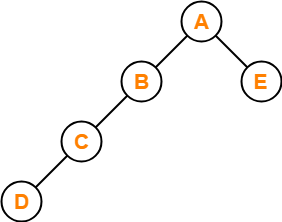
Which of the following binary trees has its inorder and preorder traversals as BCAD and ABCD respectively-


Solution-


Option (D) is correct.


To watch video solutions and practice more problems,

Watch this Video Lecture


Download Handwritten Notes Here-


Next Article- Binary Search Trees


Get more notes and other study material of Data Structures.

Watch video lectures by visiting our YouTube channel LearnVidFun.
Binary Tree | Binary Tree Properties

Binary Tree-


Before you go through this article, make sure that you gone through the previous article on Binary Trees.


We have discussed-

  • Binary tree is a special tree data structure.
  • In a binary tree, each node can have at most 2 children.
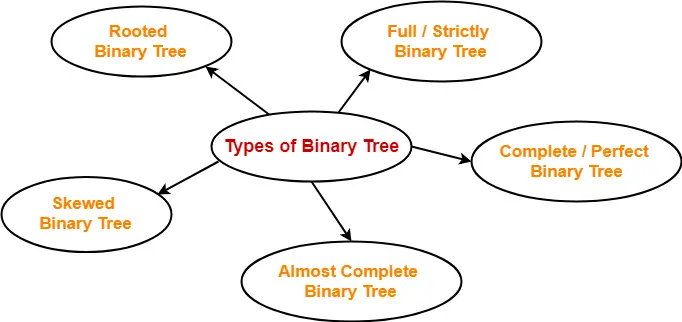
  • There are following types of binary trees-


In this article, we will discuss properties of binary trees.


Binary Tree Properties-


Important properties of binary trees are-


Property-01:


Minimum number of nodes in a binary tree of height H

= H + 1


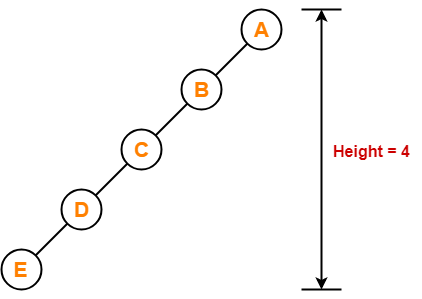
Example-


To construct a binary tree of height = 4, we need at least 4 + 1 = 5 nodes.


Property-02:


Maximum number of nodes in a binary tree of height H

= 2H+1 – 1


Example-


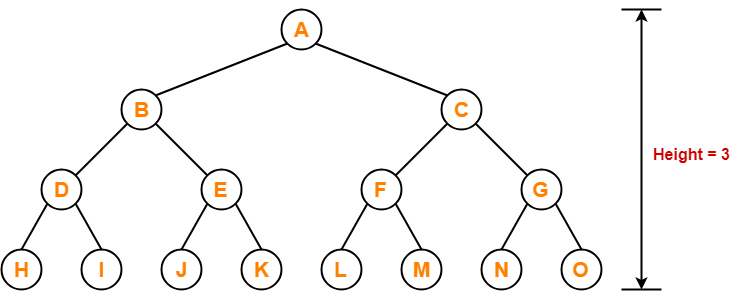
Maximum number of nodes in a binary tree of height 3

= 23+1 – 1

= 16 – 1

= 15 nodes

Thus, in a binary tree of height = 3, maximum number of nodes that can be inserted = 15.


We can not insert more number of nodes in this binary tree.


Property-03:


Total Number of leaf nodes in a Binary Tree

= Total Number of nodes with 2 children + 1


Example-


Consider the following binary tree-


Here,

  • Number of leaf nodes = 3
  • Number of nodes with 2 children = 2


Clearly, number of leaf nodes is one greater than number of nodes with 2 children.

This verifies the above relation.


NOTE

It is interesting to note that-

Number of leaf nodes in any binary tree depends only on the number of nodes with 2 children.


Property-04:


Maximum number of nodes at any level ‘L’ in a binary tree

= 2L


Example-


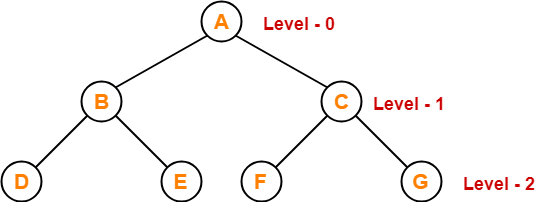
Maximum number of nodes at level-2 in a binary tree

= 22

= 4

Thus, in a binary tree, maximum number of nodes that can be present at level-2 = 4.


To gain better understanding about Binary Tree Properties,

Watch this Video Lecture


PRACTICE PROBLEMS BASED ON BINARY TREE PROPERTIES-


Problem-01:


A binary tree T has n leaf nodes. The number of nodes of degree-2 in T is ______?

  1. log2n
  2. n-1
  3. n
  4. 2n


Solution-


Using property-3, we have-

Number of degree-2 nodes

= Number of leaf nodes – 1

= n – 1


Thus, Option (B) is correct.


Problem-02:


In a binary tree, for every node the difference between the number of nodes in the left and right subtrees is at most 2. If the height of the tree is h > 0, then the minimum number of nodes in the tree is ______?

  1. 2h-1
  2. 2h-1 + 1
  3. 2h – 1
  4. 2h


Solution-


Let us assume any random value of h. Let h = 3.

Then the given options reduce to-

  1. 4
  2. 5
  3. 7
  4. 8


Now, consider the following binary tree with height h = 3-


  • This binary tree satisfies the question constraints.
  • It is constructed using minimum number of nodes.


Thus, Option (B) is correct.


Problem-03:


In a binary tree, the number of internal nodes of degree-1 is 5 and the number of internal nodes of degree-2 is 10. The number of leaf nodes in the binary tree is ______?

  1. 10
  2. 11
  3. 12
  4. 15


Solution-


Using property-3, we have-

Number of leaf nodes in a binary tree

= Number of degree-2 nodes + 1

= 10 + 1

= 11


Thus, Option (B) is correct.


Problem-04:


The height of a binary tree is the maximum number of edges in any root to leaf path. The maximum number of nodes in a binary tree of height h is ______?

  1. 2h
  2. 2h-1 – 1
  3. 2h+1 – 1
  4. 2h+1


Solution-


Using property-2, Option (C) is correct.


Problem-05:


A binary tree T has 20 leaves. The number of nodes in T having 2 children is ______?


Solution-


Using property-3, correct answer is 19.


To watch video solutions and practice more problems,

Watch this Video Lecture


Download Handwritten Notes Here-


Next Article- Binary Tree Traversal


Get more notes and other study material of Data Structures.

Watch video lectures by visiting our YouTube channel LearnVidFun.