Normal Forms in DBMS-
Before you go through this article, make sure that you have gone through the previous article on Normalization in DBMS.
We have discussed-
- Database normalization is a process of making the database consistent.
- Normalization is done through normal forms.
- The standard normal forms generally used are-
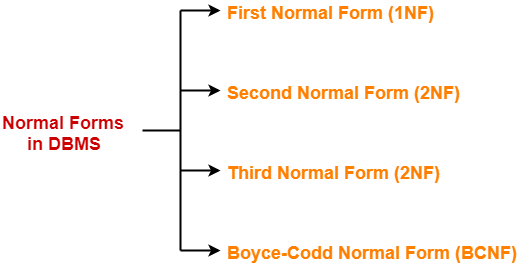
In this article, we will discuss some important points about normal forms.
Point-01:
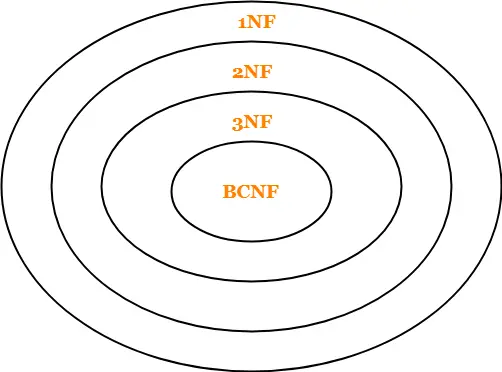
Remember the following diagram which implies-
- A relation in BCNF will surely be in all other normal forms.
- A relation in 3NF will surely be in 2NF and 1NF.
- A relation in 2NF will surely be in 1NF.
Point-02:
The above diagram also implies-
- BCNF is stricter than 3NF.
- 3NF is stricter than 2NF.
- 2NF is stricter than 1NF.
Point-03:
While determining the normal form of any given relation,
- Start checking from BCNF.
- This is because if it is found to be in BCNF, then it will surely be in all other normal forms.
- If the relation is not in BCNF, then start moving towards the outer circles and check for other normal forms in the order they appear.
Point-04:
- In a relational database, a relation is always in First Normal Form (1NF) at least.
Point-05:
- Singleton keys are those that consist of only a single attribute.
- If all the candidate keys of a relation are singleton candidate keys, then it will always be in 2NF at least.
- This is because there will be no chances of existing any partial dependency.
- The candidate keys will either fully appear or fully disappear from the dependencies.
- Thus, an incomplete candidate key will never determine a non-prime attribute.
Also read- Types of Keys in DBMS
Point-06:
- If all the attributes of a relation are prime attributes, then it will always be in 2NF at least.
- This is because there will be no chances of existing any partial dependency.
- Since there are no non-prime attributes, there will be no Functional Dependency which determines a non-prime attribute.
Point-07:
- If all the attributes of a relation are prime attributes, then it will always be in 3NF at least.
- This is because there will be no chances of existing any transitive dependency for non-prime attributes.
Point-08:
- Third Normal Form (3NF) is considered adequate for normal relational database design.
Point-09:
- Every binary relation (a relation with only two attributes) is always in BCNF.
Point-10:
- BCNF is free from redundancies arising out of functional dependencies (zero redundancy).
Point-11:
- A relation with only trivial functional dependencies is always in BCNF.
- In other words, a relation with no non-trivial functional dependencies is always in BCNF.
Point-12:
- BCNF decomposition is always lossless but not always dependency preserving.
Point-13:
- Sometimes, going for BCNF may not preserve functional dependencies.
- So, go for BCNF only if the lost functional dependencies are not required else normalize till 3NF only.
Point-14:
- There exist many more normal forms even after BCNF like 4NF and more.
- But in the real world database systems, it is generally not required to go beyond BCNF.
Point-15:
- Lossy decomposition is not allowed in 2NF, 3NF and BCNF.
- So, if the decomposition of a relation has been done in such a way that it is lossy, then the decomposition will never be in 2NF, 3NF and BCNF.
Point-16:
- Unlike BCNF, Lossless and dependency preserving decomposition into 3NF and 2NF is always possible.
Point-17:
- A prime attribute can be transitively dependent on a key in a 3NF relation.
- A prime attribute can not be transitively dependent on a key in a BCNF relation.
Point-18:
- If a relation consists of only singleton candidate keys and it is in 3NF, then it must also be in BCNF.
Point-19:
- If a relation consists of only one candidate key and it is in 3NF, then the relation must also be in BCNF.
Also Read- How To Find Candidate Keys?
Next Article- Transactions in DBMS
Get more notes and other study material of Database Management System (DBMS).
Watch video lectures by visiting our YouTube channel LearnVidFun.