Participation Constraints-
Before you go through this article, make sure that you have gone through the previous article on Introduction to ER Diagrams.
| Participation constraints define the least number of relationship instances in which an entity must compulsorily participate. |
Types of Participation Constraints-
There are two types of participation constraints-
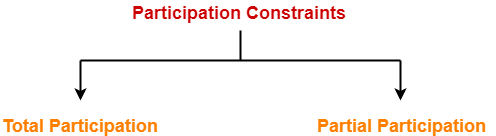
- Total participation
- Partial participation
1. Total Participation-
- It specifies that each entity in the entity set must compulsorily participate in at least one relationship instance in that relationship set.
- That is why, it is also called as mandatory participation.
- Total participation is represented using a double line between the entity set and relationship set.
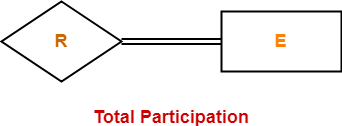
Example-

Here,
- Double line between the entity set “Student” and relationship set “Enrolled in” signifies total participation.
- It specifies that each student must be enrolled in at least one course.
Also read- Relationship Sets in DBMS and Entity Sets in DBMS
2. Partial Participation-
- It specifies that each entity in the entity set may or may not participate in the relationship instance in that relationship set.
- That is why, it is also called as optional participation.
- Partial participation is represented using a single line between the entity set and relationship set.
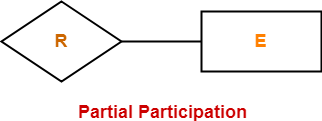
Example-
Here,
- Single line between the entity set “Course” and relationship set “Enrolled in” signifies partial participation.
- It specifies that there might exist some courses for which no enrollments are made.
Relationship between Cardinality and Participation Constraints-
Minimum cardinality tells whether the participation is partial or total.
- If minimum cardinality = 0, then it signifies partial participation.
- If minimum cardinality = 1, then it signifies total participation.
Maximum cardinality tells the maximum number of entities that participates in a relationship set.
Next Article- Types of Attributes in DBMS
Get more notes and other study material of Database Management System (DBMS).
Watch video lectures by visiting our YouTube channel LearnVidFun.