Category: Subjects

Magnetic Disk | Practice Problems | COA

Magnetic Disk in Computer Architecture-


Before you go through this article, make sure that you have gone through the previous article on Magnetic Disk.


We have discussed-

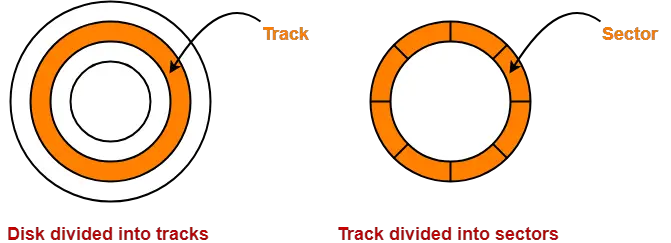
  • Magnetic disk is divided into platters which are further divided into tracks and sectors.
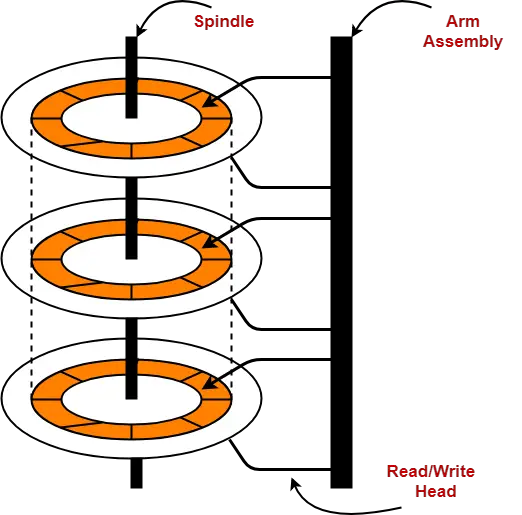
  • Read / write head is a mechanical arm that is used to write to and read from the disk.
  • Various important formulas.


In this article, we will discuss practice problems based on magnetic disk.


PRACTICE PROBLEMS BASED ON MAGNETIC DISK-


Problem-01:


Consider a disk pack with the following specifications- 16 surfaces, 128 tracks per surface, 256 sectors per track and 512 bytes per sector.

Answer the following questions-

  1. What is the capacity of disk pack?
  2. What is the number of bits required to address the sector?
  3. If the format overhead is 32 bytes per sector, what is the formatted disk space?
  4. If the format overhead is 64 bytes per sector, how much amount of memory is lost due to formatting?
  5. If the diameter of innermost track is 21 cm, what is the maximum recording density?
  6. If the diameter of innermost track is 21 cm with 2 KB/cm, what is the capacity of one track?
  7. If the disk is rotating at 3600 RPM, what is the data transfer rate?
  8. If the disk system has rotational speed of 3000 RPM, what is the average access time with a seek time of 11.5 msec?


Solution-


Given-

  • Number of surfaces = 16
  • Number of tracks per surface = 128
  • Number of sectors per track = 256
  • Number of bytes per sector = 512 bytes


Part-01: Capacity of Disk Pack-


Capacity of disk pack

= Total number of surfaces x Number of tracks per surface x Number of sectors per track x Number of bytes per sector

= 16 x 128 x 256 x 512 bytes

= 228 bytes

= 256 MB


Part-02: Number of Bits Required To Address Sector-


Total number of sectors

= Total number of surfaces x Number of tracks per surface x Number of sectors per track

= 16 x 128 x 256 sectors

= 219 sectors

Thus, Number of bits required to address the sector = 19 bits


Part-03: Formatted Disk Space-


Formatting overhead

= Total number of sectors x overhead per sector

= 219 x 32 bytes

= 219 x 25 bytes

= 224 bytes

= 16 MB


Now, Formatted disk space

= Total disk space – Formatting overhead

= 256 MB – 16 MB

= 240 MB


Part-04: Formatting Overhead-


Amount of memory lost due to formatting

= Formatting overhead

= Total number of sectors x Overhead per sector

= 219 x 64 bytes

= 219 x 26 bytes

= 225 bytes

= 32 MB


Part-05: Maximum Recording Density-


Storage capacity of a track

= Number of sectors per track x Number of bytes per sector

= 256 x 512 bytes

= 28 x 29 bytes

= 217 bytes

= 128 KB


Circumference of innermost track

= 2 x π x radius

= π x diameter

= 3.14 x 21 cm

= 65.94 cm


Now, Maximum recording density

= Recording density of innermost track

= Capacity of a track / Circumference of innermost track

= 128 KB / 65.94 cm

= 1.94 KB/cm


Part-06: Capacity Of Track-


Circumference of innermost track

= 2 x π x radius

= π x diameter

= 3.14 x 21 cm

= 65.94 cm


Capacity of a track

= Storage density of the innermost track x Circumference of the innermost track

= 2 KB/cm x 65.94 cm

= 131.88 KB

≅ 132 KB


Part-07: Data Transfer Rate-


Number of rotations in one second

= (3600 / 60) rotations/sec

= 60 rotations/sec


Now, Data transfer rate

= Number of heads x Capacity of one track x Number of rotations in one second

= 16 x (256 x 512 bytes) x 60

= 24 x 28 x 29 x 60 bytes/sec

= 60 x 221 bytes/sec

= 120 MBps


Part-08: Average Access Time-


Time taken for one full rotation

= (60 / 3000) sec

= (1 / 50) sec

= 0.02 sec

= 20 msec


Average rotational delay

= 1/2 x Time taken for one full rotation

= 1/2 x 20 msec

= 10 msec


Now, average access time

= Average seek time + Average rotational delay + Other factors

= 11.5 msec + 10 msec + 0

= 21.5 msec


Problem-02:


What is the average access time for transferring 512 bytes of data with the following specifications-

  • Average seek time = 5 msec
  • Disk rotation = 6000 RPM
  • Data rate = 40 KB/sec
  • Controller overhead = 0.1 msec


Solution-


Given-

  • Average seek time = 5 msec
  • Disk rotation = 6000 RPM
  • Data rate = 40 KB/sec
  • Controller overhead = 0.1 msec


Time Taken For One Full Rotation-


Time taken for one full rotation

= (60 / 6000) sec

= (1 / 100) sec

= 0.01 sec

= 10 msec


Average Rotational Delay-


Average rotational delay

= 1/2 x Time taken for one full rotation

= 1/2 x 10 msec

= 5 msec


Transfer Time-


Transfer time

= (512 bytes / 40 KB) sec

= 0.0125 sec

= 12.5 msec


Average Access Time-


Average access time

= Average seek time + Average rotational delay + Transfer time + Controller overhead + Queuing delay

= 5 msec + 5 msec + 12.5 msec + 0.1 msec + 0

= 22.6 msec


Problem-03:


A certain moving arm disk storage with one head has the following specifications-

  • Number of tracks per surface = 200
  • Disk rotation speed = 2400 RPM
  • Track storage capacity = 62500 bits
  • Average latency = P msec
  • Data transfer rate = Q bits/sec

What is the value of P and Q?


Solution-


Given-

  • Number of tracks per surface = 200
  • Disk rotation speed = 2400 RPM
  • Track storage capacity = 62500 bits


Time Taken For One Full Rotation-


Time taken for one full rotation

= (60 / 2400) sec

= (1 / 40) sec

= 0.025 sec

= 25 msec


Average Latency-


Average latency or Average rotational latency

= 1/2 x Time taken for one full rotation

= 1/2 x 25 msec

= 12.5 msec


Data Transfer Rate-


Data transfer rate

= Number of heads x Capacity of one track x Number of rotations in one second

= 1 x 62500 bits x (2400 / 60)

= 2500000 bits/sec

= 2.5 x 106 bits/sec


Thus, P = 12.5 and Q = 2.5 x 10⁶


Problem-04:


A disk pack has 19 surfaces and storage area on each surface has an outer diameter of 33 cm and inner diameter of 22 cm. The maximum recording storage density on any track is 200 bits/cm and minimum spacing between tracks is 0.25 mm. Calculate the capacity of disk pack.


Solution-


Given-

  • Number of surfaces = 19
  • Outer diameter = 33 cm
  • Inner diameter = 22 cm
  • Maximum recording density = 200 bits/cm
  • Inter track gap = 0.25 mm


Number Of Tracks On Each Surface-


Number of tracks on each surface

= (Outer radius – Inner radius) / Inter track gap

= (16.5 cm – 11 cm) / 0.25 mm

= 5.5 cm / 0.25 mm

= 55 mm / 0.25 mm

= 220 tracks


Capacity Of Each Track-


Capacity of each track

= Maximum recording density x Circumference of innermost track

= 200 bits/cm x (3.14 x 22 cm)

= 200 x 69.08 bits

= 13816 bits

= 1727 bytes


Capacity Of Disk Pack-


Capacity of disk pack

= Total number of surfaces x Number of tracks per surface x Capacity of one track

= 19 x 220 x 1727 bytes

= 7218860 bytes

= 6.88 MB


Problem-05:


Consider a typical disk that rotates at 15000 RPM and has a transfer rate of 50 x 106 bytes/sec. If the average seek time of the disk is twice the average rotational delay and the controller’s transfer time is 10 times the disk transfer time. What is the average time (in milliseconds) to read or write a 512 byte sector of the disk?


Solution-


Given-

  • Rotation speed of the disk = 15000 RPM
  • Transfer rate = 50 x 106 bytes/sec
  • Average seek time = 2 x Average rotational delay
  • Controller’s transfer time = 10 x Disk transfer time


Time Taken For One Full Rotation-


Time taken for one full rotation

= (60 / 15000) sec

= 0.004 sec

= 4 msec


Average Rotational Delay-


Average rotational delay

= 1/2 x Time taken for one full rotation

= 1/2 x 4 msec

= 2 msec


Average Seek Time-


Average seek time

= 2 x Average rotational delay

= 2 x 2 msec

= 4 msec


Disk Transfer Time-


Disk transfer time

= Time taken to read or write 512 bytes

= 512 bytes / (50 x 106 bytes/sec)

= 10.24 x 10⁻⁶ sec

= 0.01024 msec


Controller’s Transfer Time-


Controller’s transfer time

= 10 x Disk transfer time

= 10 x 0.01024 msec

= 0.1024 msec


Average Time To Read Or Write 512 Bytes-


Average time to read or write 512 bytes

= Average seek time + Average rotational delay + Disk transfer time + Controller’s transfer time + Queuing delay

= 4 msec + 2 msec + 0.01024 msec + 0.1024 msec + 0

= 6.11 msec


Problem-06:


A hard disk system has the following parameters-

  • Number of tracks = 500
  • Number of sectors per track = 100
  • Number of bytes per sector = 500
  • Time taken by the head to move from one track to another adjacent track = 1 msec
  • Rotation speed = 600 RPM

What is the average time taken for transferring 250 bytes from the disk?


Solution-


Given-

  • Number of tracks = 500
  • Number of sectors per track = 100
  • Number of bytes per sector = 500
  • Time taken by the head to move from one track to another adjacent track = 1 msec
  • Rotation speed = 600 RPM


Average Seek Time-


Average seek time

= (Time taken by the head to move from track-1 to track-1 + Time taken by the head to move from track-1 to track-500) / 2

= (0 + 499 x 1 msec) / 2

= 249.5 msec


Time Taken For One Full Rotation-


Time taken for one full rotation

= (60 / 600) sec

= 0.1 sec

= 100 msec


Average Rotational Delay-


Average rotational delay

= 1/2 x Time taken for one full rotation

= 1/2 x 100 msec

= 50 msec


Capacity Of One Track-


Capacity of one track

= Number of sectors per track x Number of bytes per sector

= 100 x 500 bytes

= 50000 bytes


Data Transfer Rate-


Data transfer rate

= Number of heads x Capacity of one track x Number of rotations in one second

= 1 x 50000 bytes x (600 / 60)

= 50000 x 10 bytes/sec

= 5 x 105 bytes/sec


Transfer Time-


Transfer time

= (250 bytes / 5 x 105 bytes) sec

= 50 x 10-5 sec

= 0.5 msec


Average Time Taken To Transfer 250 Bytes-


Average time taken to transfer 250 bytes

= Average seek time + Average rotational delay + Transfer time + Controller overhead + Queuing delay

= 249.5 msec + 50 msec + 0.5 msec + 0 + 0

= 300 msec


Problem-07:


A hard disk has 63 sectors per track, 10 platters each with 2 recording surfaces and 1000 cylinders.

The address of a sector is given as a triple (c, h, s) where c is the cylinder number, h is the surface number and s is the sector number. Thus, the 0th sector is addressed as (0,0,0), the 1st sector as (0,0,1) and so on.


Part-01:


The address <400, 16, 29> corresponds to sector number-

  1. 505035
  2. 505036
  3. 505037
  4. 505038


Part-02:


The address of 1039 sector is-

  1. <0, 15, 31>
  2. <0, 16, 30>
  3. <0, 16, 31>
  4. <0, 17, 31>


Solution-


Know this Concept?


In general, when counting of items is started from 0, then-

  • For any item-n, number ‘n’ specifies the number of items that must be crossed in order to reach that item.


Example-


If counting is started from 0, then-

  • To reach cylinder-5, the number of cylinders that must be crossed = 5 cylinders
  • To reach surface-5, the number of surfaces that must be crossed = 5 surfaces
  • To reach sector-5, the number of sectors that must be crossed = 5 sectors


To solve this question, we assume there is only one track on each surface.


Part-01:


We have to calculate the sector number for the address <400, 16, 29>


Step-01:


To reach our desired cylinder, we have to cross 400 cylinders.

Total number of sectors that are crossed in 400 cylinders

= Number of cylinders x Number of surfaces per cylinder x Number of tracks per surface x Number of sectors per track

= 400 x (10 x 2) x 1 x 63

= 504000


Now, after crossing 400 cylinders (cylinder-0 to cylinder-399), we are at cylinder-400.


Step-02:


To reach our desired surface, we have to cross 16 surfaces.

Total number of sectors that are crossed in 16 surfaces

= Number of surfaces x Number of tracks per surface x Number of sectors per track

= 16 x 1 x 63

= 1008


Now, after crossing 16 surfaces (surface-0 to surface-15) in cylinder-400, we are at surface-16.


Step-03:


To reach our desired sector, we have to cross 29 sectors.

Now, after crossing 29 sectors on surface-16 of cylinder-400, we are at sector-29.


Thus

Total number of sectors that are crossed

= 504000 + 1008 + 29

= 505037


Thus,

  • After crossing 505037 sectors, we are at sector-505037.
  • So, required address of the sector is 505037.
  • Option (C) is correct.


Part-02:


We have to find the address of the sector-2039.

Let us check all the options one by one.


Option-A:


For the address <0, 15, 31>, the sector number is-

Sector number = 0 + (15 x 1 x 63) + 31 = 976


Option-B:


For the address <0, 16, 30>, the sector number is-

Sector number = 0 + (16 x 1 x 63) + 30 = 1038


Option-C:


For the address <0, 16, 31>, the sector number is-

Sector number = 0 + (16 x 1 x 63) + 31 = 1039


Option-D:


For the address <0, 17, 31>, the sector number is-

Sector number = 0 + (17 x 1 x 63) + 31 = 1102


Thus, Option (C) is correct.


Next Article- Addressing Modes


Get more notes and other study material of Computer Organization and Architecture.

Watch video lectures by visiting our YouTube channel LearnVidFun.
Magnetic Disk in Computer Architecture

Magnetic Disk in Computer Architecture-


In computer architecture,

  • Magnetic disk is a storage device that is used to write, rewrite and access data.
  • It uses a magnetization process.


Architecture-


  • The entire disk is divided into platters.
  • Each platter consists of concentric circles called as tracks.
  • These tracks are further divided into sectors which are the smallest divisions in the disk.


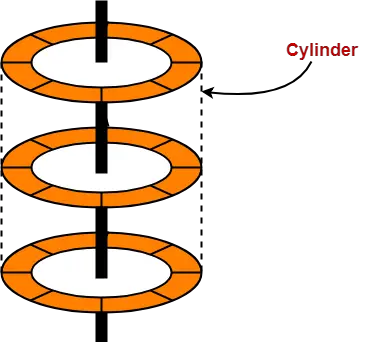
  • A cylinder is formed by combining the tracks at a given radius of a disk pack.


  • There exists a mechanical arm called as Read / Write head.
  • It is used to read from and write to the disk.
  • Head has to reach at a particular track and then wait for the rotation of the platter.
  • The rotation causes the required sector of the track to come under the head.
  • Each platter has 2 surfaces- top and bottom and both the surfaces are used to store the data.
  • Each surface has its own read / write head.


Disk Performance Parameters-


The time taken by the disk to complete an I/O request is called as disk service time or disk access time.

Components that contribute to the service time are-


  1. Seek time
  2. Rotational latency
  3. Data transfer rate
  4. Controller overhead
  5. Queuing delay


1. Seek Time-


  • The time taken by the read / write head to reach the desired track is called as seek time.
  • It is the component which contributes the largest percentage of the disk service time.
  • The lower the seek time, the faster the I/O operation.


Specifications

Seek time specifications include-

  1. Full stroke
  2. Average
  3. Track to Track


1. Full Stroke-


  • It is the time taken by the read / write head to move across the entire width of the disk from the innermost track to the outermost track


2. Average-


  • It is the average time taken by the read / write head to move from one random track to another.


Average seek time = 1 / 3 x Full stroke


3. Track to Track-


  • It is the time taken by the read-write head to move between the adjacent tracks.


2. Rotational Latency-


  • The time taken by the desired sector to come under the read / write head is called as rotational latency.
  • It depends on the rotation speed of the spindle.


Average rotational latency = 1 / 2 x Time taken for full rotation


3. Data Transfer Rate-


  • The amount of data that passes under the read / write head in a given amount of time is called as data transfer rate.
  • The time taken to transfer the data is called as transfer time.


It depends on the following factors-

  1. Number of bytes to be transferred
  2. Rotation speed of the disk
  3. Density of the track
  4. Speed of the electronics that connects the disk to the computer


4. Controller Overhead-


  • The overhead imposed by the disk controller is called as controller overhead.
  • Disk controller is a device that manages the disk.


5. Queuing Delay-


  • The time spent waiting for the disk to become free is called as queuing delay.


NOTE-


All the tracks of a disk have the same storage capacity.


Storage Density-


  • All the tracks of a disk have the same storage capacity.
  • This is because each track has different storage density.
  • Storage density decreases as we from one track to another track away from the center.


Thus,

  • Innermost track has maximum storage density.
  • Outermost track has minimum storage density.


Important Formulas-


1. Disk Access Time-


Disk access time is calculated as-


Disk access time

= Seek time + Rotational delay + Transfer time + Controller overhead + Queuing delay


2. Average Disk Access Time-


Average disk access time is calculated as-


Average disk access time

= Average seek time + Average rotational delay + Transfer time + Controller overhead + Queuing delay


3. Average Seek Time-


Average seek time is calculated as-


Average seek time

= 1 / 3 x Time taken for one full stroke


Alternatively,

If time taken by the head to move from one track to adjacent track = t units and there are total k tracks, then-

Average seek time

= { Time taken to move from track 1 to track 1 + Time taken to move from track 1 to last track } / 2

= { 0 + (k-1)t } / 2

= (k-1)t / 2


4. Average Rotational Latency-


Average rotational latency is calculated as-


Average rotational latency

= 1 / 2 x Time taken for one full rotation


Average rotational latency may also be referred as-

  • Average rotational delay
  • Average latency
  • Average delay


5. Capacity Of Disk Pack-


Capacity of a disk pack is calculated as-


Capacity of a disk pack

= Total number of surfaces x Number of tracks per surface x Number of sectors per track x Storage capacity of one sector


6. Formatting Overhead-


Formatting overhead is calculated as-


Formatting overhead

= Number of sectors x Overhead per sector


7. Formatted Disk Space-


Formatted disk space also called as usable disk space is the disk space excluding formatting overhead.

It is calculated as-


Formatted disk space

= Total disk space or capacity – Formatting overhead


8. Recording Density Or Storage Density-


Recording density or Storage density is calculated as-


Storage density of a track

= Capacity of the track / Circumference of the track


From here, we can infer-

Storage density of a track ∝ 1 / Circumference of the track


9. Track Capacity-


Capacity of a track is calculated as-


Capacity of a track

= Recording density of the track x Circumference of the track


10. Data Transfer Rate-


Data transfer rate is calculated as-


Data transfer rate

= Number of heads x Bytes that can be read in one full rotation x Number of rotations in one second

OR

Data transfer rate

= Number of heads x Capacity of one track x Number of rotations in one second


11. Tracks Per Surface-


Total number of tracks per surface is calculated as-


Total number of tracks per surface

= (Outer radius – Inner radius) / Inter track gap


Points to Remember-


  • The entire disk space is not usable for storage because some space is wasted in formatting.
  • When rotational latency is not given, use average rotational latency for solving numerical problems.
  • When seek time is not given, use average seek time for solving numerical problems.
  • It is wrong to say that as we move from one track to another away from the center, the capacity increases.
  • All the tracks have same storage capacity.


To gain better understanding about magnetic disk-

Watch this Video Lecture


Next Article- Practice Problems On Magnetic Disk


Get more notes and other study material of Computer Organization and Architecture.

Watch video lectures by visiting our YouTube channel LearnVidFun.
Cache Mapping | Practice Problems

Cache Mapping-


Before you go through this article, make sure that you have gone through the previous article on Cache Mapping.


We have discussed-

  • Cache mapping is a technique by which the contents of main memory are brought into the cache.
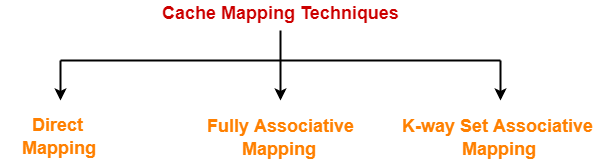
  • Cache mapping is performed using following three different techniques-


In this article, we will discuss practice problems based on cache mapping techniques.


PRACTICE PROBLEMS BASED ON CACHE MAPPING TECHNIQUES-


Problem-01:


The main memory of a computer has 2 cm blocks while the cache has 2c blocks. If the cache uses the set associative mapping scheme with 2 blocks per set, then block k of the main memory maps to the set-

  1. (k mod m) of the cache
  2. (k mod c) of the cache
  3. (k mod 2 c) of the cache
  4. (k mod 2 cm) of the cache


Solution-


Given-

  • Number of blocks in main memory = 2 cm
  • Number of blocks in cache = 2 c
  • Number of blocks in one set of cache = 2


Number of Sets in Cache-


Number of sets in cache

= Number of blocks in cache / Number of blocks in one set

= 2 c / 2

= c


Required Mapping-


In set associative mapping,

  • Block ‘j’ of main memory maps to set number (j modulo number of sets in cache) of the cache.
  • So, block ‘k’ of main memory maps to set number (k mod c) of the cache.
  • Thus, option (B) is correct.


Also Read- Practice Problems On Direct Mapping


Problem-02:


In a k-way set associative cache, the cache is divided into v sets, each of which consists of k lines. The lines of a set placed in sequence one after another. The lines in set s are sequenced before the lines in set (s+1). The main memory blocks are numbered 0 on wards. The main memory block numbered ‘j’ must be mapped to any one of the cache lines from-

  1. (j mod v) x k to (j mod v) x k + (k – 1)
  2. (j mod v) to (j mod v) + (k – 1)
  3. (j mod k) to (j mod k) + (v – 1)
  4. (j mod k) x v to (j mod k) x v + (v – 1)


Solution-


Let-

  • 2-way set associative mapping is used, then k = 2
  • Number of sets in cache = 4, then v = 4
  • Block number ‘3’ has to be mapped, then j = 3


The given options on substituting these values reduce to-

  1. (3 mod 4) x 2 to (3 mod 4) x 2 + (2 – 1) = 6 to 7
  2. (3 mod 4) to (3 mod 4) + (2 – 1) = 3 to 4
  3. (3 mod 2) to (3 mod 2) + (4 – 1) = 1 to 4
  4. (3 mod 2) x 4 to (3 mod 2) x 4 + (4 – 1) = 4 to 7


Now, we have been asked to what range of cache lines, block number 3 can be mapped.

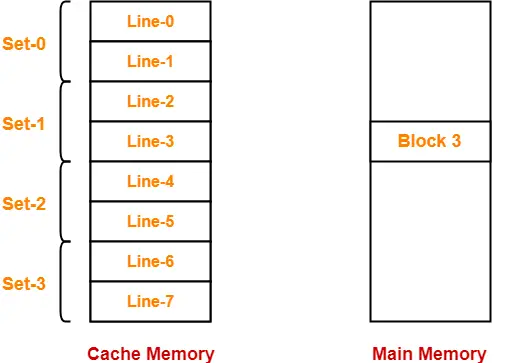
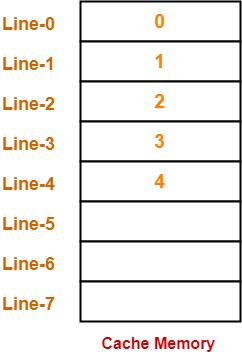
According to the above data, the cache memory and main memory will look like-


In set associative mapping,

  • Block ‘j’ of main memory maps to set number (j modulo number of sets in cache) of the cache.
  • So, block 3 of main memory maps to set number (3 mod 4) = 3 of cache.
  • Within set number 3, block 3 can be mapped to any of the cache lines.
  • Thus, block 3 can be mapped to cache lines ranging from 6 to 7.


Thus, Option (A) is correct.


Problem-03:


A block-set associative cache memory consists of 128 blocks divided into four block sets . The main memory consists of 16,384 blocks and each block contains 256 eight bit words.

  1. How many bits are required for addressing the main memory?
  2. How many bits are needed to represent the TAG, SET and WORD fields?


Solution-


Given-

  • Number of blocks in cache memory = 128
  • Number of blocks in each set of cache = 4
  • Main memory size = 16384 blocks
  • Block size = 256 bytes
  • 1 word = 8 bits = 1 byte


Main Memory Size-


We have-

Size of main memory

= 16384 blocks

= 16384 x 256 bytes

= 222 bytes

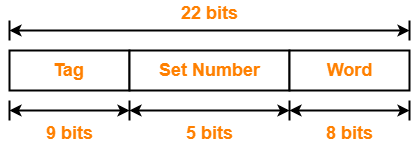
Thus, Number of bits required to address main memory = 22 bits


Number of Bits in Block Offset-


We have-

Block size

= 256 bytes

= 28 bytes

Thus, Number of bits in block offset or word = 8 bits


Number of Bits in Set Number-


Number of sets in cache

= Number of lines in cache / Set size

= 128 blocks / 4 blocks

= 32 sets

= 25 sets

Thus, Number of bits in set number = 5 bits


Number of Bits in Tag Number-


Number of bits in tag

= Number of bits in physical address – (Number of bits in set number + Number of bits in word)

= 22 bits – (5 bits + 8 bits)

= 22 bits – 13 bits

= 9 bits

Thus, Number of bits in tag = 9 bits


Thus, physical address is-


Problem-04:


A computer has a 256 KB, 4-way set associative, write back data cache with block size of 32 bytes. The processor sends 32 bit addresses to the cache controller. Each cache tag directory entry contains in addition to address tag, 2 valid bits, 1 modified bit and 1 replacement bit.


Part-01:


The number of bits in the tag field of an address is-

  1. 11
  2. 14
  3. 16
  4. 27


Part-02:


The size of the cache tag directory is-

  1. 160 Kbits
  2. 136 Kbits
  3. 40 Kbits
  4. 32 Kbits


Solution-


Given-

  • Cache memory size = 256 KB
  • Set size = 4 blocks
  • Block size = 32 bytes
  • Number of bits in physical address = 32 bits


Number of Bits in Block Offset-


We have-

Block size

= 32 bytes

= 25 bytes

Thus, Number of bits in block offset = 5 bits


Number of Lines in Cache-


Number of lines in cache

= Cache size / Line size

= 256 KB / 32 bytes

= 218 bytes / 25 bytes

= 213 lines

Thus, Number of lines in cache = 213 lines


Number of Sets in Cache-


Number of sets in cache

= Number of lines in cache / Set size

= 213 lines / 22 lines

= 211 sets

Thus, Number of bits in set number = 11 bits


Number of Bits in Tag-


Number of bits in tag

= Number of bits in physical address – (Number of bits in set number + Number of bits in block offset)

= 32 bits – (11 bits + 5 bits)

= 32 bits – 16 bits

= 16 bits

Thus, Number of bits in tag = 16 bits


Tag Directory Size-


Size of tag directory

= Number of lines in cache x Size of tag

= 213 x (16 bits + 2 valid bits + 1 modified bit + 1 replacement bit)

= 213 x 20 bits

= 163840 bits

= 20 KB or 160 Kbits


Thus,

  • For part-01, Option (C) is correct.
  • For part-02, Option (A) is correct.


Also Read- Practice Problems On Fully Associative Mapping


Problem-05:


A 4-way set associative cache memory unit with a capacity of 16 KB is built using a block size of 8 words. The word length is 32 bits. The size of the physical address space is 4 GB. The number of bits for the TAG field is _____.


Solution-


Given-

  • Set size = 4 lines
  • Cache memory size = 16 KB
  • Block size = 8 words
  • 1 word = 32 bits = 4 bytes
  • Main memory size = 4 GB


Number of Bits in Physical Address-


We have,

Main memory size

= 4 GB

= 232 bytes

Thus, Number of bits in physical address = 32 bits


Number of Bits in Block Offset-


We have,

Block size

= 8 words

= 8 x 4 bytes

= 32 bytes

= 25 bytes

Thus, Number of bits in block offset = 5 bits


Number of Lines in Cache-


Number of lines in cache

= Cache size / Line size

= 16 KB / 32 bytes

= 214 bytes / 25 bytes

= 29 lines

= 512 lines

Thus, Number of lines in cache = 512 lines


Number of Sets in Cache-


Number of sets in cache

= Number of lines in cache / Set size

= 512 lines / 4 lines

= 29 lines / 22 lines

= 27 sets

Thus, Number of bits in set number = 7 bits


Number of Bits in Tag-


Number of bits in tag

= Number of bits in physical address – (Number of bits in set number + Number of bits in block offset)

= 32 bits – (7 bits + 5 bits)

= 32 bits – 12 bits

= 20 bits

Thus, number of bits in tag = 20 bits


Problem-06:


If the associativity of a processor cache is doubled while keeping the capacity and block size unchanged, which one of the following is guaranteed to be NOT affected?

  1. Width of tag comparator
  2. Width of set index decoder
  3. Width of way selection multiplexer
  4. Width of processor to main memory data bus


Solution-


Since block size is unchanged, so number of bits in block offset will remain unchanged.


Effect On Width Of Tag Comparator-


  • Associativity of cache is doubled means number of lines in one set is doubled.
  • Since number of lines in one set is doubled, therefore number of sets reduces to half.
  • Since number of sets reduces to half, so number of bits in set number decrements by 1.
  • Since number of bits in set number decrements by 1, so number of bits in tag increments by 1.
  • Since number of bits in tag increases, therefore width of tag comparator also increases.


Effect On Width of Set Index Decoder-


  • Associativity of cache is doubled means number of lines in one set is doubled.
  • Since number of lines in one set is doubled, therefore number of sets reduces to half.
  • Since number of sets reduces to half, so number of bits in set number decrements by 1.
  • Since number of bits in set number decreases, therefore width of set index decoder also decreases.


Effect On Width Of Way Selection Multiplexer-


  • Associativity of cache (k) is doubled means number of lines in one set is doubled.
  • New associativity of cache is 2k.
  • To handle new associativity, size of multiplexers must be 2k x 1.
  • Therefore, width of way selection multiplexer increases.


Effect On Width Of Processor To Main Memory Data Bus-


  • Processor to main memory data bus has nothing to do with cache associativity.
  • It depends on the number of bits in block offset which is unchanged here.
  • So, width of processor to main memory data bus is not affected and remains unchanged.


Thus, Option (D) is correct.


Problem-07:


Consider a direct mapped cache with 8 cache blocks (0-7). If the memory block requests are in the order-

3, 5, 2, 8, 0, 6, 3, 9, 16, 20, 17, 25, 18, 30, 24, 2, 63, 5, 82, 17, 24

Which of the following memory blocks will not be in the cache at the end of the sequence?

  1. 3
  2. 18
  3. 20
  4. 30

Also, calculate the hit ratio and miss ratio.


Solution-


We have,

  • There are 8 blocks in cache memory numbered from 0 to 7.
  • In direct mapping, a particular block of main memory is mapped to a particular line of cache memory.
  • The line number is given by-

Cache line number = Block address modulo Number of lines in cache


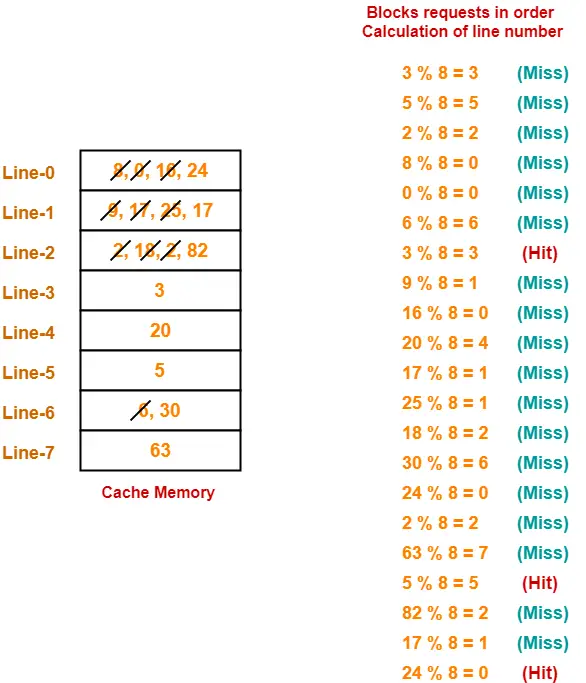
For the given sequence-

  • Requests for memory blocks are generated one by one.
  • The line number of the block is calculated using the above relation.
  • Then, the block is placed in that particular line.
  • If already there exists another block in that line, then it is replaced.


Thus,

  • Out of given options, only block-18 is not present in the main memory.
  • Option-(B) is correct.
  • Hit ratio = 3 / 20
  • Miss ratio = 17 / 20


Problem-08:


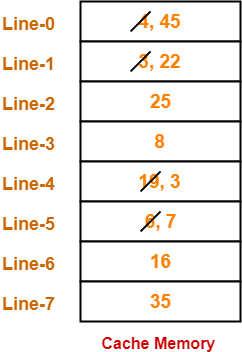
Consider a fully associative cache with 8 cache blocks (0-7). The memory block requests are in the order-

4, 3, 25, 8, 19, 6, 25, 8, 16, 35, 45, 22, 8, 3, 16, 25, 7

If LRU replacement policy is used, which cache block will have memory block 7?

Also, calculate the hit ratio and miss ratio.


Solution-


We have,

  • There are 8 blocks in cache memory numbered from 0 to 7.
  • In fully associative mapping, any block of main memory can be mapped to any line of the cache that is freely available.
  • If all the cache lines are already occupied, then a block is replaced in accordance with the replacement policy.


Thus,

  • Line-5 contains the block-7.
  • Hit ratio = 5 / 17
  • Miss ratio = 12 / 17


Problem-09:


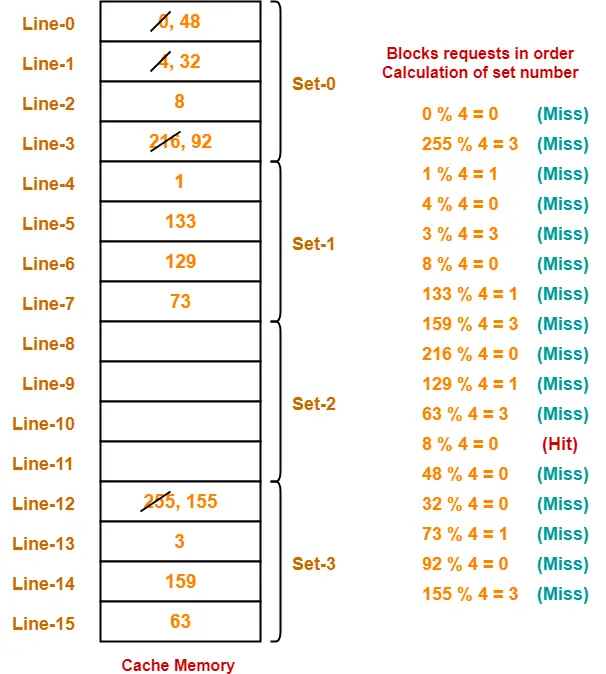
Consider a 4-way set associative mapping with 16 cache blocks. The memory block requests are in the order-

0, 255, 1, 4, 3, 8, 133, 159, 216, 129, 63, 8, 48, 32, 73, 92, 155

If LRU replacement policy is used, which cache block will not be present in the cache?

  1. 3
  2. 8
  3. 129
  4. 216

Also, calculate the hit ratio and miss ratio.


Solution-


We have,

  • There are 16 blocks in cache memory numbered from 0 to 15.
  • Each set contains 4 cache lines.
  • In set associative mapping, a particular block of main memory is mapped to a particular set of cache memory.
  • The set number is given by-

Cache line number = Block address modulo Number of sets in cache


For the given sequence-

  • Requests for memory blocks are generated one by one.
  • The set number of the block is calculated using the above relation.
  • Within that set, the block is placed in any freely available cache line.
  • If all the blocks are already occupied, then one of the block is replaced in accordance with the employed replacement policy.


Thus,

  • Out of given options, only block-216 is not present in the main memory.
  • Option-(D) is correct.
  • Hit ratio = 1 / 17
  • Miss ratio = 16 / 17


Also Read- Practice Problems On Set Associative Mapping


Problem-10:


Consider a small 2-way set associative mapping with a total of 4 blocks. LRU replacement policy is used for choosing the block to be replaced. The number of cache misses for the following sequence of block addresses 8, 12, 0, 12, 8 is ____.


Solution-


  • Practice yourself.
  • Total number of cache misses = 4


Problem-11:


Consider the cache has 4 blocks. For the memory references-

5, 12, 13, 17, 4, 12, 13, 17, 2, 13, 19, 13, 43, 61, 19

What is the hit ratio for the following cache replacement algorithms-

  1. FIFO
  2. LRU
  3. Direct mapping
  4. 2-way set associative mapping using LRU


Solution-


  • Practice yourself.
  • Using FIFO as cache replacement algorithm, hit ratio = 5/15 = 1/3.
  • Using LRU as cache replacement algorithm, hit ratio = 6/15 = 2/5.
  • Using direct mapping as cache replacement algorithm, hit ratio = 1/15.
  • Using 2-way set associative mapping as cache replacement algorithm, hit ratio = 5/15 = 1/3


Problem-12:


A hierarchical memory system has the following specification, 20 MB main storage with access time of 300 ns, 256 bytes cache with access time of 50 ns, word size 4 bytes, page size 8 words. What will be the hit ratio if the page address trace of a program has the pattern 0, 1, 2, 3, 0, 1, 2, 4 following LRU page replacement technique?


Solution-


Given-

  • Main memory size = 20 MB
  • Main memory access time = 300 ns
  • Cache memory size = 256 bytes
  • Cache memory access time = 50 ns
  • Word size = 4 bytes
  • Page size = 8 words


Line Size-


We have,

Line size

= 8 words

= 8 x 4 bytes

= 32 bytes


Number of Lines in Cache-


Number of lines in cache

= Cache size / Line size

= 256 bytes / 32 bytes

= 8 lines


Thus,

  • Number of hits = 3
  • Hit ratio = 3 / 8


Problem-13:


Consider an array A[100] and each element occupies 4 words. A 32 word cache is used and divided into 8 word blocks. What is the hit ratio for the following code-

for (i=0 ; i < 100 ; i++)

A[i] = A[i] + 10;


Solution-


Number of lines in cache

= Cache size / Line size

= 32 words / 8 words

= 4 lines


Since each element of the array occupies 4 words, so-

Number of elements that can be placed in one line = 2


Now, let us analyze the statement-

A[i] = A[i] + 10;

For each i,

  • Firstly, the value of A[i] is read.
  • Secondly, 10 is added to the A[i].
  • Thirdly, the updated value of A[i] is written back.


Thus,

  • For each i, A[i] is accessed two times.
  • Two memory accesses are required-one for read operation and other for write operation.


Assume the cache is all empty initially.


In the first loop iteration,

  • First, value of A[0] has to be read.
  • Since cache is empty, so A[0] is brought in the cache.
  • Along with A[0], element A[1] also enters the cache since each block can hold 2 elements of the array.


  • Thus, For A[0], a miss occurred for the read operation.
  • Now, 10 is added to the value of A[0].
  • Now, the updated value has to be written back to A[0].
  • Again cache memory is accessed to get A[0] for writing its updated value.
  • This time, for A[0], a hit occurs for the write operation.


In the second loop iteration,

  • First, value of A[1] has to be read.
  • A[1] is already present in the cache.
  • Thus, For A[1]. a hit occurs for the read operation.
  • Now, 10 is added to the value of A[1].
  • Now, the updated value has to be written back to A[1].
  • Again cache memory is accessed to get A[1] for writing its updated value.
  • Again, for A[1], a hit occurs for the write operation.


In the similar manner, for every next two consecutive elements-

  • There will be a miss for the read operation for the first element.
  • There will be a hit for the write operation for the first element.
  • There will be a hit for both read and write operations for the second element.


Likewise, for 100 elements, we will have 50 such pairs in cache and in every pair, there will be one miss and three hits.


Thus,

  • Total number of hits = 50 x 3 = 150
  • Total number of misses = 50 x 1 = 50
  • Total number of references = 200 (100 for read and 100 for write)


Thus,

  • Hit ratio = 150 / 200 = 3 / 4 = 0.75
  • Miss ratio = 50 / 200 = 1 / 4 = 0.25


Problem-14:


Consider an array has 100 elements and each element occupies 4 words. A 32 bit word cache is used and divided into a block of 8 words.

What is the hit ratio for the following statement-

for (i=0 ; i < 10 ; i++)

for (j=0 ; j < 10 ; j++)

A[i][j] = A[i][j] + 10;

if-

  1. Row major order is used
  2. Column major order is used


Solution-


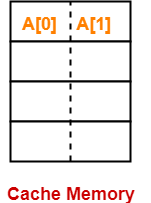
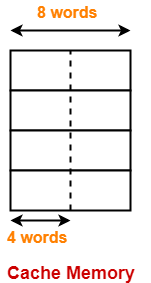
According to question, cache is divided as-


In each cache line, two elements of the array can reside.


Case-01: When Row Major Order is Used-


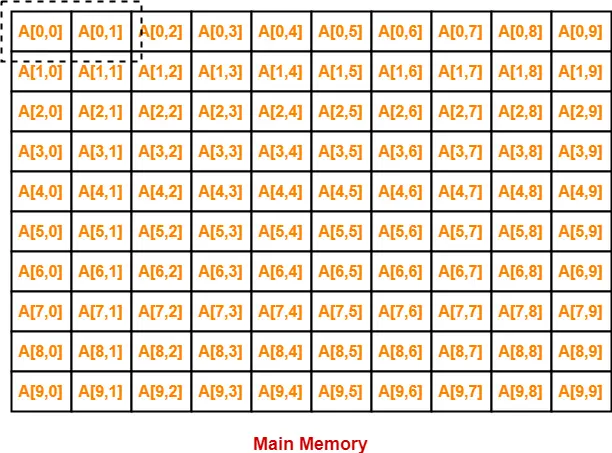
In row major order, elements of the array are stored row wise in the memory as-


  • In the first iteration, when A[0][0] will be brought in the cache, A[0][1] will also be brought.
  • Then, things goes as it went in the previous question.
  • There will be a miss for A[0,0] read operation and hit for A[0,0] write operation.
  • For A[0,1], there will be a hit for both read and write operations.
  • Similar will be the story with every next two consecutive elements.


Thus,

  • Total number of hits = 50 x 3 = 150
  • Total number of misses = 50 x 1 = 50
  • Total number of references = 200 (100 for read and 100 for write)


Thus,

  • Hit ratio = 150 / 200 = 3 / 4 = 0.75
  • Miss ratio = 50 / 200 = 1 / 4 = 0.25


Case-02: When Column Major Order is Used-


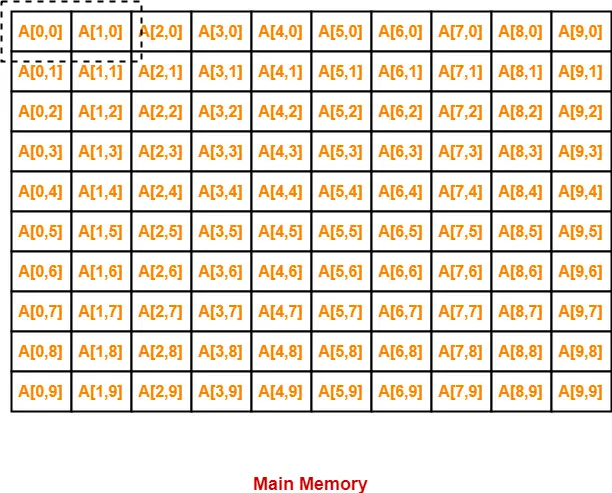
In column major order, elements of the array are stored column wise in the memory as-


  • In the first iteration, when A[0,0] will be brought in the cache, A[1][0] will also be brought.
  • This time A[1][0] will not be useful in iteration-2.
  • A[1][0] will be needed after surpassing 10 element.
  • But by that time, this block would have got replaced since there are only 4 lines in the cache.
  • For A[1][0] to be useful, there has to be at least 10 lines in the cache.


Thus,

Under given scenario, for each element of the array-

  • There will be a miss for the read operation.
  • There will be a hit for the write operation.


Thus,

  • Total number of hits = 100 x 1 = 100
  • Total number of misses = 100 x 1 = 100
  • Total number of references = 200 (100 for read and 100 for write)


Thus,

  • Hit ratio = 100 / 200 = 1 / 2 = 0.50
  • Miss ratio = 100 / 200 = 1 / 2 = 0.50


To increase the hit rate, following measures can be taken-

  • Row major order can be used (Hit rate = 75%)
  • The statement A[i][j] = A[i][j] + 10 can be replaced with A[j,i] = A[j][i] + 10 (Hit rate = 75%)


Problem-15:


An access sequence of cache block addresses is of length N and contains n unique block addresses. The number of unique block addresses between two consecutive accesses to the same block address is bounded above by k. What is the miss ratio if the access sequence is passed through a cache of associativity A>=k exercising LRU replacement policy?

  1. n/N
  2. 1/N
  3. 1/A
  4. k/n


Solution-


Required miss ratio = n/N.

Thus, Option (A) is correct.


Next Article- Cache Line | Effects of Changing Cache Line Size


Get more notes and other study material of Computer Organization and Architecture.

Watch video lectures by visiting our YouTube channel LearnVidFun.
Cache Line | Cache Line Size | Cache Memory

Cache Memory-


Before you go through this article, make sure that you have gone through the previous article on Cache Memory.


We have discussed-

  • Cache memory is a random access memory.
  • It lies on the path between the processor and the main memory.
  • It bridges the speed mismatch between the fastest processor and the slower main memory.


Also Read- Cache Mapping Techniques


Cache Lines-


Cache memory is divided into equal size partitions called as cache lines.


  • While designing a computer’s cache system, the size of cache lines is an important parameter.
  • The size of cache line affects a lot of parameters in the caching system.


The following results discuss the effect of changing the cache block (or line) size in a caching system.


Result-01: Effect of Changing Block Size on Spatial Locality-


The larger the block size, better will be the spatial locality.


Explanation-


Keeping the cache size constant, we have-


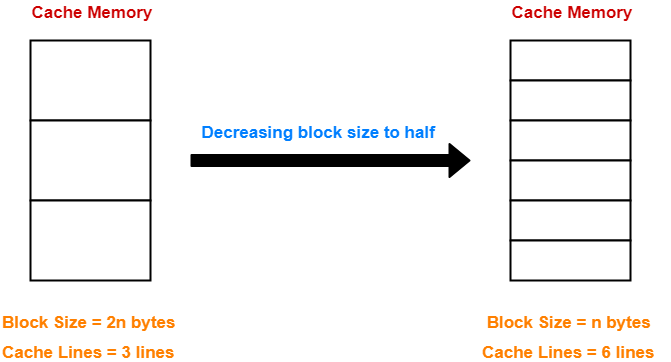
Case-01: Decreasing the Block Size-


  • A smaller block size will contain a smaller number of near by addresses in it.
  • Thus, only smaller number of near by addresses will be brought into the cache.
  • This increases the chances of cache miss which reduces the exploitation of spatial locality.
  • Thus, smaller is the block size, inferior is the spatial locality.


Case-02: Increasing the Block Size-


  • A larger block size will contain a larger number of near by addresses in it.
  • Thus, larger number of near by addresses will be brought into the cache.
  • This increases the chances of cache hit which increases the exploitation of spatial locality.
  • Thus, larger is the block size, better is the spatial locality.


Result-02: Effect of Changing Block Size On Cache Tag in Direct Mapped Cache-


In direct mapped cache, block size does not affect the cache tag anyhow.


Explanation-


Keeping the cache size constant, we have-


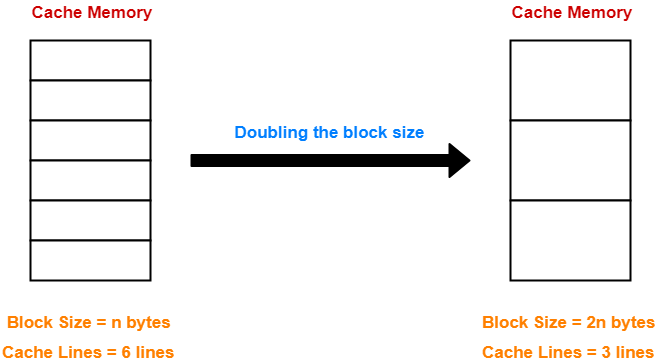
Case-01: Decreasing the Block Size-


  • Decreasing the block size increases the number of lines in cache.
  • With the decrease in block size, the number of bits in block offset decreases.
  • However, with the increase in the number of cache lines, number of bits in line number increases.
  • So, number of bits in line number + number of bits in block offset = remains constant.
  • Thus, there is no effect on the cache tag.


Example-


Case-02: Increasing the Block Size-


  • Increasing the block size decreases the number of lines in cache.
  • With the increase in block size, the number of bits in block offset increases.
  • However, with the decrease in the number of cache lines, number of bits in line number decreases.
  • Thus, number of bits in line number + number of bits in block offset = remains constant.
  • Thus, there is no effect on the cache tag.


Example-


Result-03: Effect of Changing Block Size On Cache Tag in Fully Associative Cache-


In fully associative cache, on decreasing block size, cache tag is reduced and vice versa.


Explanation-


Keeping the cache size constant, we have-


Case-01: Decreasing the Block Size-


  • Decreasing the block size decreases the number of bits in block offset.
  • With the decrease in number of bits in block offset, number of bits in tag increases.


Case-02: Increasing the Block Size-


  • Increasing the block size increases the number of bits in block offset.
  • With the increase in number of bits in block offset, number of bits in tag decreases.


Result-04: Effect of Changing Block Size On Cache Tag in Set Associative Cache-


In set associative cache, block size does not affect cache tag anyhow.


Explanation-


Keeping the cache size constant, we have-


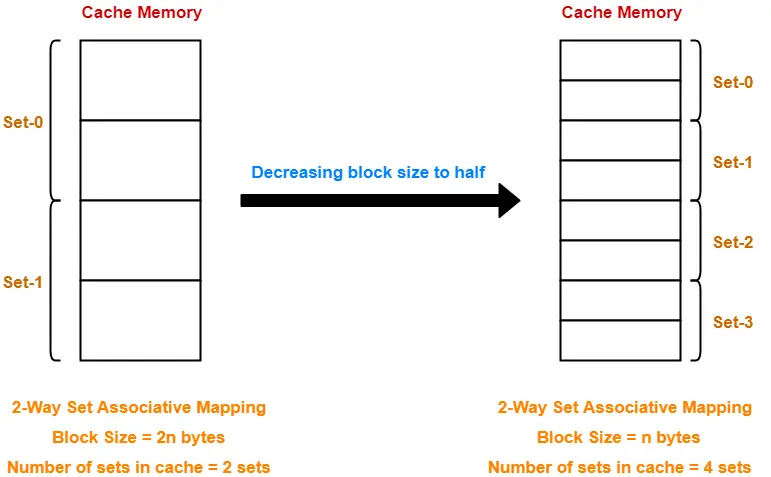
Case-01: Decreasing the Block Size-


  • Decreasing the block size increases the number of lines in cache.
  • With the decrease in block size, number of bits in block offset decreases.
  • With the increase in the number of cache lines, number of sets in cache increases.
  • With the increase in number of sets in cache, number of bits in set number increases.
  • So, number of bits in set number + number of bits in block offset = remains constant.
  • Thus, there is no effect on the cache tag.


Example-


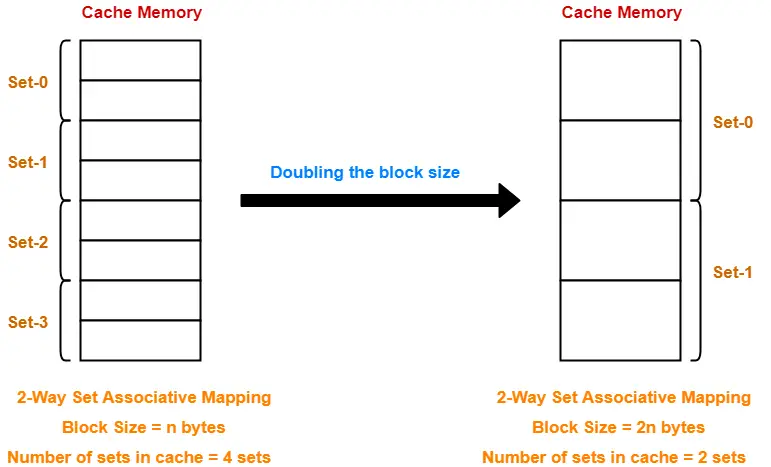
Case-02: Increasing the Block Size-


  • Increasing the block size decreases the number of lines in cache.
  • With the increase in block size, number of bits in block offset increases.
  • With the decrease in the number of cache lines, number of sets in cache decreases.
  • With the decrease in number of sets in cache, number of bits in set number decreases.
  • So, number of bits in set number + number of bits in block offset = remains constant.
  • Thus, there is no effect on the cache tag.


Example-


Result-05: Effect of Changing Block Size On Cache Miss Penalty-


A smaller cache block incurs a lower cache miss penalty.


Explanation-


  • When a cache miss occurs, block containing the required word has to be brought from the main memory.
  • If the block size is small, then time taken to bring the block in the cache will be less.
  • Hence, less miss penalty will incur.
  • But if the block size is large, then time taken to bring the block in the cache will be more.
  • Hence, more miss penalty will incur.


Result-06: Effect of Cache Tag On Cache Hit Time-


A smaller cache tag ensures a lower cache hit time.


Explanation-


  • Cache hit time is the time required to find out whether the required block is in cache or not.
  • It involves comparing the tag of generated address with the tag of cache lines.
  • Smaller is the cache tag, lesser will be the time taken to perform the comparisons.
  • Hence, smaller cache tag ensures lower cache hit time.
  • On the other hand, larger is the cache tag, more will be time taken to perform the comparisons.
  • Thus, larger cache tag results in higher cache hit time.


PRACTICE PROBLEM BASED ON CACHE LINE-


Problem-


In designing a computer’s cache system, the cache block or cache line size is an important parameter. Which of the following statements is correct in this context?

  1. A smaller block size implies better spatial locality
  2. A smaller block size implies a smaller cache tag and hence lower cache tag overhead
  3. A smaller block size implies a larger cache tag and hence lower cache hit time
  4. A smaller bock size incurs a lower cache miss penalty


Solution-


Option (D) is correct. (Result-05)


Reasons-


Option (A) is incorrect because-

  • Smaller block does not imply better spatial locality.
  • Always, Larger the block size, better is the spatial locality.


Option (B) is incorrect because-

  • In direct mapped cache and set associative cache, there is no effect of changing block size on cache tag.
  • In fully associative mapped cache, on decreasing block size, cache tag becomes larger.
  • Thus, smaller block size does not imply smaller cache tag in any cache organization.


Option (C) is incorrect because-

  • “A smaller block size implies a larger cache tag” is true only for fully associative mapped cache.
  • Larger cache tag does not imply lower cache hit time rather cache hit time is increased.


Next Article- Magnetic Disk | Important Formulas


Get more notes and other study material of Computer Organization and Architecture.

Watch video lectures by visiting our YouTube channel LearnVidFun.

Set Associative Mapping | Practice Problems

Set Associative Mapping-


Before you go through this article, make sure that you have gone through the previous article on Set Associative Mapping.


In set associative mapping,

  • A particular block of main memory can be mapped to one particular cache set only.
  • Block ‘j’ of main memory will map to set number (j mod number of sets in cache) of the cache.
  • A replacement algorithm is needed if the cache is full.


In this article, we will discuss practice problems based on set associative mapping.


Also Read- Cache Mapping Techniques


PRACTICE PROBLEMS BASED ON SET ASSOCIATIVE MAPPING-


Problem-01:


Consider a 2-way set associative mapped cache of size 16 KB with block size 256 bytes. The size of main memory is 128 KB. Find-

  1. Number of bits in tag
  2. Tag directory size


Solution-


Given-

  • Set size = 2
  • Cache memory size = 16 KB
  • Block size = Frame size = Line size = 256 bytes
  • Main memory size = 128 KB


We consider that the memory is byte addressable.


Number of Bits in Physical Address-


We have,

Size of main memory

= 128 KB

= 217 bytes

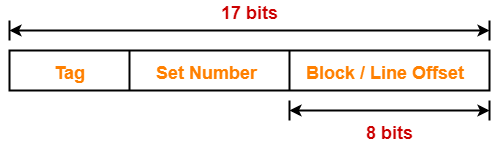
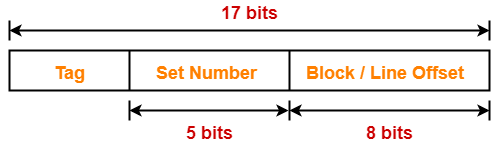
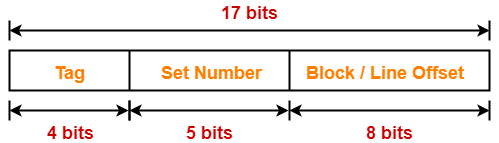
Thus, Number of bits in physical address = 17 bits


Number of Bits in Block Offset-


We have,

Block size

= 256 bytes

= 28 bytes

Thus, Number of bits in block offset = 8 bits


Number of Lines in Cache-


Total number of lines in cache

= Cache size / Line size

= 16 KB / 256 bytes

= 214 bytes / 28 bytes

= 64 lines

Thus, Number of lines in cache = 64 lines


Number of Sets in Cache-


Total number of sets in cache

= Total number of lines in cache / Set size

= 64 / 2

= 32 sets

= 25 sets

Thus, Number of bits in set number = 5 bits


Number of Bits in Tag-


Number of bits in tag

= Number of bits in physical address – (Number of bits in set number + Number of bits in block offset)

= 17 bits – (5 bits + 8 bits)

= 17 bits – 13 bits

= 4 bits

Thus, Number of bits in tag = 4 bits


Tag Directory Size-


Tag directory size

= Number of tags x Tag size

= Number of lines in cache x Number of bits in tag

= 64 x 4 bits

= 256 bits

= 32 bytes

Thus, size of tag directory = 32 bytes


Also Read- Practice Problems On Direct Mapping


Problem-02:


Consider a 8-way set associative mapped cache of size 512 KB with block size 1 KB. There are 7 bits in the tag. Find-

  1. Size of main memory
  2. Tag directory size


Solution-


Given-

  • Set size = 8
  • Cache memory size = 512 KB
  • Block size = Frame size = Line size = 1 KB
  • Number of bits in tag = 7 bits


We consider that the memory is byte addressable.


Number of Bits in Block Offset-


We have,

Block size

= 1 KB

= 210 bytes

Thus, Number of bits in block offset = 10 bits


Number of Lines in Cache-


Total number of lines in cache

= Cache size / Line size

= 512 KB / 1 KB

= 512 lines

Thus, Number of lines in cache = 512 lines


Number of Sets in Cache-


Total number of sets in cache

= Total number of lines in cache / Set size

= 512 / 8

= 64 sets

= 26 sets

Thus, Number of bits in set number = 6 bits


Number of Bits in Physical Address-


Number of bits in physical address

= Number of bits in tag + Number of bits in set number + Number of bits in block offset

= 7 bits + 6 bits + 10 bits

= 23 bits

Thus, Number of bits in physical address = 23 bits


Size of Main Memory-


We have,

Number of bits in physical address = 23 bits

Thus, Size of main memory

= 223 bytes

= 8 MB


Tag Directory Size-


Tag directory size

= Number of tags x Tag size

= Number of lines in cache x Number of bits in tag

= 512 x 7 bits

= 3584 bits

= 448 bytes

Thus, size of tag directory = 448 bytes


Problem-03:


Consider a 4-way set associative mapped cache with block size 4 KB. The size of main memory is 16 GB and there are 10 bits in the tag. Find-

  1. Size of cache memory
  2. Tag directory size


Solution-


Given-

  • Set size = 4
  • Block size = Frame size = Line size = 4 KB
  • Main memory size = 16 GB
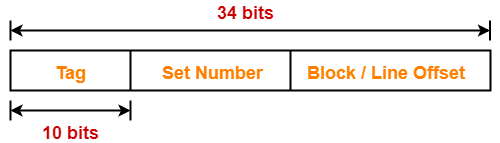
  • Number of bits in tag = 10 bits


We consider that the memory is byte addressable.


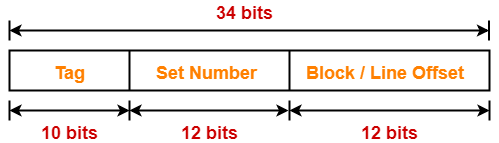
Number of Bits in Physical Address-


We have,

Size of main memory

= 16 GB

= 234 bytes

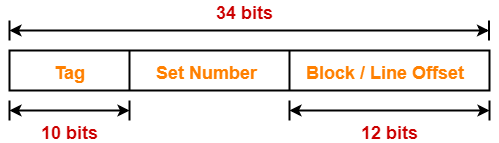
Thus, Number of bits in physical address = 34 bits


Number of Bits in Block Offset-


We have,

Block size

= 4 KB

= 212 bytes

Thus, Number of bits in block offset = 12 bits


Number of Bits in Set Number-


Number of bits in set number

= Number of bits in physical address – (Number of bits in tag + Number of bits in block offset)

= 34 bits – (10 bits + 12 bits)

= 34 bits – 22 bits

= 12 bits

Thus, Number of bits in set number = 12 bits


Number of Sets in Cache-


We have-

Number of bits in set number = 12 bits

Thus, Total number of sets in cache = 212 sets


Number of Lines in Cache-


We have-

Total number of sets in cache = 212 sets

Each set contains 4 lines


Thus,

Total number of lines in cache

= Total number of sets in cache x Number of lines in each set

= 212 x 4 lines

= 214 lines


Size of Cache Memory-


Size of cache memory

= Total number of lines in cache x Line size

= 214 x 4 KB

= 216 KB

= 64 MB

Thus, Size of cache memory = 64 MB


Tag Directory Size-


Tag directory size

= Number of tags x Tag size

= Number of lines in cache x Number of bits in tag

= 214 x 10 bits

= 163840 bits

= 20480 bytes

= 20 KB

Thus, size of tag directory = 20 KB


Also Read- Practice Problems On Fully Associative Mapping


Problem-04:


Consider a 8-way set associative mapped cache. The size of cache memory is 512 KB and there are 10 bits in the tag. Find the size of main memory.


Solution-


Given-

  • Set size = 8
  • Cache memory size = 512 KB
  • Number of bits in tag = 10 bits


We consider that the memory is byte addressable.

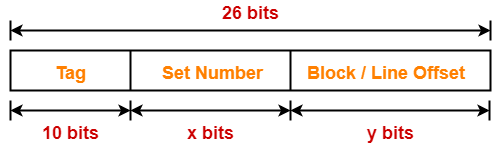
Let-

  • Number of bits in set number field = x bits
  • Number of bits in block offset field = y bits


Sum of Number Of Bits Of Set Number Field And Block Offset Field-


We have,

Cache memory size = Number of sets in cache x Number of lines in one set x Line size

Now, substituting the values, we get-

512 KB = 2x x 8 x 2y bytes

219 bytes = 23+x+y bytes

19 = 3 +x + y

x + y = 19 – 3

x + y = 16


Number of Bits in Physical Address-


Number of bits in physical address

= Number of bits in tag + Number of bits in set number + Number of bits in block offset

= 10 bits + x bits + y bits

= 10 bits + (x + y) bits

= 10 bits + 16 bits

= 26 bits

Thus, Number of bits in physical address = 26 bits


Size of Main Memory-


We have,

Number of bits in physical address = 26 bits

Thus, Size of main memory

= 226 bytes

= 64 MB

Thus, size of main memory = 64 MB


Problem-05:


Consider a 4-way set associative mapped cache. The size of main memory is 64 MB and there are 10 bits in the tag. Find the size of cache memory.


Solution-


Given-

  • Set size = 4
  • Main memory size = 64 MB
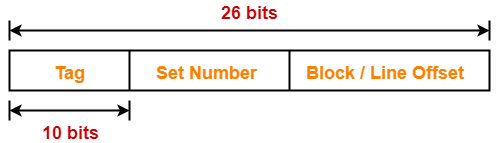
  • Number of bits in tag = 10 bits


We consider that the memory is byte addressable.


Number of Bits in Physical Address-


We have,

Size of main memory

= 64 MB

= 226 bytes

Thus, Number of bits in physical address = 26 bits


Sum Of Number Of Bits Of Set Number Field And Block Offset Field-


Let-

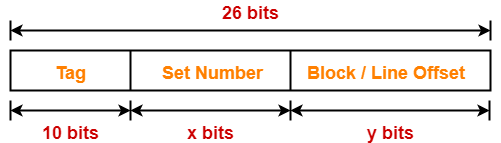
  • Number of bits in set number field = x bits
  • Number of bits in block offset field = y bits


Then, Number of bits in physical address

= Number of bits in tag + Number of bits in set number + Number of bits in block offset


So, we have-

26 bits = 10 bits + x bits + y bits

26 = 10 + (x + y)

x + y = 26 – 10

x + y = 16

Thus, Sum of number of bits of set number field and block offset field = 16 bits


Size of Cache Memory-


Cache memory size

= Number of sets in cache x Number of lines in one set x Line size

= 2x x 4 x 2y bytes

= 22+x+y bytes

= 22+16 bytes

= 218 bytes

= 256 KB

Thus, size of cache memory = 256 KB


To watch video solutions and practice more problems,

Watch this Video Lecture


Next Article- Miscellaneous Practice Problems On Cache Mapping Techniques


Get more notes and other study material of Computer Organization and Architecture.

Watch video lectures by visiting our YouTube channel LearnVidFun.