Category: Subjects

CYK Algorithm | CYK Algorithm Example

CYK Algorithm-


CYK Algorithm is a membership algorithm of context free grammar.


  • It is used to decide whether a given string belongs to the language of grammar or not.
  • It is also known as CKY Algorithm or Cocke-Younger-Kasami Algorithm after its inventors.


Important Notes-


Note-01:


Note-02:


  • The worst case running time of CYK Algorithm is Θ (n3.|G|).
  • Here, n = Length of parsed string and |G| = Size of the CNF Grammar G.


Algorithm-


Begin
      for ( i = 1 to n do )
      Vi1 { A | A → a is a production where ith symbol of x is a }

      for ( j = 2 to n do )
           for ( i = 1 to n - j + 1 do )
           Begin
                 Vij = ϕ
                 For k = 1 to j - 1 do
                 Vij = Vij ∪ { A | A → BC is a production where B is in Vik and C is in V(i + k)(j - k) }
           End
End


Also Read- Algorithm To Check Whether CFL is Empty


Deciding Membership Using CYK Algorithm-


To decide the membership of any given string, we construct a triangular table where-

  • Each row of the table corresponds to one particular length of sub strings.
  • Bottom most row corresponds to strings of length-1.
  • Second row from bottom corresponds to strings of length-2.
  • Third row from bottom corresponds to strings of length-3.
  • Top most row from bottom corresponds to the given string of length-n.


Example-


For a given string “x” of length 4 units, triangular table looks like-
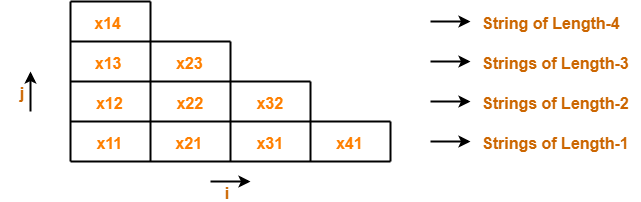


We will fill each box of xij with its Vij.

These notations are discussed below.


Notations Used


Notation-01: xij


xij represents a sub string of “x” starting from location ‘i’ and has length ‘j’.

Example-

Consider x = abcd is a string, then-

Number of sub strings possible = n(n+1)/2 = 4 x (4+1) / 2 = 10

We have-

  • x11 = a
  • x21 = b
  • x31 = c
  • x41 = d
  • x12 = ab
  • x22 = bc
  • x32 = cd
  • x13 = abc
  • x23 = bcd
  • x14 = abcd


Notation-02: Vij


Vij represents a set of variables in the grammar which can derive the sub string xij.

If the set of variables consists of the start symbol, then it becomes sure-

  • Sub string xij can be derived from the given grammar.
  • Sub string xij is a member of the language of the given grammar.


Also Read- Algorithm To Check Whether CFL is Finite


PRACTICE PROBLEM BASED ON CYK ALGORITHM-


Problem-


For the given grammar, check the acceptance of string w = baaba using CYK Algorithm-

S → AB / BC

A → BA / a

B → CC / b

C → AB / a

Solution-


First, let us draw the triangular table.

  • The given string is x = baaba.
  • Length of given string = |x| = 5.
  • So, Number of sub strings possible = (5 x 6) / 2 = 15.


So, triangular table looks like-
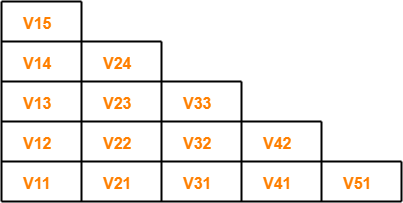


Now, let us find the value of Vij for each cell.


For Row-1:


Finding V11


  • V11 represents the set of variables deriving x11.
  • x11 = b.
  • Only variable B derives string “b” in the given grammar.
  • Thus, V11 = { B }


Finding V21


  • V21 represents the set of variables deriving x21.
  • x21 = a.
  • Variables A and C derive string “a” in the given grammar.
  • Thus, V21 = { A , C }


Finding V31


  • V31 represents the set of variables deriving x31.
  • x31 = a.
  • Variables A and C derive string “b” in the given grammar.
  • Thus, V31 = { A , C }


Finding V41


  • V41 represents the set of variables deriving x41.
  • x41 = b.
  • Only variable B derives string “b” in the given grammar.
  • Thus, V41 = { B }


Finding V51


  • V51 represents the set of variables deriving x51.
  • x51 = a.
  • Variables A and C derives string “a” in the given grammar.
  • Thus, V51 = { A , C }


For Row-2-


RULE

As per the algorithm, to find the value of Vij from 2nd row on wards,

we use the formula-

Vij = Vik V(i+k)(j-k)

where k varies from 1 to j-1


Finding V12


We have i = 1 , j = 2 , k = 1

Substituting values in the formula, we get-

V12 = V11. V21

V12 = { B } { A , C }

V12 = { BA , BC }

∴ V12 = { A , S }


Finding V22


We have i = 2 , j = 2 , k = 1

Substituting values in the formula, we get-

V22 = V21. V31

V22 = { A , C } { A , C }

V22 = { AA , AC , CA , CC }

Since AA , AC and CA do not exist, so we have-

V22 = { CC }

∴ V22 = { B }


Finding V32


We have i = 3 , j = 2 , k = 1

Substituting values in the formula, we get-

V32 = V31. V41

V32 = { A , C } { B }

V32 = { AB , CB }

Since CB does not exist, so we have-

V32 = { AB }

∴ V32 = { S , C }


Finding V42


We have i = 4 , j = 2 , k = 1

Substituting values in the formula, we get-

V42 = V41. V51

V42 = { B } { A , C }

V42 = { BA , BC }

∴ V42 = { A , S }


For Row-3-


Finding V13


We have i = 1 , j = 3 , k = 1 to (3-1) = 1,2

Substituting values in the formula, we get-

V13 = V11. V22 ∪ V12. V31

V13 = { B } { B } ∪ { A , S } { A , C }

V13 = { BB } ∪ { AA , AC , SA , SC }

Since BB , AA , AC , SA and SC do not exist, so we have-

V13 = ϕ ∪ ϕ

∴ V13 = ϕ


Finding V23


We have i = 2 , j = 3 , k = 1 to (3-1) = 1,2

Substituting values in the formula, we get-

V23 = V21. V32 ∪ V22. V41

V23 = { A , C } { S , C } ∪ { B } { B }

V23 = { AS , AC , CS , CC } ∪ { BB }

Since AS , AC , CS and BB do not exist, so we have-

V23 = { CC }

∴ V23 = B


Finding V33


We have i = 3 , j = 3 , k = 1 to (3-1) = 1,2

Substituting values in the formula, we get-

V33 = V31. V42 ∪ V32. V51

V33 = { A , C } { A , S } ∪ { S , C } { A , C }

V33 = { AA , AS , CA , CS } ∪ { SA , SC , CA , CC }

Since AA , AS , CA , CS , SA , SC and CA do not exist, so we have-

V33 = ϕ ∪ { CC }

V33 = ϕ ∪ { B }

∴ V33 = { B }


For Row-4-


Finding V14


We have i = 1 , j = 4 , k = 1 to (4-1) = 1,2,3

Substituting values in the formula, we get-

V14 = V11. V23 ∪ V12. V32 ∪ V13. V41

V14 = { B } { B } ∪ { A , S } { S , C } ∪ { ϕ , B }

V14 = { BB } ∪ { AS , AC , SS , SC } ∪ { B }

Since BB , AS , AC , SS , SC and B do not exist, so we have-

V14 = ϕ ∪ ϕ ∪ ϕ

∴ V14 = ϕ


Finding V24


We have i = 2 , j = 4 , k = 1 to (4-1) = 1,2,3

Substituting values in the formula, we get-

V24 = V21. V33 ∪ V22. V42 ∪ V23. V51

V24 = { A , C } { B } ∪ { B } { A , S } ∪ { B } { A , C }

V24 = { AB , CB } ∪ { BA , BS } ∪ { BA , BC }

Since CB does not exist, so we have-

V24 = { AB } ∪ { BA , BS } ∪ { BA , BC }

V24 = { S , C } ∪ { A } ∪ { A , S }

∴ V24 = { S , C , A }


For Row-5-


Finding V15


We have i = 1 , j = 5 , k = 1 to (5-1) = 1,2,3,4

Substituting values in the formula, we get-

V15 = V11. V24 ∪ V12. V33 ∪ V13. V42 ∪ V14. V51

V15 = { B } { S , C , A } ∪ { A , S } { B } ∪ { ϕ } { A , S } ∪ { ϕ } { A , C }

V15 = { BS , BC , BA } ∪ { AB , SB } ∪ { A , S } ∪ { A , C }

Since BS , SB , A , S and C do not exist, so we have-

V15 = { BC , BA } ∪ { AB } ∪ ϕ ∪ ϕ

V15 = { S , A } ∪ { S , C } ∪ ϕ ∪ ϕ

∴ V15 = { S , A , C }


Now,

  • The value of Vij is computed for each cell.
  • We observe V15 contains the start symbol S.
  • Thus, string x15 = baaba is a member of the language of given grammar.


After filling the triangular table, it looks like-
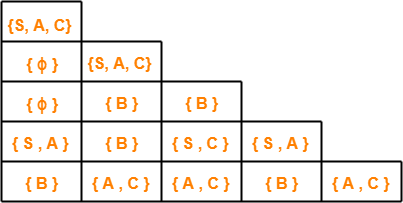


Results From Triangular Table-


The following important results can be made from the above triangular table-


Result-01:


  • There exists total 4 distinct sub strings which are members of the language of given grammar.
  • These 4 sub strings are ba, ab, aaba, baaba.
  • This is because they contain start symbol in their respective cell.


Result-02:


  • Strings which can not be derived from any variable are baa, baab.
  • This is because they contain ϕ in their respective cell.


Result-03:


  • Strings which can be derived from variable B alone are b, aa, aba, aab.
  • This is because they contain variable B alone in their respective cell.


Get more notes and other study material of Theory of Automata and Computation.

Watch video lectures by visiting our YouTube channel LearnVidFun.
Algorithm To Decide Whether CFL Is Finite

Context Free Language-


Before you go through this article, make sure that you have gone through the previous article on Context Free Language.


We have discussed-

  • Context free language is generated using a context free grammar.
  • Each context free language is accepted by a Pushdown automaton.


In this article, we will discuss a decision algorithm of CFL.


Algorithm To Decide Whether CFL Is Finite Or Not-


For a given CFG, there exists an algorithm to decide whether its language is finite or not.


Step-01:


Reduce the given grammar completely by-

  • Eliminating ∈ productions
  • Eliminating unit productions
  • Eliminating useless productions


Also Watch- How To Reduce Grammar?


Step-02:


  • Draw a directed graph whose nodes are variables of the given grammar.
  • There exists an edge from node A to node B if there exists a production of the form A → αBβ.


Now, following 2 cases are possible-


Case-01:


  • Directed graph contains a cycle.
  • In this case, language of the given grammar is infinite.


Case-02:


  • Directed graph does not contain any cycle.
  • In this case, language of the given grammar is finite.


Also Read- Algorithm To Decide Whether CFL Is Empty


PRACTICE PROBLEMS BASED ON DECIDING WHETHER CFL IS FINITE-


Problem-01:


Check whether language of the following grammar is finite or not-

S → AB / a

A → BC / b

B → CC / c


Solution-


Step-01:


The given grammar is already completely reduced.


Step-02:


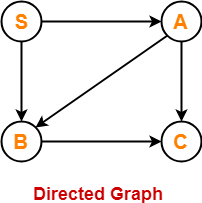
We will draw a directed graph whose nodes will be S , A , B , C.


Now,

  • Due to the production S → AB, directed graph will have edges S → A and S → B.
  • Due to the production A → BC, directed graph will have edges A → B and A → C.
  • Due to the production B → CC, directed graph will have edge B → C.


The required directed graph is-


Clearly,

  • The directed graph does not contain any cycle.
  • Therefore, language of the given grammar is finite.


Problem-02:


Check whether language of the following grammar is finite or not-

S → XS / b

X → YZ

Y → ab

Z → XY


Solution-


Step-01:


The given grammar is already completely reduced.


Step-02:


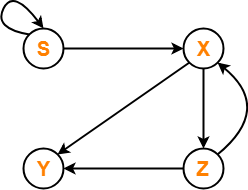
We will draw a directed graph whose nodes will be S , X , Y , Z.


Now,

  • Due to the production S → XS / b, directed graph will have edges S → X and S → S.
  • Due to the production X → YZ, directed graph will have edges X → Y and X → Z.
  • Due to the production Z → XY, directed graph will have edges Z → X and Z → Y.


The required directed graph is-


Clearly,

  • The directed graph contain cycles.
  • Therefore, language of the given grammar is infinite.


Next Article- CYK Algorithm


Get more notes and other study material of Theory of Automata and Computation.

Watch video lectures by visiting our YouTube channel LearnVidFun.
Algorithm To Decide Whether CFL Is Empty

Context Free Language-


Before you go through this article, make sure that you have gone through the previous article on Context Free Language.


We have discussed-

  • Context free language is generated using a context free grammar.
  • Each context free language is accepted by a Pushdown automaton.


In this article, we will discuss a decision algorithm of CFL.


Algorithm To Decide Whether CFL Is Empty Or Not-


If we can not derive any string of terminals from the given grammar,

then its language is called as an Empty Language.

L(G) = ϕ


For a given CFG, there exists an algorithm to decide whether its language is empty L(G) = ϕ or not.


Algorithm-


  • Remove all the useless symbols from the grammar.
  • A useless symbol is one that does not derive any string of terminals.
  • If the start symbol is found to be useless, then language is empty otherwise not.


Remember

The language generated from a CFG is non-empty iff the start symbol is generating.


Example-


Consider the following grammar-

S → XY

X → AX

X → AA

A → a

Y → BY

Y → BB

B → b


Now, let us check whether language generated by this grammar is empty or not.


The given grammar can be written as-

S → aabb

X → aX

X → aa

A → a

Y → bY

Y → bb

B → b


Clearly,

  • The start symbol generates at least one string (many more are possible).
  • Therefore, start symbol is useful.
  • Thus, language generated by the given grammar is non-empty.


L(G) ≠ ϕ


NOTE-


If L(G) = { ∈ } i.e.

  • If the language generated by a grammar contains only a null string,
  • then it is considered as non-empty.


Next Article- Algorithm To Decide Whether CFL Is Finite


Get more notes and other study material of Theory of Automata and Computation.

Watch video lectures by visiting our YouTube channel LearnVidFun.

Context Free Grammar | Context Free Language

Context Free Grammar-


A context Free Grammar (CFG) is a 4-tuple such that-

G = (V , T , P , S)

where-

  • V = Finite non-empty set of variables / non-terminal symbols
  • T = Finite set of terminal symbols
  • P = Finite non-empty set of production rules of the form A → α where A ∈ V and α ∈ (V ∪ T)*
  • S = Start symbol


Why Context Free Grammar Is Called So?


Context Free Grammar provides no mechanism to restrict the usage of the production rule A → α within some specific context unlike other types of grammars.

That is why it is called as “Context Free” Grammar.


Example-01:


Consider a grammar G = (V , T , P , S) where-

  • V = { S }
  • T = { a , b }
  • P = { S → aSbS , S → bSaS , S → ∈ }
  • S = { S }


  • This grammar is an example of a context free grammar.
  • It generates the strings having equal number of a’s and b’s.


Example-02:


Consider a grammar G = (V , T , P , S) where-

  • V = { S }
  • T = { ( , ) }
  • P = { S → SS , S → (S) , S → ∈ }
  • S = { S }


  • This grammar is an example of a context free grammar.
  • It generates the strings of balanced parenthesis.


Applications-


Context Free Grammar (CFG) is of great practical importance. It is used for following purposes-


  • For defining programming languages
  • For parsing the program by constructing syntax tree
  • For translation of programming languages
  • For describing arithmetic expressions
  • For construction of compilers


Context Free Language-


The language generated using Context Free Grammar is called as Context Free Language.


Properties-


  • The context free languages are closed under union.
  • The context free languages are closed under concatenation.
  • The context free languages are closed under kleen closure.
  • The context free languages are not closed under intersection and complement.
  • The family of regular language is a proper subset of the family of context free language.
  • Each Context Free Language is accepted by a Pushdown automaton.


Remember

If L1 and L2 are two context free languages, then-

  • L1 ∪ L2 is also a context free language.
  • L1.L2 is also a context free language.
  • L1* and L2* are also context free languages.
  • L1 ∩ L2 is not a context free language.
  • L1′ and L2′ are not context free languages.


Ambiguity in Context Free Grammar-


A grammar is said to be ambiguous if for a given string generated by the grammar, there exists-

  • more than one leftmost derivation
  • or more than one rightmost derivation
  • or more than one parse tree (or derivation tree).


Read More- Grammar Ambiguity


To gain better understanding about Context Free Grammar,

Watch this Video Lecture


Next Article- Chomsky Normal Form


Get more notes and other study material of Theory of Automata and Computation.

Watch video lectures by visiting our YouTube channel LearnVidFun.
Converting Bases | Conversion of Bases

Number System Conversions-


Before you go through this article, make sure that you have gone through the previous article on Basics of Number System.


In number system,

  • It is very important to have a good knowledge of how to convert numbers from one base to another base.
  • Here, we will learn how to convert any given number from any base to any other base.


Conversion of Bases-


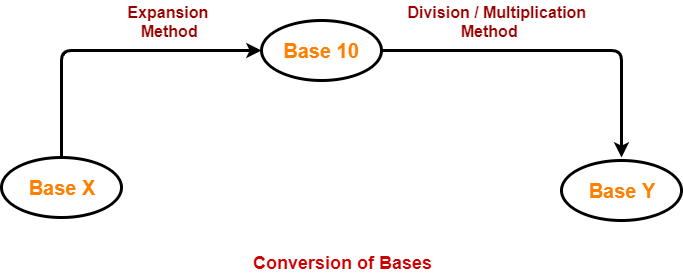
A given number in base x can be converted to any other base y using the following steps-


Step-01:


Convert the number from base x to base 10 using expansion method.


Read More- Conversion to Base 10


Step-02:


Convert the number from base 10 to base y using division & multiplication method.


Read More-


PRACTICE PROBLEMS BASED ON CONVERSION OF BASES-


Problem-01:


Convert (1056)16 to ( ? )8


Solution-


Step-01: Conversion To Base 10-


(1056)16 → ( ? )10


Using Expansion method, we have-

(1056)16

= 1 x 163 + 0 x 162 + 5 x 161 + 6 x 160

= 4096 + 0 + 80 + 6

= (4182)10


From here, (1056)16 = (4182)10


Step-02: Conversion To Base 8-


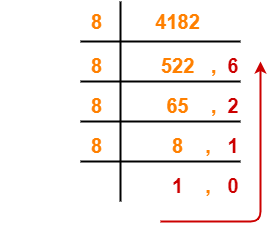
(4182)10 → ( ? )8


Using Division method, we have-


From here, (4182)10 = (10126)8

Thus, (1056)16 = (10126)8


Also Read- http://www.exam-labs.com


Problem-02:


Convert (11672)8 to ( ? )16


Solution-


Step-01: Conversion To Base 10-


(11672)8 → ( ? )10


Using Expansion method, we have-

(11672)8

= 1 x 84 + 1 x 83 + 6 x 82 + 7 x 81 + 2 x 80

= 4096 + 512 + 384 + 56 + 2

= (5050)10


From here, (11672)8 = (5050)10


Step-02: Conversion To Base 16-


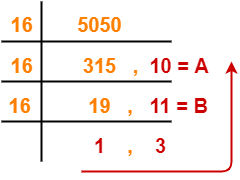
(5050)10 → ( ? )16


Using Division method, we have-


From here, (5050)10 = (13BA)16

Thus, (11672)8 = (13BA)16


Problem-03:


Convert (2724)8 to ( ? )5


Solution-


Step-01: Conversion To Base 10-


(2724)8 → ( ? )10


Using Expansion method, we have-

(2724)8

= 2 x 83 + 7 x 82 + 2 x 81 + 4 x 80

= 1024 + 448 + 16 + 4

= (1492)10


From here, (2724)8 = (1492)10


Step-02: Conversion To Base 5-


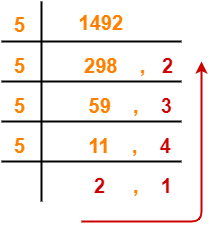
(1492)10 → ( ? )5


Using Division method, we have-


From here, (1492)10 = (21432)5

Thus, (2724)8 = (21432)5


Problem-04:


Convert (3211)4 to ( ? )5


Solution-


Step-01: Conversion To Base 10-


(3211)4 → ( ? )10


Using Expansion method, we have-

(3211)4

= 3 x 43 + 2 x 42 + 1 x 41 + 1 x 40

= 192 + 32 + 4 + 1

= (229)10


From here, (3211)4 = (229)10


Step-02: Conversion To Base 5-


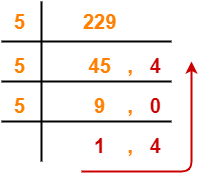
(229)10 → ( ? )5


Using Division method, we have-


From here, (229)10 = (1404)5

Thus, (3211)4 = (1404)5


Problem-05:


Convert (1001001100)2 to ( ? )6


Solution-


Step-01: Conversion To Base 10-


(1001001100)2 → ( ? )10


Using Expansion method, we have-

(1001001100)2

= 1 x 29 + 0 x 28 + 0 x 27 + 1 x 26 + 0 x 25 + 0 x 24 + 1 x 23 + 1 x 22 + 0 x 21 + 0 x 20

= 512 + 64 + 8 + 4

= (588)10


From here, (1001001100)= (588)10


Step-02: Conversion To Base 6-


(588)10 → ( ? )6


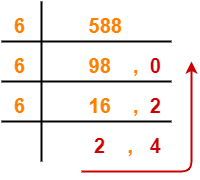
Using Division method, we have-


From here, (588)10 = (2420)6

Thus, (1001001100)2 = (2420)6


To gain better understanding about Conversion of Bases,

Watch this Video Lecture


Get more notes and other study material of Number System.

Watch video lectures by visiting our YouTube channel LearnVidFun.