WordlyCove Review: What Can Students and Writers Learn From It?

If you’ve ever searched online for help with writing, chances are that you’ve landed on a site that either:
- Drowns you in technical explanations or
- Gives you such a short answer that you’re left with even more questions.
And finding something in between isn’t always easy.
Here is why:
Some writing questions need more than a definition or a quick example, while others don’t need a lengthy explanation filled with technical terms.
What actually matters is whether you can get from the question you’re asking to an explanation that actually addresses it or not.
So, while going through a similar concern, we’ve landed on WordlyCove—a site that covers a range of writing questions, from grammar and punctuation to plagiarism, paraphrasing, vocabulary, proofreading, and writing. Its articles deal with specific problems within these areas rather than treating writing as one broad subject.
But what does that mean for students and writers? The answer depends largely on what you’re working on.
So, let’s explore this answer in detail here.
Grammar and Punctuation: Fixing the Small Things That Matter
Grammar is one of the easiest areas to underestimate because a single mistake rarely ruins an entire piece of writing. However, repeated mistakes can make your work look careless, especially when you’re submitting an essay or publishing something professionally.
So, WordlyCove has articles that deal with specific grammar problems, including common points of confusion, such as:
- The difference between ‘its’ and ‘it’s’
- The use of ‘who’ and ‘whom’
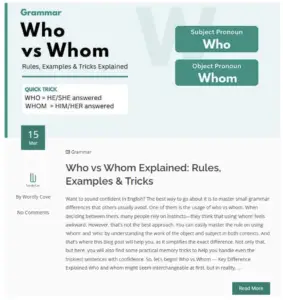
These are the kinds of questions that can be difficult to settle when you know what you meant but aren’t sure which form is actually correct.
For students, those distinctions can come up when you’re writing an essay or assignment. For writers, the same issues appear in blog posts, emails, and other professional writing.
Punctuation deals with a similar set of problems, but at the sentence level:
A comma, semicolon, or other punctuation mark can affect how a sentence is divided and understood.
For a student, that can affect the clarity of an argument. For a writer, it can change the way a sentence reads.
Spelling and Vocabulary: Making Your Writing Clearer
Spelling may seem like a basic writing skill, but that is exactly why mistakes stand out.
A misspelled word in an assignment can make the work look rushed, while the same mistake in published content can distract from the writing itself.
So, spelling is one of the areas covered by WordlyCove, alongside grammar and punctuation.
Vocabulary solves a slightly different problem. Students often need a wider range of words when writing essays, while writers need to make word choices that sound natural rather than unnecessarily complicated.
Hence, the site’s vocabulary material includes guides on learning and remembering new words. One recent guide, for example, covers methods such as:
- Spaced review
- Learning words in context
and
- Actively using new vocabulary rather than relying only on memorization
So, for a student, that connects vocabulary learning with the process of expressing ideas in an assignment. And for a writer, the same knowledge can matter when choosing words during drafting and editing.
Plagiarism and Paraphrasing: Where Sources Become Part of the Writing
Once outside sources enter the picture, writing becomes less about the words on the page and more about how those words were obtained and used. That’s especially important in academic writing, where students often have to incorporate information from:
- Articles
- Books
- Research papers
- Websites
So, WordlyCove has separate material covering paraphrasing and plagiarism. For instance, its plagiarism content discusses ways to avoid plagiarism that further includes things like:
- Keeping track of sources
- Paraphrasing carefully
and
- Using proper citations
And this distinction matters because a student can change several words in a source and still remain too close to the original. Remember that proper paraphrasing requires understanding the source, expressing the idea in a different structure and wording, and acknowledging the original source where necessary.
Writers encounter the same issue when they research articles, blog posts, reports, or other content. For them, the setting may be different from an academic assignment, but the basic process remains:
Understand the source, write the idea in your own words, and handle attribution appropriately.
Proofreading and Writing: Looking at the Whole Piece
The writing phase doesn’t get completed simply because the last sentence has been typed. There is a difference between getting the words onto the page and checking whether the finished piece actually works or not. For instance,
- A sentence can be grammatically correct while an entire paragraph remains unclear.
- An essay can contain good points while still having a weak structure.
So, WordlyCove’s writing material covers broader aspects of producing a piece, while proofreading deals with checking the finished text. Its homepage describes proofreading as the final stage of checking a completed draft.
Its guide on how to write an essay illustrates that broader approach. In fact, when we explored this article, we realized that it covers:
- Understanding the question
- Researching with purpose
- Developing a thesis
- Creating an outline
- Maintaining logical flow
- Editing
- Proofreading
It also addresses problems, such as weak arguments, missing evidence, overly complex sentences, and unclear sentences.
So, for students, these are different stages of the same assignment. For instance, as a student, you may need to understand the question before writing, organize your argument before drafting, and proofread after the main writing is complete.
And as far as writers are concerned, they go through a similar process when creating articles, blog posts, or professional content. The subject may change, but the need for clear ideas, editing, structure, and a final check remains.
The Tool Reviews: Looking at Writing Software in Practice
WordlyCove also publishes reviews of writing-related tools, including plagiarism checkers and AI detectors.
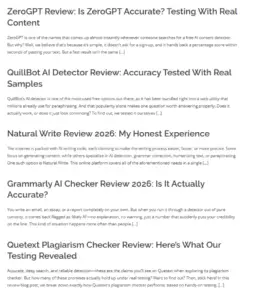
Now, that’s a different type of content from its writing guides. For instance, instead of explaining a writing concept, these blog posts look at how a particular tool behaves when it is given specific text.
For example, the QuillBot AI Detector review describes four tests involving:
- Raw AI-generated text.
- AI text edited by a human.
- Fully human-written text.
- Human writing that was processed with AI for grammar, clarity, and flow.
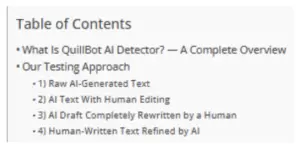
The review then reports the results from each test.
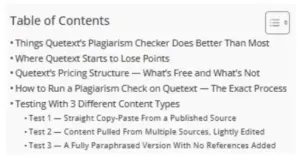
The Quetext plagiarism checker review takes a similar testing approach. It documents tests involving directly copied content, lightly edited material, and a fully paraphrased passage, along with the matches and sources returned by the tool.
So, for someone reading these reviews, there is a distinction between a tool’s stated features and the results of a particular test. A test shows what happened with the specific sample that was used; it does not necessarily establish how the tool will perform with every possible type of text.
How Students Can Use WordlyCove’s Information
For students, the different subjects covered by WordlyCove correspond to different points in the writing process:
- If you’re starting an essay, the writing material covers things such as understanding the question, researching with purpose, developing a thesis, and organizing an outline. And the site’s essay guide breaks those stages down individually.
- If you’re already drafting, grammar, punctuation, spelling, and vocabulary become more relevant.
- And once you’re using research, plagiarism and paraphrasing become part of the process.
- At the end, proofreading gives you another stage for checking the finished piece.
So, the same student might encounter several different types of content, depending on where they are in an assignment.
How Writers Can Use WordlyCove’s Information
The process looks similar for writers, although the type of writing changes. Here’s how it can help writers:
- A blogger might encounter a grammar or punctuation question while editing a post.
- A freelance writer might need to rethink word choice or check a finished draft.
- Someone working from research might need to distinguish between an acceptable paraphrase and text that remains too close to the source.
The tool reviews address a separate question:
What happens when writing software is used on actual text?
So, all of this makes the site’s different sections applicable to different writing situations rather than one single type of writer. For instance, a person writing a blog post may have little reason to read an essay-structure guide, while a student may have little reason to read a review of a professional writing tool.
The Overlap Between Students and Writers
Students and writers don’t necessarily need completely different writing knowledge. For instance,
- A student writing an essay needs grammar, paraphrasing, proofreading, structure, vocabulary, and an understanding of plagiarism.
- A writer creating a blog post or professional piece needs many of the same things.
So, the difference is usually the context.
For instance,
- A student may use a paraphrasing guide while incorporating research into an assignment, while a content writer may use the same principle when turning research into an original article.
- A student may look up a grammar rule while revising an essay, whereas a blogger may encounter the same grammar question while editing a post.
So, WordlyCove’s site covers writing for different contexts, including academic and professional writing, alongside areas such as grammar, plagiarism, proofreading, punctuation, spelling, and writing.
Conclusion
To conclude, the usefulness of a writing resource depends on the problem you’re trying to solve. A student working on an essay may need help with structure at one point, plagiarism at another, and grammar or proofreading later. A writer may encounter similar questions while researching, drafting, or editing a piece. Thus, WordlyCove brings these subjects together across its writing-related content, so the relevant article depends on what you’re trying to figure out at the time. And that’s probably the simplest way to look at it:
You don’t need to read the entire site. You can start with the particular writing problem in front of you and work from there.