Category: Subjects

Three Address Code | Examples

Three Address Code-


Three Address Code is a form of an intermediate code.


The characteristics of Three Address instructions are-

  • They are generated by the compiler for implementing Code Optimization.
  • They use maximum three addresses to represent any statement.
  • They are implemented as a record with the address fields.


General Form-


In general, Three Address instructions are represented as-


a = b op c


Here,

  • a, b and c are the operands.
  • Operands may be constants, names, or compiler generated temporaries.
  • op represents the operator.


Examples-


Examples of Three Address instructions are-

  • a = b + c
  • c = a x b


Common Three Address Instruction Forms-


The common forms of Three Address instructions are-


1. Assignment Statement-


x = y op z and x = op y


Here,

  • x, y and z are the operands.
  • op represents the operator.


It assigns the result obtained after solving the right side expression of the assignment operator to the left side operand.


2. Copy Statement-


x = y


Here,

  • x and y are the operands.
  • = is an assignment operator.


It copies and assigns the value of operand y to operand x.


3. Conditional Jump-


If x relop y goto X


Here,

  • x & y are the operands.
  • X is the tag or label of the target statement.
  • relop is a relational operator.


If the condition “x relop y” gets satisfied, then-

  • The control is sent directly to the location specified by label X.
  • All the statements in between are skipped.


If the condition “x relop y” fails, then-

  • The control is not sent to the location specified by label X.
  • The next statement appearing in the usual sequence is executed.


4. Unconditional Jump-


goto X


Here, X is the tag or label of the target statement.


On executing the statement,

  • The control is sent directly to the location specified by label X.
  • All the statements in between are skipped.


5. Procedure Call-


param x call p return y


Here, p is a function which takes x as a parameter and returns y.


PRACTICE PROBLEMS BASED ON THREE ADDRESS CODE-


To solve the problems, Learn about the Precedence Relations and Associativity of Operators.


Problem-01:


Write Three Address Code for the following expression-

a = b + c + d


Solution-


The given expression will be solved as-
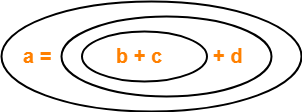


Three Address Code for the given expression is-

(1) T1 = b + c

(2) T2 = T1 + d

(3) a = T2


Problem-02:


Write Three Address Code for the following expression-

-(a x b) + (c + d) – (a + b + c + d)


Solution-


Three Address Code for the given expression is-

(1) T1 = a x b

(2) T2 = uminus T1

(3) T3 = c + d

(4) T4 = T2 + T3

(5) T5 = a + b

(6) T6 = T3 + T5

(7) T7 = T4 – T6


Problem-03:


Write Three Address Code for the following expression-

If A < B then 1 else 0


Solution-


Three Address Code for the given expression is-

(1) If (A < B) goto (4)

(2) T1 = 0

(3) goto (5)

(4) T1 = 1

(5)


Problem-04:


Write Three Address Code for the following expression-

If A < B and C < D then t = 1 else t = 0


Solution-


Three Address Code for the given expression is-

(1) If (A < B) goto (3)

(2) goto (4)

(3) If (C < D) goto (6)

(4) t = 0

(5) goto (7)

(6) t = 1

(7)


Also Read- More Problems On Three Address Code


To gain better understanding about Three Address Code,

Watch this Video Lecture


Download Handwritten Notes Here-


Next Article- Quadruples, Triples & Indirect Triples


Get more notes and other study material of Compiler Design.

Watch video lectures by visiting our YouTube channel LearnVidFun.
Directed Acyclic Graphs | DAGs | Examples

Directed Acyclic Graph-


Directed Acyclic Graph (DAG) is a special kind of Abstract Syntax Tree.


  • Each node of it contains a unique value.
  • It does not contain any cycles in it, hence called Acyclic.


Optimization Of Basic Blocks-


DAG is a very useful data structure for implementing transformations on Basic Blocks.


  • A DAG is constructed for optimizing the basic block.
  • A DAG is usually constructed using Three Address Code.
  • Transformations such as dead code elimination and common sub expression elimination are then applied.


Properties-


  • Reachability relation forms a partial order in DAGs.
  • Both transitive closure & transitive reduction are uniquely defined for DAGs.
  • Topological Orderings are defined for DAGs.


Applications-


DAGs are used for the following purposes-

  • To determine the expressions which have been computed more than once (called common sub-expressions).
  • To determine the names whose computation has been done outside the block but used inside the block.
  • To determine the statements of the block whose computed value can be made available outside the block.
  • To simplify the list of Quadruples by not executing the assignment instructions x:=y unless they are necessary and eliminating the common sub-expressions.


Construction of DAGs-


Following rules are used for the construction of DAGs-


Rule-01:


In a DAG,

  • Interior nodes always represent the operators.
  • Exterior nodes (leaf nodes) always represent the names, identifiers or constants.


Rule-02:


While constructing a DAG,

  • A check is made to find if there exists any node with the same value.
  • A new node is created only when there does not exist any node with the same value.
  • This action helps in detecting the common sub-expressions and avoiding the re-computation of the same.


Rule-03:


The assignment instructions of the form x:=y are not performed unless they are necessary.


Also Read- Code Optimization


PRACTICE PROBLEMS BASED ON DIRECTED ACYCLIC GRAPHS-


Problem-01:


Consider the following expression and construct a DAG for it-

         ( a + b ) x ( a + b + c )


Solution-


Three Address Code for the given expression is-


T1 = a + b

T2 = T1 + c

T3 = T1 x T2


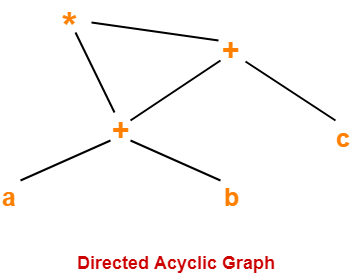
Now, Directed Acyclic Graph is-


NOTE


From the constructed DAG, we observe-

  • The common sub-expression (a+b) has been expressed into a single node in the DAG.
  • The computation is carried out only once and stored in the identifier T1 and reused later.


This illustrates how the construction scheme of a DAG identifies the common sub-expression and helps in eliminating its re-computation later.


Problem-02:


Consider the following expression and construct a DAG for it-

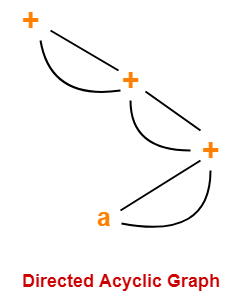
( ( ( a + a ) + ( a + a ) ) + ( ( a + a ) + ( a + a ) ) )


Solution-


Directed Acyclic Graph for the given expression is-


Problem-03:


Consider the following block and construct a DAG for it-


(1) a = b x c

(2) d = b

(3) e = d x c

(4) b = e

(5) f = b + c

(6) g = f + d


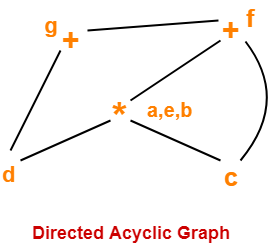
Solution-


Directed Acyclic Graph for the given block is-


Problem-04:


Optimize the block in the Problem-03.


Solution-


Step-01:


Firstly, construct a DAG for the given block (already done above).


Step-02:


Now, the optimized block can be generated by traversing the DAG.

  • The common sub-expression e = d x c which is actually b x c (since d = b) is eliminated.
  • The dead code b = e is eliminated.


The optimized block is-


(1) a = b x c

(2) d = b

(3) f = a + c

(4) g = f + d


Problem-05:


Consider the following basic block-


B10:

S1 = 4 x I

S2 = addr(A) – 4

S3 = S2[S1]

S4 = 4 x I

S5 = addr(B) – 4

S6 = S5[S4]

S7 = S3 x S6

S8 = PROD + S7

PROD = S8

S9 = I + 1

I = S9

If I <= 20 goto L10


  1. Draw a directed acyclic graph and identify local common sub-expressions.
  2. After eliminating the common sub-expressions, re-write the basic block.


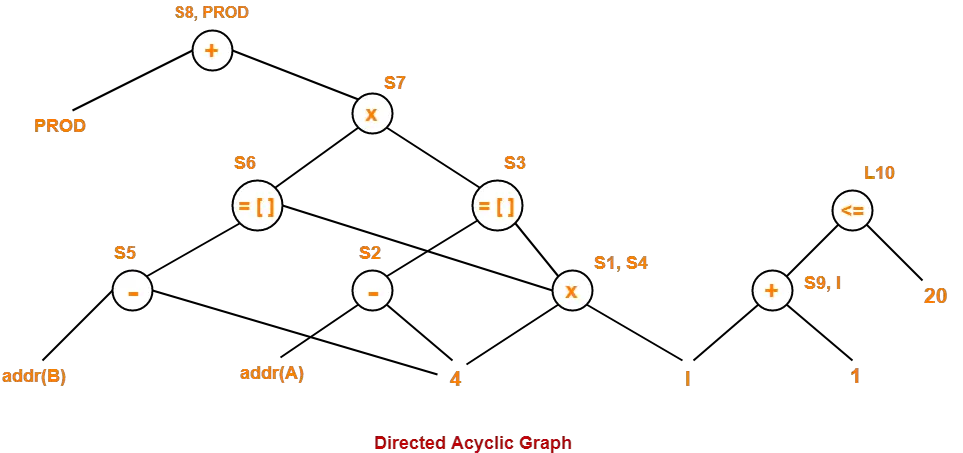
Solution-


Directed Acyclic Graph for the given basic block is-


In this code fragment,

  • 4 x I is a common sub-expression. Hence, we can eliminate because S1 = S4.
  • We can optimize S8 = PROD + S7 and PROD = S8 as PROD = PROD + S7.
  • We can optimize S9 = I + 1 and I = S9 as I = I + 1.


After eliminating S4, S8 and S9, we get the following basic block-


B10:

S1 = 4 x I

S2 = addr(A) – 4

S3 = S2[S1]

S5 = addr(B) – 4

S6 = S5[S1]

S7 = S3 x S6

PROD = PROD + S7

I = I + 1

If I <= 20 goto L10


To gain  better understanding about Directed Acyclic Graphs,

Watch this Video Lecture


Download Handwritten Notes Here-


Next Article- Misc Problems On Directed Acyclic Graphs


Get more notes and other study material of Compiler Design.

Watch video lectures by visiting our YouTube channel LearnVidFun.
Basic Blocks and Flow Graphs | Examples

Basic Blocks-


Basic block is a set of statements that always executes in a sequence one after the other.


The characteristics of basic blocks are-

  • They do not contain any kind of jump statements in them.
  • There is no possibility of branching or getting halt in the middle.
  • All the statements execute in the same order they appear.
  • They do not lose lose the flow control of the program.


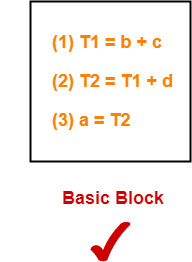
Example Of Basic Block-


Three Address Code for the expression a = b + c + d is-


Here,

  • All the statements execute in a sequence one after the other.
  • Thus, they form a basic block.


Also Read- Three Address Code


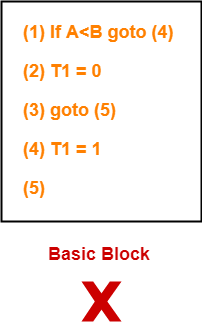
Example Of Not A Basic Block-


Three Address Code for the expression If A<B then 1 else 0 is-


Here,

  • The statements do not execute in a sequence one after the other.
  • Thus, they do not form a basic block.


Partitioning Intermediate Code Into Basic Blocks-


Any given code can be partitioned into basic blocks using the following rules-


Rule-01: Determining Leaders-


Following statements of the code are called as Leaders

  • First statement of the code.
  • Statement that is a target of the conditional or unconditional goto statement.
  • Statement that appears immediately after a goto statement.


Rule-02: Determining Basic Blocks-


  • All the statements that follow the leader (including the leader) till the next leader appears form one basic block.
  • The first statement of the code is called as the first leader.
  • The block containing the first leader is called as Initial block.


Flow Graphs-


A flow graph is a directed graph with flow control information added to the basic blocks.


  • The basic blocks serve as nodes of the flow graph.
  • There is a directed edge from block B1 to block B2 if B2 appears immediately after B1 in the code.


PRACTICE PROBLEMS BASED ON BASIC BLOCKS & FLOW GRAPHS-


Problem-01:


Compute the basic blocks for the given three address statements-


(1) PROD = 0

(2) I = 1

(3) T2 = addr(A) – 4

(4) T4 = addr(B) – 4

(5) T1 = 4 x I

(6) T3 = T2[T1]

(7) T5 = T4[T1]

(8) T6 = T3 x T5

(9) PROD = PROD + T6

(10) I = I + 1

(11) IF I <=20 GOTO (5)


Solution-


We have-

  • PROD = 0 is a leader since first statement of the code is a leader.
  • T1 = 4 x I is a leader since target of the conditional goto statement is a leader.


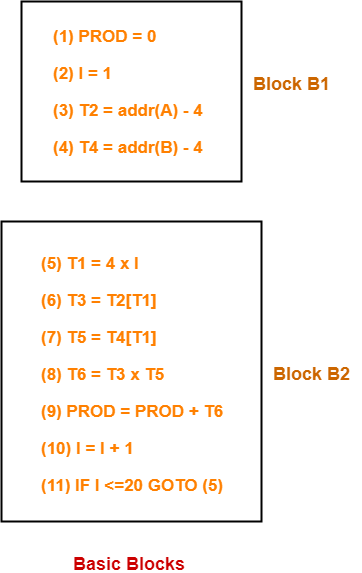
Now, the given code can be partitioned into two basic blocks as-


Problem-02:


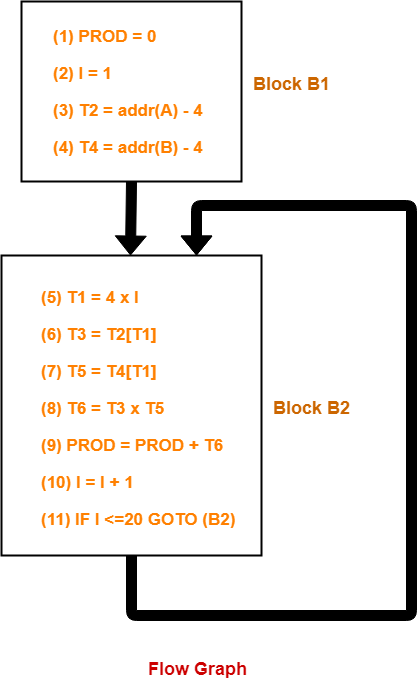
Draw a flow graph for the three address statements given in problem-01.


Solution-


  • Firstly, we compute the basic blocks (already done above).
  • Secondly, we assign the flow control information.


The required flow graph is-


Also Read- More Problems On Basic Blocks & Flow Graphs


To gain better understanding about Basic Blocks and Flow Graphs,

Watch this Video Lecture


Download Handwritten Notes Here-


Next Article- Directed Acyclic Graphs


Get more notes and other study material of Compiler Design.

Watch video lectures by visiting our YouTube channel LearnVidFun.