Category: Subjects

AVL Tree Insertion | Insertion in AVL Tree

AVL Tree-


Before you go through this article, make sure that you have gone through the previous article on AVL Trees.


We have discussed-

  • AVL trees are self-balancing binary search trees.
  • In AVL trees, balancing factor of each node is either 0 or 1 or -1.


In this article, we will discuss insertion in AVL tree.


Insertion in AVL Tree-


Insertion Operation is performed to insert an element in the AVL Tree.


To insert an element in the AVL tree, follow the following steps-

  • Insert the element in the AVL tree in the same way the insertion is performed in BST.
  • After insertion, check the balance factor of each node of the resulting tree.


Read More- Insertion in Binary Search Tree


Now, following two cases are possible-


Case-01:


  • After the insertion, the balance factor of each node is either 0 or 1 or -1.
  • In this case, the tree is considered to be balanced.
  • Conclude the operation.
  • Insert the next element if any.


Case-02:


  • After the insertion, the balance factor of at least one node is not 0 or 1 or -1.
  • In this case, the tree is considered to be imbalanced.
  • Perform the suitable rotation to balance the tree.
  • After the tree is balanced, insert the next element if any.


Also Read- AVL Tree Properties


Rules To Remember-


Rule-01:


After inserting an element in the existing AVL tree,

  • Balance factor of only those nodes will be affected that lies on the path from the newly inserted node to the root node.


Rule-02:


To check whether the AVL tree is still balanced or not after the insertion,

  • There is no need to check the balance factor of every node.
  • Check the balance factor of only those nodes that lies on the path from the newly inserted node to the root node.


Rule-03:


After inserting an element in the AVL tree,

  • If tree becomes imbalanced, then there exists one particular node in the tree by balancing which the entire tree becomes balanced automatically.
  • To re balance the tree, balance that particular node.


To find that particular node,

  • Traverse the path from the newly inserted node to the root node.
  • Check the balance factor of each node that is encountered while traversing the path.
  • The first encountered imbalanced node will be the node that needs to be balanced.


To balance that node,

  • Count three nodes in the direction of leaf node.
  • Then, use the concept of AVL tree rotations to re balance the tree.


PRACTICE PROBLEM BASED ON AVL TREE INSERTION-


Problem-


Construct AVL Tree for the following sequence of numbers-

50 , 20 , 60 , 10 , 8 , 15 , 32 , 46 , 11 , 48


Solution-


Step-01: Insert 50
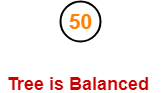


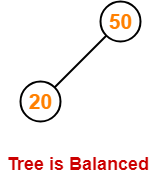
Step-02: Insert 20


  • As 20 < 50, so insert 20 in 50’s left sub tree.


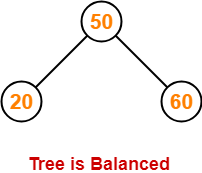
Step-03: Insert 60


  • As 60 > 50, so insert 60 in 50’s right sub tree.


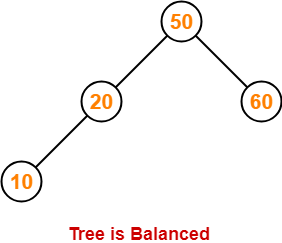
Step-04: Insert 10


  • As 10 < 50, so insert 10 in 50’s left sub tree.
  • As 10 < 20, so insert 10 in 20’s left sub tree.


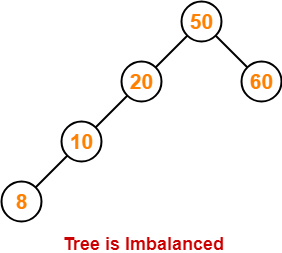
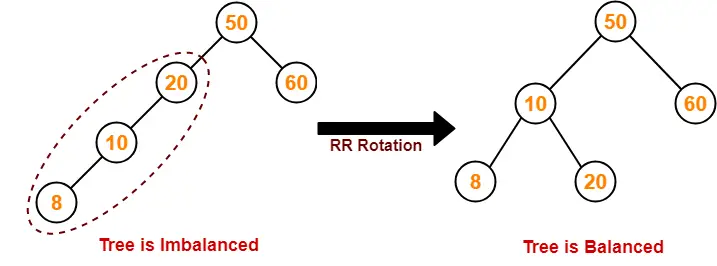
Step-05: Insert 8


  • As 8 < 50, so insert 8 in 50’s left sub tree.
  • As 8 < 20, so insert 8 in 20’s left sub tree.
  • As 8 < 10, so insert 8 in 10’s left sub tree.


To balance the tree,

  • Find the first imbalanced node on the path from the newly inserted node (node 8) to the root node.
  • The first imbalanced node is node 20.
  • Now, count three nodes from node 20 in the direction of leaf node.
  • Then, use AVL tree rotation to balance the tree.


Following this, we have-


Step-06: Insert 15


  • As 15 < 50, so insert 15 in 50’s left sub tree.
  • As 15 > 10, so insert 15 in 10’s right sub tree.
  • As 15 < 20, so insert 15 in 20’s left sub tree.
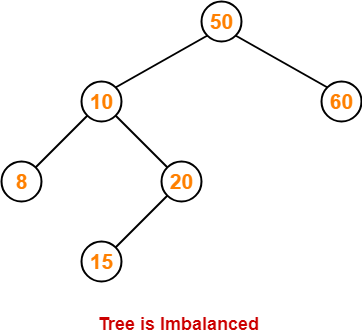


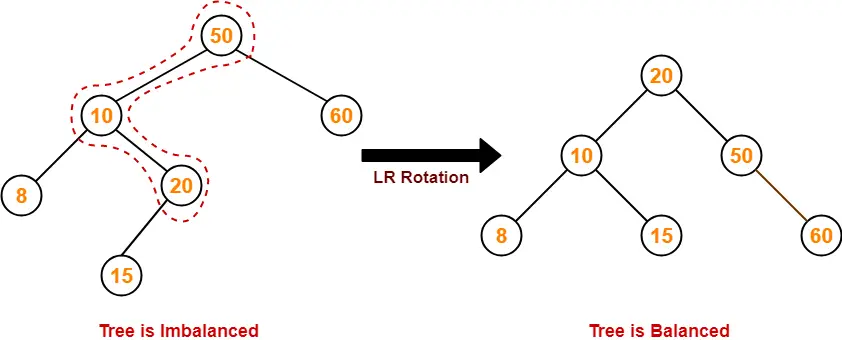
To balance the tree,

  • Find the first imbalanced node on the path from the newly inserted node (node 15) to the root node.
  • The first imbalanced node is node 50.
  • Now, count three nodes from node 50 in the direction of leaf node.
  • Then, use AVL tree rotation to balance the tree.


Following this, we have-


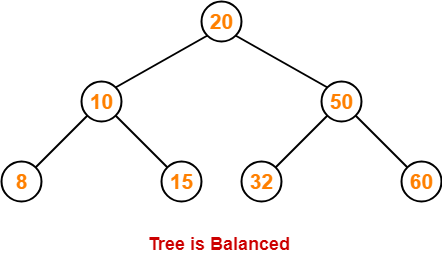
Step-07: Insert 32


  • As 32 > 20, so insert 32 in 20’s right sub tree.
  • As 32 < 50, so insert 32 in 50’s left sub tree.


Step-08: Insert 46


  • As 46 > 20, so insert 46 in 20’s right sub tree.
  • As 46 < 50, so insert 46 in 50’s left sub tree.
  • As 46 > 32, so insert 46 in 32’s right sub tree.
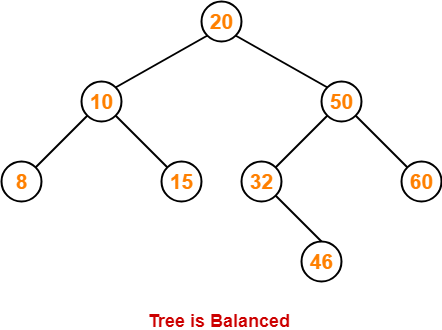


Step-09: Insert 11


  • As 11 < 20, so insert 11 in 20’s left sub tree.
  • As 11 > 10, so insert 11 in 10’s right sub tree.
  • As 11 < 15, so insert 11 in 15’s left sub tree.
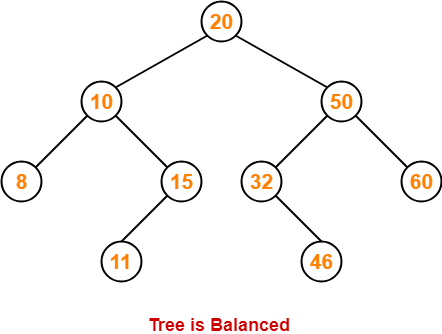


Step-10: Insert 48


  • As 48 > 20, so insert 48 in 20’s right sub tree.
  • As 48 < 50, so insert 48 in 50’s left sub tree.
  • As 48 > 32, so insert 48 in 32’s right sub tree.
  • As 48 > 46, so insert 48 in 46’s right sub tree.
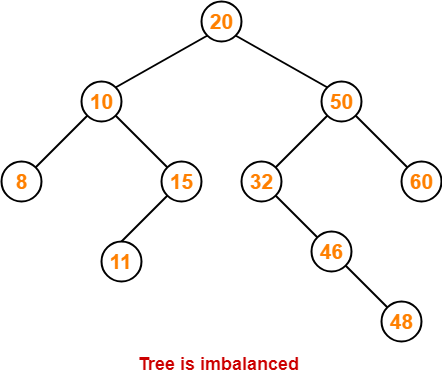


To balance the tree,

  • Find the first imbalanced node on the path from the newly inserted node (node 48) to the root node.
  • The first imbalanced node is node 32.
  • Now, count three nodes from node 32 in the direction of leaf node.
  • Then, use AVL tree rotation to balance the tree.


Following this, we have-
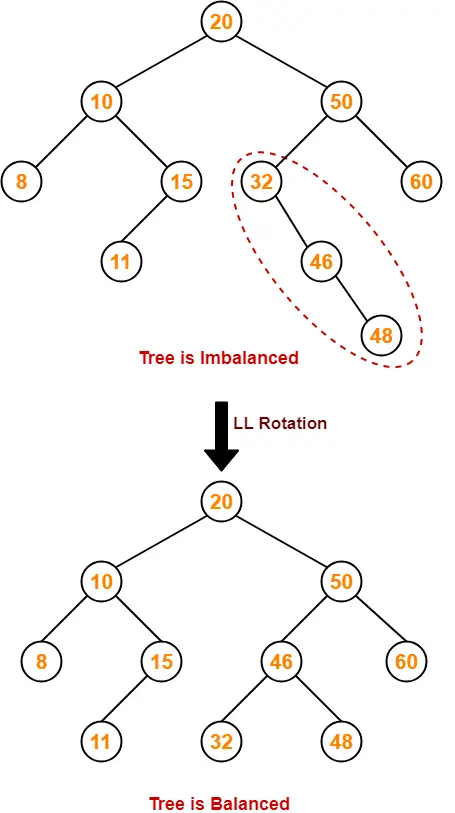


This is the final balanced AVL tree after inserting all the given elements.


To gain better understanding of AVL Tree Insertion,

Watch this Video Lecture


Next Article- Heap Data Structure


Get more notes and other study material of Data Structures.

Watch video lectures by visiting our YouTube channel LearnVidFun.
Parse Tree | Derivations | Automata

Parse Tree-


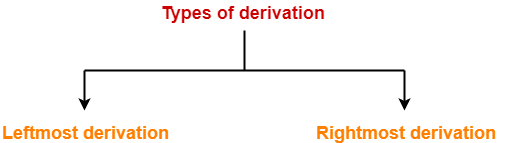
  • The process of deriving a string is called as derivation.
  • The geometrical representation of a derivation is called as a parse tree or derivation tree.


1. Leftmost Derivation-


  • The process of deriving a string by expanding the leftmost non-terminal at each step is called as leftmost derivation.
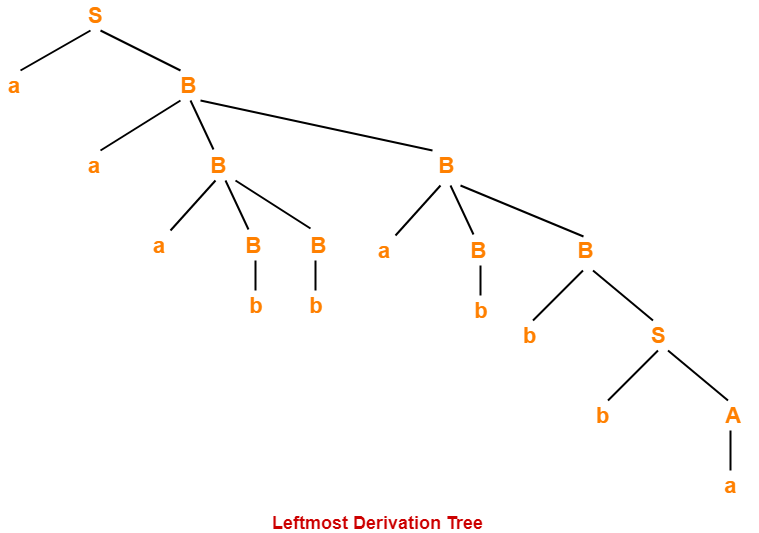
  • The geometrical representation of leftmost derivation is called as a leftmost derivation tree.


Example-


Consider the following grammar-

S → aB / bA

S → aS / bAA / a

B → bS / aBB / b

(Unambiguous Grammar)


Let us consider a string w = aaabbabbba

Now, let us derive the string w using leftmost derivation.


Leftmost Derivation-


S   → aB

→  aaBB                   (Using B → aBB)

→ aaaBBB                (Using B → aBB)

→ aaabBB                (Using B → b)

→ aaabbB                (Using B → b)

→ aaabbaBB            (Using B → aBB)

→ aaabbabB            (Using B → b)

→ aaabbabbS          (Using B → bS)

→ aaabbabbbA        (Using S → bA)

→ aaabbabbba         (Using A → a)


2. Rightmost Derivation-


  • The process of deriving a string by expanding the rightmost non-terminal at each step is called as rightmost derivation.
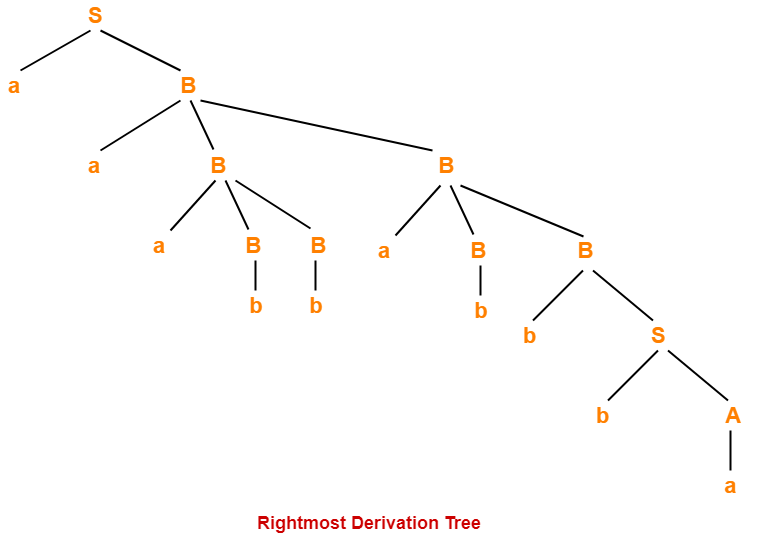
  • The geometrical representation of rightmost derivation is called as a rightmost derivation tree.


Example-


Consider the following grammar-

S → aB / bA

S → aS / bAA / a

B → bS / aBB / b

(Unambiguous Grammar)


Let us consider a string w = aaabbabbba

Now, let us derive the string w using rightmost derivation.


Rightmost Derivation-


S   → aB

→  aaBB                    (Using B → aBB)

→ aaBaBB                 (Using B → aBB)

→ aaBaBbS               (Using B → bS)

→ aaBaBbbA             (Using S → bA)

→ aaBaBbba              (Using A → a)

→ aaBabbba              (Using B → b)

→ aaaBBabbba          (Using B → aBB)

→ aaaBbabbba          (Using B → b)

→ aaabbabbba           (Using B → b)


NOTES

  • For unambiguous grammars, Leftmost derivation and Rightmost derivation represents the same parse tree.
  • For ambiguous grammars, Leftmost derivation and Rightmost derivation represents different parse trees.


Here,

  • The given grammar was unambiguous.
  • That is why, leftmost derivation and rightmost derivation represents the same parse tree.


Leftmost Derivation Tree = Rightmost Derivation Tree


Also Read- Ambiguous Grammar


Properties Of Parse Tree-


  • Root node of a parse tree is the start symbol of the grammar.
  • Each leaf node of a parse tree represents a terminal symbol.
  • Each interior node of a parse tree represents a non-terminal symbol.
  • Parse tree is independent of the order in which the productions are used during derivations.


Yield Of Parse Tree-


  • Concatenating the leaves of a parse tree from the left produces a string of terminals.
  • This string of terminals is called as yield of a parse tree.


PRACTICE PROBLEMS BASED ON DERIVATIONS AND PARSE TREE-


Problem-01:


Consider the grammar-

S → bB / aA

A → b / bS / aAA

B → a / aS / bBB


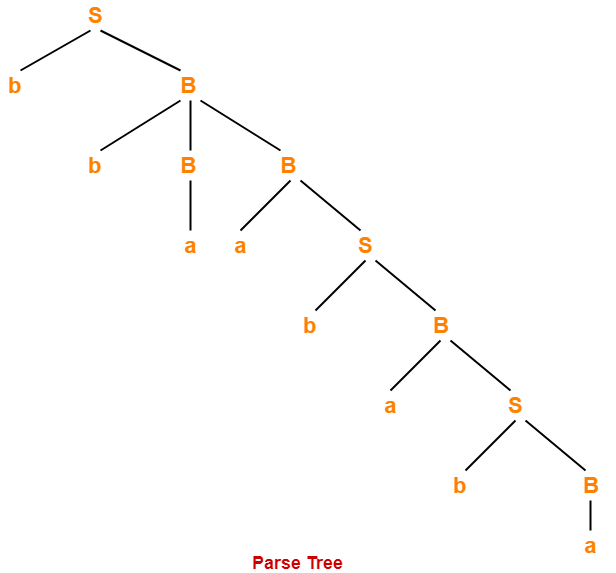
For the string w = bbaababa, find-

  1. Leftmost derivation
  2. Rightmost derivation
  3. Parse Tree


Solution-


1. Leftmost Derivation-


S   → bB

→ bbBB              (Using B → bBB)

→ bbaB              (Using B → a)

→ bbaaS            (Using B → aS)

→ bbaabB          (Using S → bB)

→ bbaabaS        (Using B → aS)

→ bbaababB      (Using S → bB)

→ bbaababa       (Using B → a)


2. Rightmost Derivation-


S   → bB

→ bbBB                (Using B → bBB)

→ bbBaS              (Using B → aS)

→ bbBabB            (Using S → bB)

→ bbBabaS          (Using B → aS)

→ bbBababB        (Using S → bB)

→ bbBababa        (Using B → a)

→ bbaababa         (Using B → a)


3. Parse Tree-


  • Whether we consider the leftmost derivation or rightmost derivation, we get the above parse tree.
  • The reason is given grammar is unambiguous.


Problem-02:


Consider the grammar-

S → A1B

A → 0A / ∈

B → 0B / 1B / ∈


For the string w = 00101, find-

  1. Leftmost derivation
  2. Rightmost derivation
  3. Parse Tree


Solution-


1. Leftmost Derivation-


S   → A1B

→ 0A1B              (Using A → 0A)

→ 00A1B            (Using A → 0A)

→ 001B              (Using A → ∈)

→ 0010B            (Using B → 0B)

→ 00101B          (Using B → 1B)

→ 00101             (Using B → ∈)


2. Rightmost Derivation-


S   → A1B

→ A10B                (Using B → 0B)

→ A101B              (Using B → 1B)

A101                (Using B → ∈)

→ 0A101              (Using A → 0A)

→ 00A101            (Using A → 0A)

→ 00101               (Using A → ∈)


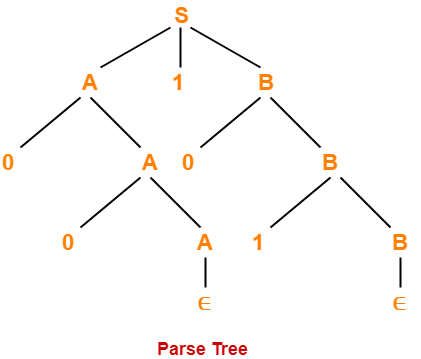
3. Parse Tree-


  • Whether we consider the leftmost derivation or rightmost derivation, we get the above parse tree.
  • The reason is given grammar is unambiguous.


To gain better understanding about Derivations and Parse Tree,

Watch this Video Lecture


Next Article- Elimination of Left Recursion


Get more notes and other study material of Theory of Automata and Computation.

Watch video lectures by visiting our YouTube channel LearnVidFun.
Set Theory Operators | Relational Algebra | DBMS

Relational Algebra Operators-


Before you go through this article, make sure that you have gone through the previous article on Introduction to Relational Algebra.


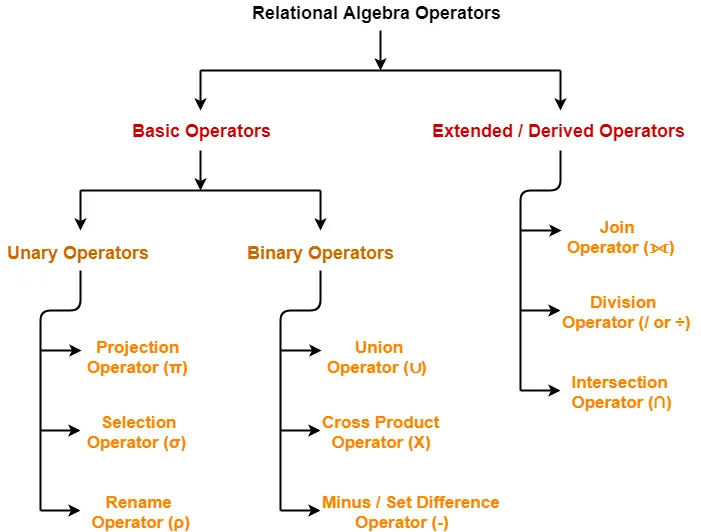
The operators in relational algebra are classified as-


In this article, we will discuss about Set Theory Operators.


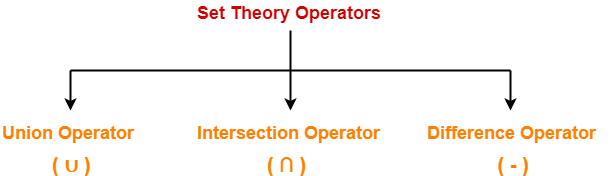
Set Theory Operators-


Following operators are called as set theory operators-


  1. Union Operator (∪)
  2. Intersection Operator (∩)
  3. Difference Operator (-)


Condition For Using Set Theory Operators


To use set theory operators on two relations,

The two relations must be union compatible.

Union compatible property means-

  • Both the relations must have same number of attributes.
  • The attribute domains (types of values accepted by attributes) of both the relations must be compatible.


Also read- Selection Operator and Projection Operator


1. Union Operator (∪)-


Let R and S be two relations.

Then-

  • R ∪ S is the set of all tuples belonging to either R or S or both.
  • In R ∪ S, duplicates are automatically removed.
  • Union operation is both commutative and associative.


Example-


Consider the following two relations R and S-


ID Name Subject
100 Ankit English
200 Pooja Maths
300 Komal Science

Relation R


ID Name Subject
100 Ankit English
400 Kajol French

Relation S


Then, R ∪ S is-


ID Name Subject
100 Ankit English
200 Pooja Maths
300 Komal Science
400 Kajol French

Relation R ∪ S


2. Intersection Operator (∩)-


Let R and S be two relations.

Then-

  • R ∩ S is the set of all tuples belonging to both R and S.
  • In R ∩ S, duplicates are automatically removed.
  • Intersection operation is both commutative and associative.


Example-


Consider the following two relations R and S-


ID Name Subject
100 Ankit English
200 Pooja Maths
300 Komal Science

Relation R


ID Name Subject
100 Ankit English
400 Kajol French

Relation S


Then, R ∩ S is-


ID Name Subject
100 Ankit English

Relation R ∩ S


3. Difference Operator (-)-


Let R and S be two relations.

Then-

  • R – S is the set of all tuples belonging to R and not to S.
  • In R – S, duplicates are automatically removed.
  • Difference operation is associative but not commutative.


Example-


Consider the following two relations R and S-


ID Name Subject
100 Ankit English
200 Pooja Maths
300 Komal Science

Relation R


ID Name Subject
100 Ankit English
400 Kajol French

Relation S


Then, R – S is-


ID Name Subject
200 Pooja Maths
300 Komal Science

Relation R – S


Get more notes and other study material of Database Management System (DBMS).

Watch video lectures by visiting our YouTube channel LearnVidFun.
Projection Operator | Relational Algebra | DBMS

Relational Algebra Operators-


Before you go through this article, make sure that you have gone through the previous article on Introduction to Relational Algebra.


The operators in relational algebra are classified as-


In this article, we will discuss about Projection Operator.


Projection Operator-


  • Projection Operator (π) is a unary operator in relational algebra that performs a projection operation.
  • It displays the columns of a relation or table based on the specified attributes.


Syntax-


π<attribute list>(R)


Example-


Consider the following Student relation-


ID Name Subject Age
100 Ashish Maths 19
200 Rahul Science 20
300 Naina Physics 20
400 Sameer Chemistry 21

Student


Then, we have-


Result for Query πName, Age(Student)-


Name Age
Ashish 19
Rahul 20
Naina 20
Sameer 21


Result for Query πID , Name(Student)-


ID Name
100 Ashish
200 Rahul
300 Naina
400 Sameer


Important Points-


Point-01:


  • The degree of output relation (number of columns present) is equal to the number of attributes mentioned in the attribute list.


Point-02:


  • Projection operator automatically removes all the duplicates while projecting the output relation.
  • So, cardinality of the original relation and output relation may or may not be same.
  • If there are no duplicates in the original relation, then the cardinality will remain same otherwise it will surely reduce.


Point-03:


  • If attribute list is a super key on relation R, then we will always get the same number of tuples in the output relation.
  • This is because then there will be no duplicates to filter.


Point-04:


  • Projection operator does not obey commutative property i.e.

π <list2> (π <list1> (R)) ≠ π <list1> (π <list2> (R))


Point-05:


  • Following expressions are equivalent because both finally projects columns of list-1

π <list1> (π <list2> (R)) = π <list1> (R)


Point-06:


  • Selection Operator performs horizontal partitioning of the relation.
  • Projection operator performs vertical partitioning of the relation.


Point-07:


  • There is only one difference between projection operator of relational algebra and SELECT operation of SQL.
  • Projection operator does not allow duplicates while SELECT operation allows duplicates.
  • To avoid duplicates in SQL, we use “distinct” keyword and write SELECT distinct.
  • Thus, projection operator of relational algebra is equivalent to SELECT operation of SQL.


Next Article- Set Theory Operators in Relational Algebra


Get more notes and other study material of Database Management System (DBMS).

Watch video lectures by visiting our YouTube channel LearnVidFun.
Selection Operator | Relational Algebra | DBMS

Relational Algebra Operators-


Before you go through this article, make sure that you have gone through the previous article on Introduction to Relational Algebra.


The operators in relational algebra are classified as-


In this article, we will discuss about Selection Operator.


Selection Operator-


  • Selection Operator (σ) is a unary operator in relational algebra that performs a selection operation.
  • It selects those rows or tuples from the relation that satisfies the selection condition.


Syntax-


σ<selection_condition>(R)


Examples-


  • Select tuples from a relation “Books” where subject is “database”

σsubject = “database” (Books)

  • Select tuples from a relation “Books” where subject is “database” and price is “450”

σsubject = “database” ∧ price = “450” (Books)

  • Select tuples from a relation “Books” where subject is “database” and price is “450” or have a publication year after 2010

σsubject = “database” ∧ price = “450” ∨ year >”2010″ (Books)


Important Points-


Point-01:


  • We may use logical operators like ∧ , ∨ , ! and relational operators like  = , ≠ , > , < , <= , >= with the selection condition.


Point-02:


  • Selection operator only selects the required tuples according to the selection condition.
  • It does not display the selected tuples.
  • To display the selected tuples, projection operator is used.


Point-03:


  • Selection operator always selects the entire tuple. It can not select a section or part of a tuple.


Point-04:


  • Selection operator is commutative in nature i.e.

σ A ∧ B (R) = σ B ∧ A (R)

OR

σ (σ A(R)) = σ (σ B(R))


Point-05:


  • Degree of the relation from a selection operation is same as degree of the input relation.


Point-06:


  • The number of rows returned by a selection operation is obviously less than or equal to the number of rows in the original table.

Thus,

  • Minimum Cardinality = 0
  • Maximum Cardinality = |R|


Next Article- Projection Operation in Relational Algebra


Get more notes and other study material of Database Management System (DBMS).

Watch video lectures by visiting our YouTube channel LearnVidFun.