Month: March 2018

Dijkstra Algorithm | Example | Time Complexity

Dijkstra Algorithm-


  • Dijkstra Algorithm is a very famous greedy algorithm.
  • It is used for solving the single source shortest path problem.
  • It computes the shortest path from one particular source node to all other remaining nodes of the graph.


Also Read- Shortest Path Problem


Conditions-


It is important to note the following points regarding Dijkstra Algorithm-

  • Dijkstra algorithm works only for connected graphs.
  • Dijkstra algorithm works only for those graphs that do not contain any negative weight edge.
  • The actual Dijkstra algorithm does not output the shortest paths.
  • It only provides the value or cost of the shortest paths.
  • By making minor modifications in the actual algorithm, the shortest paths can be easily obtained.
  • Dijkstra algorithm works for directed as well as undirected graphs.


Dijkstra Algorithm-


dist[S] ← 0                                                  // The distance to source vertex is set to 0

Π[S] ← NIL                                                   // The predecessor of source vertex is set as NIL

for all v ∈ V - {S}                                          // For all other vertices

        do dist[v] ← ∞                                       // All other distances are set to ∞

        Π[v] ← NIL                                           // The predecessor of all other vertices is set as NIL

S ← ∅                                                        // The set of vertices that have been visited 'S' is initially empty

Q ← V                                                        // The queue 'Q' initially contains all the vertices

while Q ≠ ∅                                                  // While loop executes till the queue is not empty

        do u ← mindistance (Q, dist)                         // A vertex from Q with the least distance is selected

        S ← S ∪ {u}                                          // Vertex 'u' is added to 'S' list of vertices that have been visited

for all v ∈ neighbors[u]                                     // For all the neighboring vertices of vertex 'u'

        do if dist[v] > dist[u] + w(u,v)                     // if any new shortest path is discovered

                then dist[v] ← dist[u] + w(u,v)              // The new value of the shortest path is selected

return dist


Implementation-


The implementation of above Dijkstra Algorithm is explained in the following steps-


Step-01:


In the first step. two sets are defined-

  • One set contains all those vertices which have been included in the shortest path tree.
  • In the beginning, this set is empty.
  • Other set contains all those vertices which are still left to be included in the shortest path tree.
  • In the beginning, this set contains all the vertices of the given graph.


Step-02:


For each vertex of the given graph, two variables are defined as-

  • Π[v] which denotes the predecessor of vertex ‘v’
  • d[v] which denotes the shortest path estimate of vertex ‘v’ from the source vertex.


Initially, the value of these variables is set as-

  • The value of variable ‘Π’ for each vertex is set to NIL i.e. Π[v] = NIL
  • The value of variable ‘d’ for source vertex is set to 0 i.e. d[S] = 0
  • The value of variable ‘d’ for remaining vertices is set to ∞ i.e. d[v] = ∞


Step-03:


The following procedure is repeated until all the vertices of the graph are processed-

  • Among unprocessed  vertices, a vertex with minimum value of variable ‘d’ is chosen.
  • Its outgoing edges are relaxed.
  • After relaxing the edges for that vertex, the sets created in step-01 are updated.


What is Edge Relaxation?


Consider the edge (a,b) in the following graph-
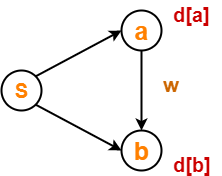


Here, d[a] and d[b] denotes the shortest path estimate for vertices a and b respectively from the source vertex ‘S’.

Now,

If d[a] + w < d[b]

then d[b] = d[a] + w and Π[b] = a

This is called as edge relaxation.


Time Complexity Analysis-


Case-01:


This case is valid when-

  • The given graph G is represented as an adjacency matrix.
  • Priority queue Q is represented as an unordered list.


Here,

  • A[i,j] stores the information about edge (i,j).
  • Time taken for selecting i with the smallest dist is O(V).
  • For each neighbor of i, time taken for updating dist[j] is O(1) and there will be maximum V neighbors.
  • Time taken for each iteration of the loop is O(V) and one vertex is deleted from Q.
  • Thus, total time complexity becomes O(V2).


Case-02:


This case is valid when-

  • The given graph G is represented as an adjacency list.
  • Priority queue Q is represented as a binary heap.


Here,

  • With adjacency list representation, all vertices of the graph can be traversed using BFS in O(V+E) time.
  • In min heap, operations like extract-min and decrease-key value takes O(logV) time.
  • So, overall time complexity becomes O(E+V) x O(logV) which is O((E + V) x logV) = O(ElogV)
  • This time complexity can be reduced to O(E+VlogV) using Fibonacci heap.


PRACTICE PROBLEM BASED ON DIJKSTRA ALGORITHM-


Problem-


Using Dijkstra’s Algorithm, find the shortest distance from source vertex ‘S’ to remaining vertices in the following graph-
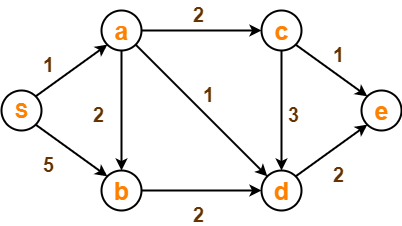


Also, write the order in which the vertices are visited.


Solution-


Step-01:


The following two sets are created-

  • Unvisited set : {S , a , b , c , d , e}
  • Visited set     : { }


Step-02:


The two variables  Π and d are created for each vertex and initialized as-

  • Π[S] = Π[a] = Π[b] = Π[c] = Π[d] = Π[e] = NIL
  • d[S] = 0
  • d[a] = d[b] = d[c] = d[d] = d[e] = ∞


Step-03:


  • Vertex ‘S’ is chosen.
  • This is because shortest path estimate for vertex ‘S’ is least.
  • The outgoing edges of vertex ‘S’ are relaxed.


Before Edge Relaxation-
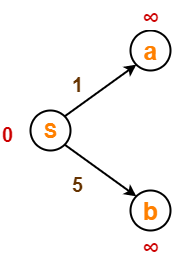


Now,

  • d[S] + 1 = 0 + 1 = 1 < ∞

∴ d[a] = 1 and Π[a] = S

  • d[S] + 5 = 0 + 5 = 5 < ∞

∴ d[b] = 5 and Π[b] = S


After edge relaxation, our shortest path tree is-
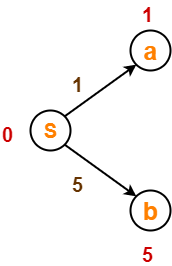


Now, the sets are updated as-

  • Unvisited set : {a , b , c , d , e}
  • Visited set : {S}


Step-04:


  • Vertex ‘a’ is chosen.
  • This is because shortest path estimate for vertex ‘a’ is least.
  • The outgoing edges of vertex ‘a’ are relaxed.


Before Edge Relaxation-
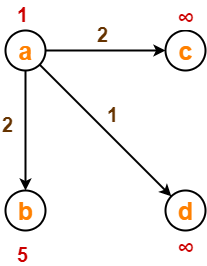


Now,

  • d[a] + 2 = 1 + 2 = 3 < ∞

∴ d[c] = 3 and Π[c] = a

  • d[a] + 1 = 1 + 1 = 2 < ∞

∴ d[d] = 2 and Π[d] = a

  • d[b] + 2 = 1 + 2 = 3 < 5

∴ d[b] = 3 and Π[b] = a


After edge relaxation, our shortest path tree is-
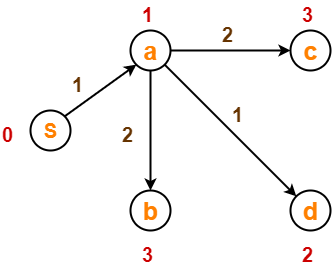


Now, the sets are updated as-

  • Unvisited set : {b , c , d , e}
  • Visited set : {S , a}


Step-05:


  • Vertex ‘d’ is chosen.
  • This is because shortest path estimate for vertex ‘d’ is least.
  • The outgoing edges of vertex ‘d’ are relaxed.


Before Edge Relaxation-
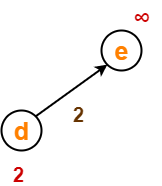


Now,

  • d[d] + 2 = 2 + 2 = 4 < ∞

∴ d[e] = 4 and Π[e] = d


After edge relaxation, our shortest path tree is-
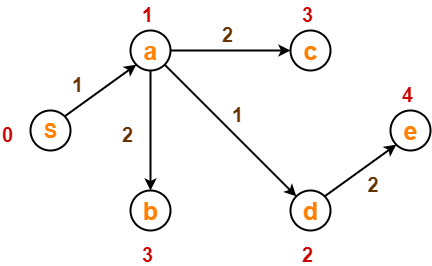


Now, the sets are updated as-

  • Unvisited set : {b , c , e}
  • Visited set : {S , a , d}


Step-06:


  • Vertex ‘b’ is chosen.
  • This is because shortest path estimate for vertex ‘b’ is least.
  • Vertex ‘c’ may also be chosen since for both the vertices, shortest path estimate is least.
  • The outgoing edges of vertex ‘b’ are relaxed.


Before Edge Relaxation-
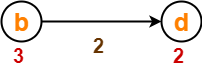


Now,

  • d[b] + 2 = 3 + 2 = 5 > 2

∴ No change


After edge relaxation, our shortest path tree remains the same as in Step-05.

Now, the sets are updated as-

  • Unvisited set : {c , e}
  • Visited set     : {S , a , d , b}


Step-07:


  • Vertex ‘c’ is chosen.
  • This is because shortest path estimate for vertex ‘c’ is least.
  • The outgoing edges of vertex ‘c’ are relaxed.


Before Edge Relaxation-
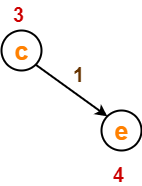


Now,

  • d[c] + 1 = 3 + 1 = 4 = 4

∴ No change


After edge relaxation, our shortest path tree remains the same as in Step-05.

Now, the sets are updated as-

  • Unvisited set : {e}
  • Visited set : {S , a , d , b , c}


Step-08:


  • Vertex ‘e’ is chosen.
  • This is because shortest path estimate for vertex ‘e’ is least.
  • The outgoing edges of vertex ‘e’ are relaxed.
  • There are no outgoing edges for vertex ‘e’.
  • So, our shortest path tree remains the same as in Step-05.


Now, the sets are updated as-

  • Unvisited set : { }
  • Visited set : {S , a , d , b , c , e}


Now,

  • All vertices of the graph are processed.
  • Our final shortest path tree is as shown below.
  • It represents the shortest path from source vertex ‘S’ to all other remaining vertices.
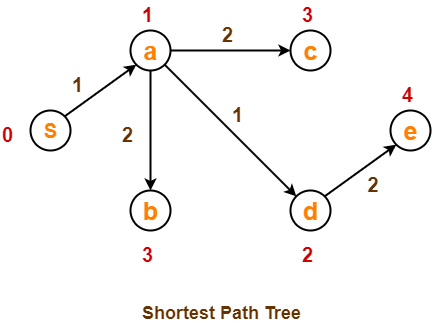


The order in which all the vertices are processed is :

S , a , d , b , c , e.


To gain better understanding about Dijkstra Algorithm,

Watch this Video Lecture


Next Article- Floyd-Warshall Algorithm


Get more notes and other study material of Design and Analysis of Algorithms.

Watch video lectures by visiting our YouTube channel LearnVidFun.
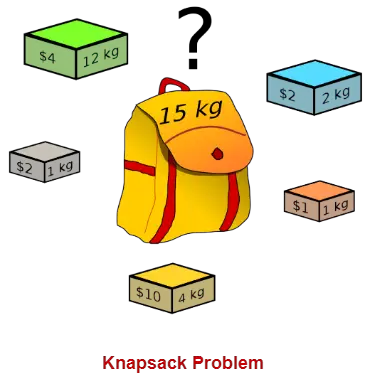
0/1 Knapsack Problem | Dynamic Programming | Example

Knapsack Problem-


You are given the following-

  • A knapsack (kind of shoulder bag) with limited weight capacity.
  • Few items each having some weight and value.


The problem states-

Which items should be placed into the knapsack such that-

  • The value or profit obtained by putting the items into the knapsack is maximum.
  • And the weight limit of the knapsack does not exceed.


Knapsack Problem Variants-


Knapsack problem has the following two variants-

  1. Fractional Knapsack Problem
  2. 0/1 Knapsack Problem


In this article, we will discuss about 0/1 Knapsack Problem.


0/1 Knapsack Problem-


In 0/1 Knapsack Problem,

  • As the name suggests, items are indivisible here.
  • We can not take the fraction of any item.
  • We have to either take an item completely or leave it completely.
  • It is solved using dynamic programming approach.


Also Read- Fractional Knapsack Problem


0/1 Knapsack Problem Using Dynamic Programming-


Consider-

  • Knapsack weight capacity = w
  • Number of items each having some weight and value = n


0/1 knapsack problem is solved using dynamic programming in the following steps-


Step-01:


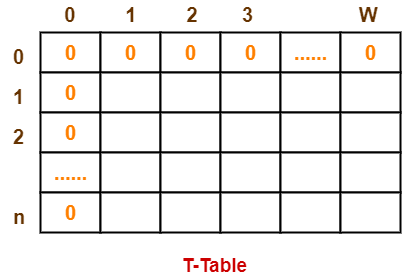
  • Draw a table say ‘T’ with (n+1) number of rows and (w+1) number of columns.
  • Fill all the boxes of 0th row and 0th column with zeroes as shown-


Step-02:


Start filling the table row wise top to bottom from left to right.

Use the following formula-

T (i , j) = max { T ( i-1 , j ) , valuei + T( i-1 , j – weight) }


Here, T(i , j) = maximum value of the selected items if we can take items 1 to i and have weight restrictions of j.


  • This step leads to completely filling the table.
  • Then, value of the last box represents the maximum possible value that can be put into the knapsack.


Step-03:


To identify the items that must be put into the knapsack to obtain that maximum profit,

  • Consider the last column of the table.
  • Start scanning the entries from bottom to top.
  • On encountering an entry whose value is not same as the value stored in the entry immediately above it, mark the row label of that entry.
  • After all the entries are scanned, the marked labels represent the items that must be put into the knapsack.


Time Complexity-


  • Each entry of the table requires constant time θ(1) for its computation.
  • It takes θ(nw) time to fill (n+1)(w+1) table entries.
  • It takes θ(n) time for tracing the solution since tracing process traces the n rows.
  • Thus, overall θ(nw) time is taken to solve 0/1 knapsack problem using dynamic programming.


PRACTICE PROBLEM BASED ON 0/1 KNAPSACK PROBLEM-


Problem-


For the given set of items and knapsack capacity = 5 kg, find the optimal solution for the 0/1 knapsack problem making use of dynamic programming approach.


Item Weight Value
1 2 3
2 3 4
3 4 5
4 5 6


OR


Find the optimal solution for the 0/1 knapsack problem making use of dynamic programming approach. Consider-

n = 4

w = 5 kg

(w1, w2, w3, w4) = (2, 3, 4, 5)

(b1, b2, b3, b4) = (3, 4, 5, 6)


OR


A thief enters a house for robbing it. He can carry a maximal weight of 5 kg into his bag. There are 4 items in the house with the following weights and values. What items should thief take if he either takes the item completely or leaves it completely?


Item Weight (kg) Value ($)
Mirror 2 3
Silver nugget 3 4
Painting 4 5
Vase 5 6


Solution-


Given-


  • Knapsack capacity (w) = 5 kg
  • Number of items (n) = 4


Step-01:


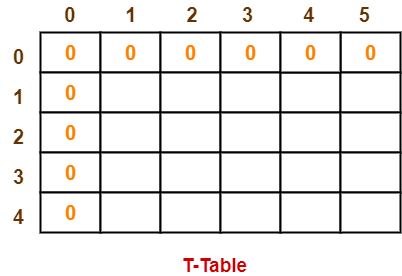
  • Draw a table say ‘T’ with (n+1) = 4 + 1 = 5 number of rows and (w+1) = 5 + 1 = 6 number of columns.
  • Fill all the boxes of 0th row and 0th column with 0.


Step-02:


Start filling the table row wise top to bottom from left to right using the formula-

T (i , j) = max { T ( i-1 , j ) , valuei + T( i-1 , j – weight) }


Finding T(1,1)-


We have,

  • i = 1
  • j = 1
  • (value)i = (value)1 = 3
  • (weight)i = (weight)1 = 2


Substituting the values, we get-

T(1,1) = max { T(1-1 , 1) , 3 + T(1-1 , 1-2) }

T(1,1) = max { T(0,1) , 3 + T(0,-1) }

T(1,1) = T(0,1)             { Ignore T(0,-1) }

T(1,1) = 0


Finding T(1,2)-


We have,

  • i = 1
  • j = 2
  • (value)i = (value)1 = 3
  • (weight)i = (weight)1 = 2


Substituting the values, we get-

T(1,2) = max { T(1-1 , 2) , 3 + T(1-1 , 2-2) }

T(1,2) = max { T(0,2) , 3 + T(0,0) }

T(1,2) = max {0 , 3+0}

T(1,2) = 3


Finding T(1,3)-


We have,

  • i = 1
  • j = 3
  • (value)i = (value)1 = 3
  • (weight)i = (weight)1 = 2


Substituting the values, we get-

T(1,3) = max { T(1-1 , 3) , 3 + T(1-1 , 3-2) }

T(1,3) = max { T(0,3) , 3 + T(0,1) }

T(1,3) = max {0 , 3+0}

T(1,3) = 3


Finding T(1,4)-


We have,

  • i = 1
  • j = 4
  • (value)i = (value)1 = 3
  • (weight)i = (weight)1 = 2


Substituting the values, we get-

T(1,4) = max { T(1-1 , 4) , 3 + T(1-1 , 4-2) }

T(1,4) = max { T(0,4) , 3 + T(0,2) }

T(1,4) = max {0 , 3+0}

T(1,4) = 3


Finding T(1,5)-


We have,

  • i = 1
  • j = 5
  • (value)i = (value)1 = 3
  • (weight)i = (weight)1 = 2


Substituting the values, we get-

T(1,5) = max { T(1-1 , 5) , 3 + T(1-1 , 5-2) }

T(1,5) = max { T(0,5) , 3 + T(0,3) }

T(1,5) = max {0 , 3+0}

T(1,5) = 3


Finding T(2,1)-


We have,

  • i = 2
  • j = 1
  • (value)i = (value)2 = 4
  • (weight)i = (weight)2 = 3


Substituting the values, we get-

T(2,1) = max { T(2-1 , 1) , 4 + T(2-1 , 1-3) }

T(2,1) = max { T(1,1) , 4 + T(1,-2) }

T(2,1) = T(1,1)           { Ignore T(1,-2) }

T(2,1) = 0


Finding T(2,2)-


We have,

  • i = 2
  • j = 2
  • (value)i = (value)2 = 4
  • (weight)i = (weight)2 = 3


Substituting the values, we get-

T(2,2) = max { T(2-1 , 2) , 4 + T(2-1 , 2-3) }

T(2,2) = max { T(1,2) , 4 + T(1,-1) }

T(2,2) = T(1,2)           { Ignore T(1,-1) }

T(2,2) = 3


Finding T(2,3)-


We have,

  • i = 2
  • j = 3
  • (value)i = (value)2 = 4
  • (weight)i = (weight)2 = 3


Substituting the values, we get-

T(2,3) = max { T(2-1 , 3) , 4 + T(2-1 , 3-3) }

T(2,3) = max { T(1,3) , 4 + T(1,0) }

T(2,3) = max { 3 , 4+0 }

T(2,3) = 4


Finding T(2,4)-


We have,

  • i = 2
  • j = 4
  • (value)i = (value)2 = 4
  • (weight)i = (weight)2 = 3


Substituting the values, we get-

T(2,4) = max { T(2-1 , 4) , 4 + T(2-1 , 4-3) }

T(2,4) = max { T(1,4) , 4 + T(1,1) }

T(2,4) = max { 3 , 4+0 }

T(2,4) = 4


Finding T(2,5)-


We have,

  • i = 2
  • j = 5
  • (value)i = (value)2 = 4
  • (weight)i = (weight)2 = 3


Substituting the values, we get-

T(2,5) = max { T(2-1 , 5) , 4 + T(2-1 , 5-3) }

T(2,5) = max { T(1,5) , 4 + T(1,2) }

T(2,5) = max { 3 , 4+3 }

T(2,5) = 7


Similarly, compute all the entries.

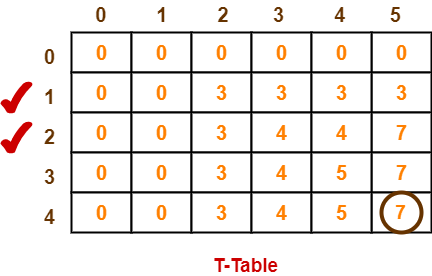
After all the entries are computed and filled in the table, we get the following table-


  • The last entry represents the maximum possible value that can be put into the knapsack.
  • So, maximum possible value that can be put into the knapsack = 7.


Identifying Items To Be Put Into Knapsack-


Following Step-04,

  • We mark the rows labelled “1” and “2”.
  • Thus, items that must be put into the knapsack to obtain the maximum value 7 are-

Item-1 and Item-2


To gain better understanding about 0/1 Knapsack Problem,

Watch this Video Lecture


Next Article- Travelling Salesman Problem


Get more notes and other study material of Design and Analysis of Algorithms.

Watch video lectures by visiting our YouTube channel LearnVidFun.
Fractional Knapsack Problem | Greedy Method | Example

Knapsack Problem-


You are given the following-

  • A knapsack (kind of shoulder bag) with limited weight capacity.
  • Few items each having some weight and value.


The problem states-

Which items should be placed into the knapsack such that-

  • The value or profit obtained by putting the items into the knapsack is maximum.
  • And the weight limit of the knapsack does not exceed.


Knapsack Problem Variants-


Knapsack problem has the following two variants-

  1. Fractional Knapsack Problem
  2. 0/1 Knapsack Problem


In this article, we will discuss about Fractional Knapsack Problem.


Fractional Knapsack Problem-


In Fractional Knapsack Problem,

  • As the name suggests, items are divisible here.
  • We can even put the fraction of any item into the knapsack if taking the complete item is not possible.
  • It is solved using Greedy Method.


Also Read- 0/1 Knapsack Problem


Fractional Knapsack Problem Using Greedy Method-


Fractional knapsack problem is solved using greedy method in the following steps-


Step-01:


For each item, compute its value / weight ratio.


Step-02:


Arrange all the items in decreasing order of their value / weight ratio.


Step-03:


Start putting the items into the knapsack beginning from the item with the highest ratio.

Put as many items as you can into the knapsack.


Time Complexity-


  • The main time taking step is the sorting of all items in decreasing order of their value / weight ratio.
  • If the items are already arranged in the required order, then while loop takes O(n) time.
  • The average time complexity of Quick Sort is O(nlogn).
  • Therefore, total time taken including the sort is O(nlogn).


PRACTICE PROBLEM BASED ON FRACTIONAL KNAPSACK PROBLEM-


Problem-


For the given set of items and knapsack capacity = 60 kg, find the optimal solution for the fractional knapsack problem making use of greedy approach.


Item Weight Value
1 5 30
2 10 40
3 15 45
4 22 77
5 25 90


OR


Find the optimal solution for the fractional knapsack problem making use of greedy approach. Consider-

n = 5

w = 60 kg

(w1, w2, w3, w4, w5) = (5, 10, 15, 22, 25)

(b1, b2, b3, b4, b5) = (30, 40, 45, 77, 90)


OR


A thief enters a house for robbing it. He can carry a maximal weight of 60 kg into his bag. There are 5 items in the house with the following weights and values. What items should thief take if he can even take the fraction of any item with him?


Item Weight Value
1 5 30
2 10 40
3 15 45
4 22 77
5 25 90


Solution-


Step-01:


Compute the value / weight ratio for each item-


Items Weight Value Ratio
1 5 30 6
2 10 40 4
3 15 45 3
4 22 77 3.5
5 25 90 3.6


Step-02:


Sort all the items in decreasing order of their value / weight ratio-


I1          I2          I5          I4          I3

(6)       (4)        (3.6)      (3.5)       (3)


Step-03:


Start filling the knapsack by putting the items into it one by one.


Knapsack Weight Items in Knapsack Cost
60 Ø 0
55 I1 30
45 I1, I2 70
20 I1, I2, I5 160


Now,

  • Knapsack weight left to be filled is 20 kg but item-4 has a weight of 22 kg.
  • Since in fractional knapsack problem, even the fraction of any item can be taken.
  • So, knapsack will contain the following items-

< I1 , I2 , I5 , (20/22) I4 >


Total cost of the knapsack

= 160 + (20/27) x 77

= 160 + 70

= 230 units


Important Note-


Had the problem been a 0/1 knapsack problem, knapsack would contain the following items-

< I1 , I2 , I5 >

The knapsack’s total cost would be 160 units.


To gain better understanding about Fractional Knapsack Problem,

Watch this Video Lecture


Next Article- Job Sequencing With Deadlines


Get more notes and other study material of Design and Analysis of Algorithms.

Watch video lectures by visiting our YouTube channel LearnVidFun.
Shift Reduce Parser | Shift Reduce Parsing

Shift-Reduce Parser-


A shift-reduce parser is a bottom-up parser.


It takes the given input string and builds a parse tree-

  • Starting from the bottom at the leaves.
  • And growing the tree towards the top to the root.


Data Structures-


Two data structures are required to implement a shift-reduce parser-

  • A Stack is required to hold the grammar symbols.
  • An Input buffer is required to hold the string to be parsed.


Working-


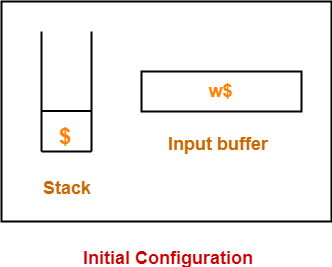
Initially, shift-reduce parser is present in the following configuration where-

  • Stack contains only the $ symbol.
  • Input buffer contains the input string with $ at its end.


The parser works by-

  • Moving the input symbols on the top of the stack.
  • Until a handle β appears on the top of the stack.


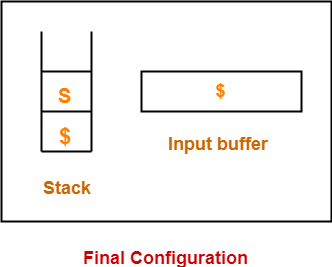
The parser keeps on repeating this cycle until-

  • An error is detected.
  • Or stack is left with only the start symbol and the input buffer becomes empty.


After achieving this configuration,

  • The parser stops / halts.
  • It reports the successful completion of parsing.


Possible Actions-


A shift-reduce parser can possibly make the following four actions-


1. Shift-


In a shift action,

  • The next symbol is shifted onto the top of the stack.


2. Reduce-


In a reduce action,

  • The handle appearing on the stack top is replaced with the appropriate non-terminal symbol.


3. Accept-


In an accept action,

  • The parser reports the successful completion of parsing.


4. Error-


In this state,

  • The parser becomes confused and is not able to make any decision.
  • It can neither perform shift action nor reduce action nor accept action.


Rules To Remember


It is important to remember the following rules while performing the shift-reduce action-

  • If the priority of incoming operator is more than the priority of in stack operator, then shift action is performed.
  • If the priority of in stack operator is same or less than the priority of in stack operator, then reduce action is performed.


PRACTICE PROBLEMS BASED ON SHIFT-REDUCE PARSING-


Problem-01:


Consider the following grammar-

E → E – E

E → E x E

E → id

Parse the input string id – id x id using a shift-reduce parser.


Solution-


The priority order is: id > x > –


Stack Input Buffer Parsing Action
$ id – id x id $ Shift
$ id – id x id $ Reduce E → id
$ E – id x id $ Shift
$ E – id x id $ Reduce E → id
$ E – E x id $ Shift
$ E – E x id $ Reduce E → id
$ E – E x E $ Reduce E → E x E
$ E – E $ Reduce E → E – E
$ E $ Accept


Problem-02:


Consider the following grammar-

S → ( L ) | a

L → L , S | S

Parse the input string ( a , ( a , a ) ) using a shift-reduce parser.


Solution-


Stack Input Buffer Parsing Action
$ ( a , ( a , a ) ) $ Shift
$ ( a , ( a , a ) ) $ Reduce S → a
$ ( S , ( a , a ) ) $ Reduce L → S
$ ( L , ( a , a ) ) $ Shift
$ ( L , ( a , a ) ) $ Reduce S → a
$ ( L , ( S , a ) ) $ Reduce L → S
$ ( L , ( L , a ) ) $ Shift
$ ( L , ( L , a ) ) $ Reduce S → a
$ ( L , ( L , S ) ) ) $ Reduce L → L , S
$ ( L , ( L ) ) $ Shift
$ ( L , ( L ) ) $ Reduce S → (L)
$ ( L , S ) $ Reduce L → L , S
$ ( L ) $ Shift
$ ( L ) $ Reduce S → (L)
$ S $ Accept


Problem-03:


Consider the following grammar-

S → T L

T → int | float

L → L , id | id

Parse the input string int id , id ; using a shift-reduce parser.


Solution-


Stack Input Buffer Parsing Action
$ int id , id ; $ Shift
$ int id , id ; $ Reduce T → int
$ T id , id ; $ Shift
$ T id , id ; $ Reduce L → id
$ T L , id ; $ Shift
$ T L , id ; $ Reduce L → L , id
$ T L ; $ Shift
$ T L ; $ Reduce S → T L
$ S $ Accept


Problem-04:


Considering the string “10201”, design a shift-reduce parser for the following grammar-

S → 0S0 | 1S1 | 2


Solution-


Stack Input Buffer Parsing Action
$ 1 0 2 0 1 $ Shift
$ 1 0 2 0 1 $ Shift
$ 1 0 2 0 1 $ Shift
$ 1 0 2 0 1 $ Reduce S → 2
$ 1 0 S 0 1 $ Shift
$ 1 0 S 0 1 $ Reduce S → 0 S 0
$ 1 S 1 $ Shift
$ 1 S 1 $ Reduce S → 1 S 1
$ S $ Accept


To gain better understanding about Shift-Reduce Parsing,

Watch this Video Lecture


Download Handwritten Notes Here-


Next Article- Operator Precedence Parsing


Get more notes and other study material of Compiler Design.

Watch video lectures by visiting our YouTube channel LearnVidFun.
Syntax Trees | Abstract Syntax Trees

Syntax Trees-


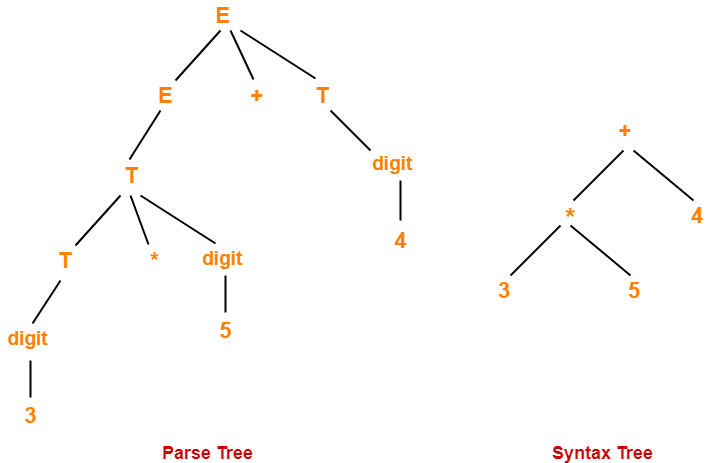
Syntax trees are abstract or compact representation of parse trees.

They are also called as Abstract Syntax Trees.


Example-


Also Read- Parse Trees


Parse Trees Vs Syntax Trees-


Parse Tree Syntax Tree
Parse tree is a graphical representation of the replacement process in a derivation. Syntax tree is the compact form of a parse tree.
Each interior node represents a grammar rule.

Each leaf node represents a terminal.

Each interior node represents an operator.

Each leaf node represents an operand.

Parse trees provide every characteristic information from the real syntax. Syntax trees do not provide every characteristic information from the real syntax.
Parse trees are comparatively less dense than syntax trees. Syntax trees are comparatively more dense than parse trees.


NOTE-


Syntax trees are called as Abstract Syntax Trees because-

  • They are abstract representation of the parse trees.
  • They do not provide every characteristic information from the real syntax.
  • For example- no rule nodes, no parenthesis etc.


PRACTICE PROBLEMS BASED ON SYNTAX TREES-


Problem-01:


Considering the following grammar-

E → E + T | T

T → T x F | F

F → ( E ) | id


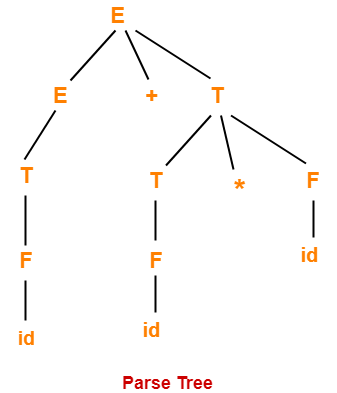
Generate the following for the string id + id x id

  1. Parse tree
  2. Syntax tree
  3. Directed Acyclic Graph (DAG)


Solution-


Parse Tree-


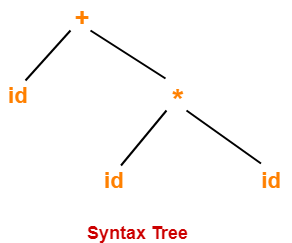
Syntax Tree-


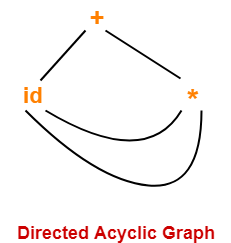
Directed Acyclic Graph-


Also Read- Directed Acyclic Graphs


Problem-02:


Construct a syntax tree for the following arithmetic expression-

( a + b ) * ( c – d ) + ( ( e / f ) * ( a + b ))


Solution-


Step-01:


We convert the given arithmetic expression into a postfix expression as-


( a + b ) * ( c – d ) + ( ( e / f ) * ( a + b ) )

ab+ * ( c – d ) + ( ( e / f ) * ( a + b ) )

ab+ * cd- + ( ( e / f ) * ( a + b ) )

ab+ * cd- + ( ef/ * ( a + b ) )

ab+ * cd- + ( ef/ * ab+ )

ab+ * cd- + ef/ab+*

ab+cd-* + ef/ab+*

ab+cd-*ef/ab+*+


Step-02:


We draw a syntax tree for the above postfix expression.


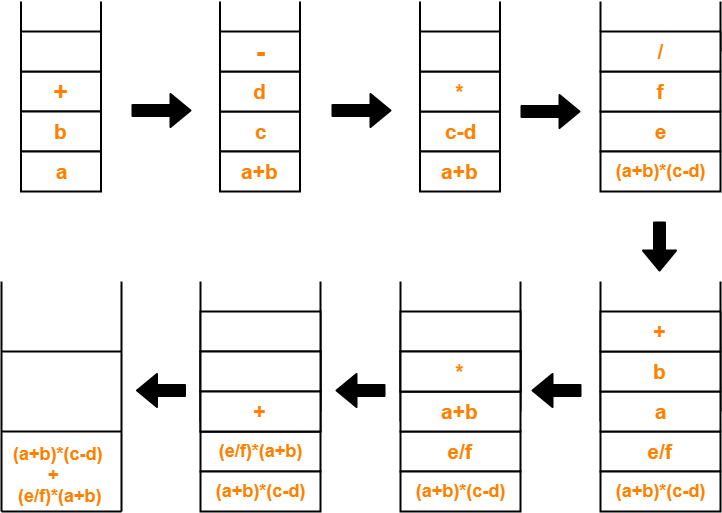
Steps Involved


Start pushing the symbols of the postfix expression into the stack one by one.

When an operand is encountered,

  • Push it into the stack.

When an operator is encountered

  • Push it into the stack.
  • Pop the operator and the two symbols below it from the stack.
  • Perform the operation on the two operands using the operator you have in hand.
  • Push the result back into the stack.

Continue in the similar manner and draw the syntax tree simultaneously.


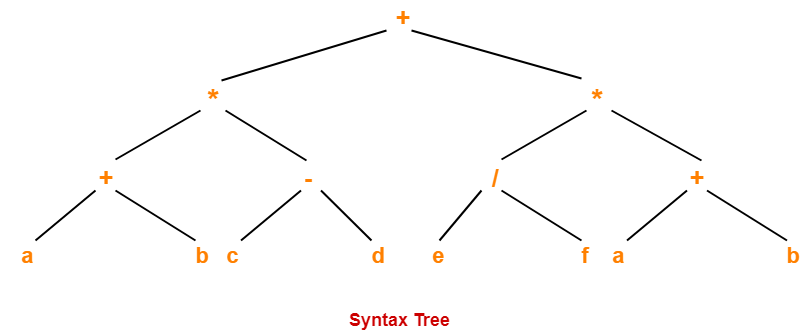
The required syntax tree is-


To gain better understanding about Syntax Trees,

Watch this Video Lecture


Download Handwritten Notes Here-


Next Article- Shift Reduce Parsing


Get more notes and other study material of Compiler Design.

Watch video lectures by visiting our YouTube channel LearnVidFun.