Month: July 2018

Prim’s Algorithm | Prim’s Algorithm Example | Problems

Prim’s Algorithm-


  • Prim’s Algorithm is a famous greedy algorithm.
  • It is used for finding the Minimum Spanning Tree (MST) of a given graph.
  • To apply Prim’s algorithm, the given graph must be weighted, connected and undirected.


Prim’s Algorithm Implementation-


The implementation of Prim’s Algorithm is explained in the following steps-


Step-01:


  • Randomly choose any vertex.
  • The vertex connecting to the edge having least weight is usually selected.


Step-02:


  • Find all the edges that connect the tree to new vertices.
  • Find the least weight edge among those edges and include it in the existing tree.
  • If including that edge creates a cycle, then reject that edge and look for the next least weight edge.


Step-03:


  • Keep repeating step-02 until all the vertices are included and Minimum Spanning Tree (MST) is obtained.


Prim’s Algorithm Time Complexity-


Worst case time complexity of Prim’s Algorithm is-

  • O(ElogV) using binary heap
  • O(E + VlogV) using Fibonacci heap


Time Complexity Analysis


  • If adjacency list is used to represent the graph, then using breadth first search, all the vertices can be traversed in O(V + E) time.
  • We traverse all the vertices of graph using breadth first search and use a min heap for storing the vertices not yet included in the MST.
  • To get the minimum weight edge, we use min heap as a priority queue.
  • Min heap operations like extracting minimum element and decreasing key value takes O(logV) time.


So, overall time complexity

= O(E + V) x O(logV)

= O((E + V)logV)

= O(ElogV)


This time complexity can be improved and reduced to O(E + VlogV) using Fibonacci heap.


PRACTICE PROBLEMS BASED ON PRIM’S ALGORITHM-


Problem-01:


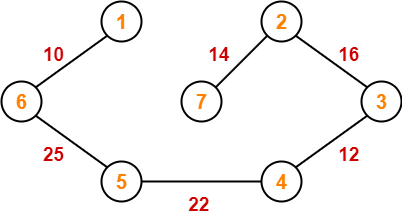
Construct the minimum spanning tree (MST) for the given graph using Prim’s Algorithm-


Solution-


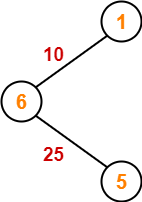
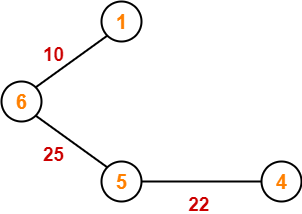
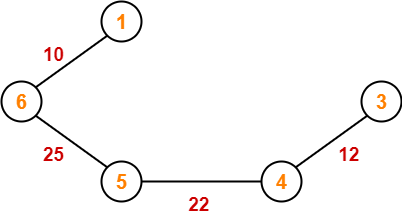
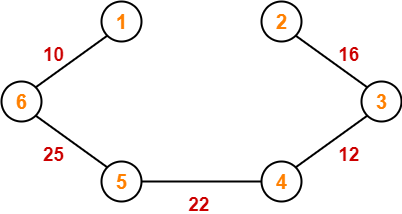
The above discussed steps are followed to find the minimum cost spanning tree using Prim’s Algorithm-


Step-01:


Step-02:


Step-03:


Step-04:


Step-05:


Step-06:


Since all the vertices have been included in the MST, so we stop.


Now, Cost of Minimum Spanning Tree

= Sum of all edge weights

= 10 + 25 + 22 + 12 + 16 + 14

= 99 units


Problem-02:


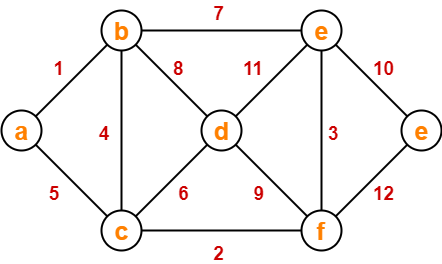
Using Prim’s Algorithm, find the cost of minimum spanning tree (MST) of the given graph-


Solution-


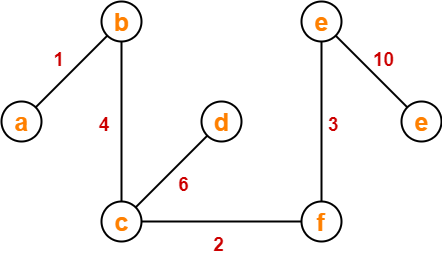
The minimum spanning tree obtained by the application of Prim’s Algorithm on the given graph is as shown below-


Now, Cost of Minimum Spanning Tree

= Sum of all edge weights

= 1 + 4 + 2 + 6 + 3 + 10

= 26 units


To gain better understanding about Prim’s Algorithm,

Watch this Video Lecture


To practice previous years GATE problems based on Prim’s Algorithm,

Watch this Video Lecture


Next Article- Kruskal’s Algorithm


Get more notes and other study material of Design and Analysis of Algorithms.

Watch video lectures by visiting our YouTube channel LearnVidFun.

Topological Sort | Topological Sort Examples

Topological Sort-


Topological Sort is a linear ordering of the vertices in such a way that

if there is an edge in the DAG going from vertex ‘u’ to vertex ‘v’,

then ‘u’ comes before ‘v’ in the ordering.


It is important to note that-

  • Topological Sorting is possible if and only if the graph is a Directed Acyclic Graph.
  • There may exist multiple different topological orderings for a given directed acyclic graph.


Topological Sort Example-


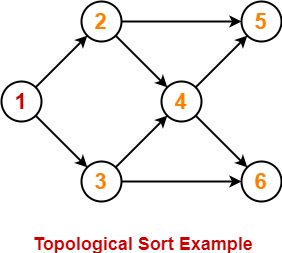
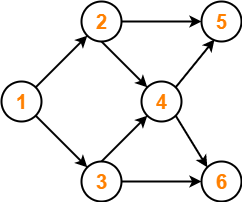
Consider the following directed acyclic graph-


For this graph, following 4 different topological orderings are possible-

  • 1 2 3 4 5 6
  • 1 2 3 4 6 5
  • 1 3 2 4 5 6
  • 1 3 2 4 6 5


Applications of Topological Sort-


Few important applications of topological sort are-

  • Scheduling jobs from the given dependencies among jobs
  • Instruction Scheduling
  • Determining the order of compilation tasks to perform in makefiles
  • Data Serialization


PRACTICE PROBLEMS BASED ON TOPOLOGICAL SORT-


Problem-01:


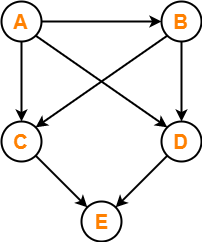
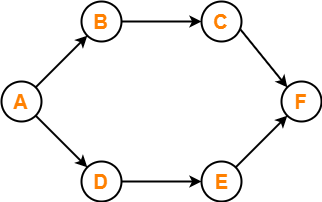
Find the number of different topological orderings possible for the given graph-


Solution-


The topological orderings of the above graph are found in the following steps-


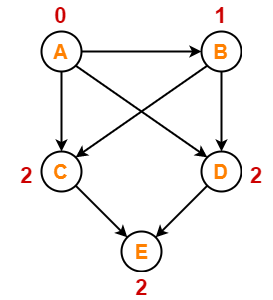
Step-01:


Write in-degree of each vertex-


Step-02:


  • Vertex-A has the least in-degree.
  • So, remove vertex-A and its associated edges.
  • Now, update the in-degree of other vertices.


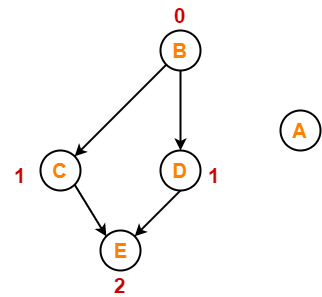
Step-03:


  • Vertex-B has the least in-degree.
  • So, remove vertex-B and its associated edges.
  • Now, update the in-degree of other vertices.


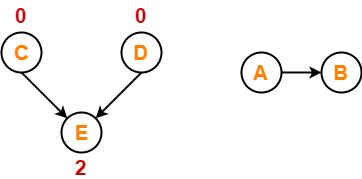
Step-04:


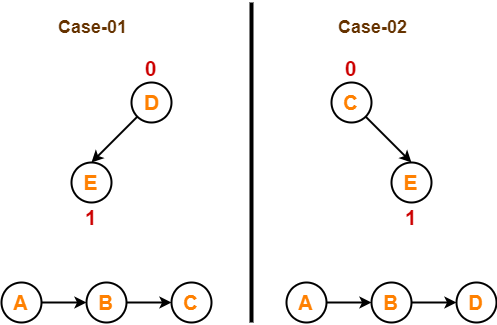
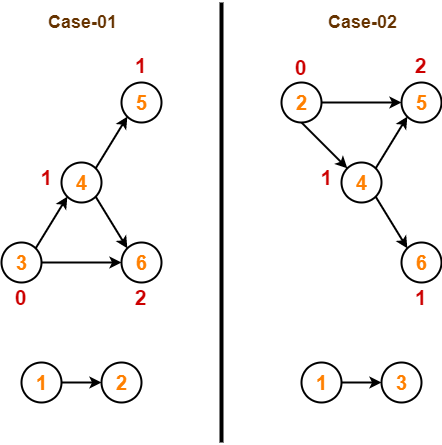
There are two vertices with the least in-degree. So, following 2 cases are possible-


In case-01,

  • Remove vertex-C and its associated edges.
  • Then, update the in-degree of other vertices.


In case-02,

  • Remove vertex-D and its associated edges.
  • Then, update the in-degree of other vertices.


Step-05:


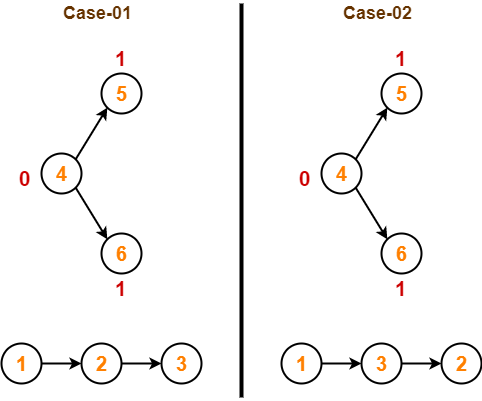
Now, the above two cases are continued separately in the similar manner.


In case-01,

  • Remove vertex-D since it has the least in-degree.
  • Then, remove the remaining vertex-E.


In case-02,

  • Remove vertex-C since it has the least in-degree.
  • Then, remove the remaining vertex-E.


Conclusion-


For the given graph, following 2 different topological orderings are possible-

  • A B C D E
  • A B D C E


Problem-02:


Find the number of different topological orderings possible for the given graph-


Solution-


The topological orderings of the above graph are found in the following steps-


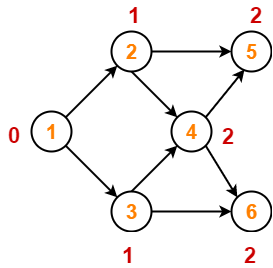
Step-01:


Write in-degree of each vertex-


Step-02:


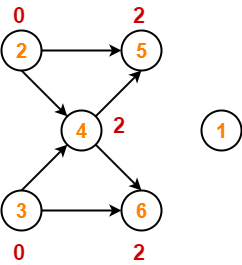
  • Vertex-1 has the least in-degree.
  • So, remove vertex-1 and its associated edges.
  • Now, update the in-degree of other vertices.


Step-03:


There are two vertices with the least in-degree. So, following 2 cases are possible-


In case-01,

  • Remove vertex-2 and its associated edges.
  • Then, update the in-degree of other vertices.


In case-02,

  • Remove vertex-3 and its associated edges.
  • Then, update the in-degree of other vertices.


Step-04:


Now, the above two cases are continued separately in the similar manner.


In case-01,

  • Remove vertex-3 since it has the least in-degree.
  • Then, update the in-degree of other vertices.


In case-02,

  • Remove vertex-2 since it has the least in-degree.
  • Then, update the in-degree of other vertices.


Step-05:


In case-01,

  • Remove vertex-4 since it has the least in-degree.
  • Then, update the in-degree of other vertices.


In case-02,

  • Remove vertex-4 since it has the least in-degree.
  • Then, update the in-degree of other vertices.


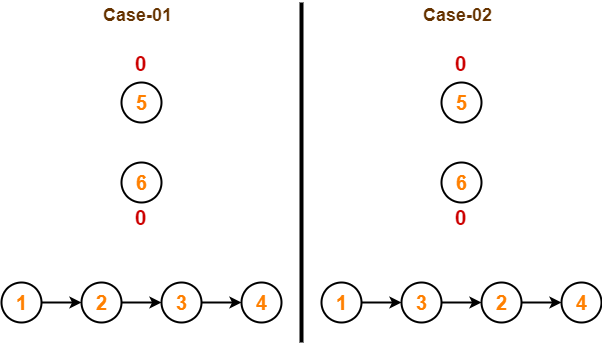
Step-06:


In case-01,

  • There are 2 vertices with the least in-degree.
  • So, 2 cases are possible.
  • Any of the two vertices may be taken first.


Same is with case-02.


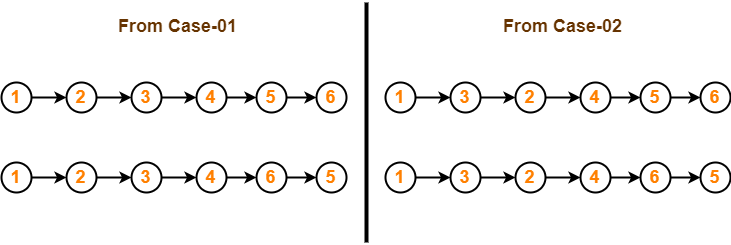
Conclusion-


For the given graph, following 4 different topological orderings are possible-

  • 1 2 3 4 5 6
  • 1 2 3 4 6 5
  • 1 3 2 4 5 6
  • 1 3 2 4 6 5


Problem-03:


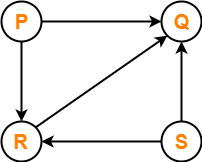
Consider the directed graph given below. Which of the following statements is true?


  1. The graph does not have any topological ordering.
  2. Both PQRS and SRPQ are topological orderings.
  3. Both PSRQ and SPRQ are topological orderings.
  4. PSRQ is the only topological ordering.


Solution-


  • The given graph is a directed acyclic graph.
  • So, topological orderings exist.
  • P and S must appear before R and Q in topological orderings as per the definition of topological sort.


Thus, Correct option is (C).


Problem-04:


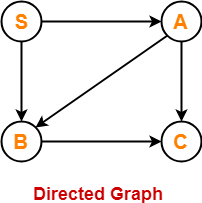
Consider the following directed graph-


The number of different topological orderings of the vertices of the graph is ________ ?


Solution-


Number of different topological orderings possible = 6.

Thus, Correct answer is 6.


(The solution is explained in detail in the linked video lecture.)


To gain better understanding about Topological Sort,

Watch this Video Lecture


To practice previous years GATE problems on Topological Sort,

Watch this Video Lecture


Next Article- Shortest Path Problems


Other Popular Sorting Algorithms-


Get more notes and other study material of Design and Analysis of Algorithms.

Watch video lectures by visiting our YouTube channel LearnVidFun.

CYK Algorithm | CYK Algorithm Example

CYK Algorithm-


CYK Algorithm is a membership algorithm of context free grammar.


  • It is used to decide whether a given string belongs to the language of grammar or not.
  • It is also known as CKY Algorithm or Cocke-Younger-Kasami Algorithm after its inventors.


Important Notes-


Note-01:


Note-02:


  • The worst case running time of CYK Algorithm is Θ (n3.|G|).
  • Here, n = Length of parsed string and |G| = Size of the CNF Grammar G.


Algorithm-


Begin
      for ( i = 1 to n do )
      Vi1 { A | A → a is a production where ith symbol of x is a }

      for ( j = 2 to n do )
           for ( i = 1 to n - j + 1 do )
           Begin
                 Vij = ϕ
                 For k = 1 to j - 1 do
                 Vij = Vij ∪ { A | A → BC is a production where B is in Vik and C is in V(i + k)(j - k) }
           End
End


Also Read- Algorithm To Check Whether CFL is Empty


Deciding Membership Using CYK Algorithm-


To decide the membership of any given string, we construct a triangular table where-

  • Each row of the table corresponds to one particular length of sub strings.
  • Bottom most row corresponds to strings of length-1.
  • Second row from bottom corresponds to strings of length-2.
  • Third row from bottom corresponds to strings of length-3.
  • Top most row from bottom corresponds to the given string of length-n.


Example-


For a given string “x” of length 4 units, triangular table looks like-
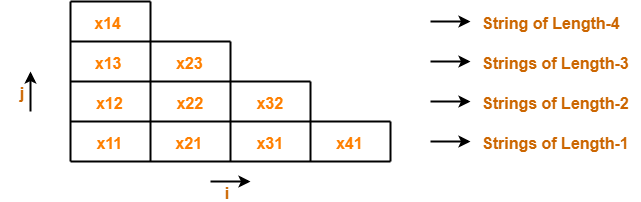


We will fill each box of xij with its Vij.

These notations are discussed below.


Notations Used


Notation-01: xij


xij represents a sub string of “x” starting from location ‘i’ and has length ‘j’.

Example-

Consider x = abcd is a string, then-

Number of sub strings possible = n(n+1)/2 = 4 x (4+1) / 2 = 10

We have-

  • x11 = a
  • x21 = b
  • x31 = c
  • x41 = d
  • x12 = ab
  • x22 = bc
  • x32 = cd
  • x13 = abc
  • x23 = bcd
  • x14 = abcd


Notation-02: Vij


Vij represents a set of variables in the grammar which can derive the sub string xij.

If the set of variables consists of the start symbol, then it becomes sure-

  • Sub string xij can be derived from the given grammar.
  • Sub string xij is a member of the language of the given grammar.


Also Read- Algorithm To Check Whether CFL is Finite


PRACTICE PROBLEM BASED ON CYK ALGORITHM-


Problem-


For the given grammar, check the acceptance of string w = baaba using CYK Algorithm-

S → AB / BC

A → BA / a

B → CC / b

C → AB / a

Solution-


First, let us draw the triangular table.

  • The given string is x = baaba.
  • Length of given string = |x| = 5.
  • So, Number of sub strings possible = (5 x 6) / 2 = 15.


So, triangular table looks like-
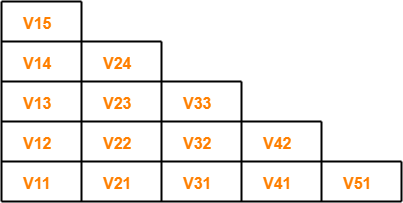


Now, let us find the value of Vij for each cell.


For Row-1:


Finding V11


  • V11 represents the set of variables deriving x11.
  • x11 = b.
  • Only variable B derives string “b” in the given grammar.
  • Thus, V11 = { B }


Finding V21


  • V21 represents the set of variables deriving x21.
  • x21 = a.
  • Variables A and C derive string “a” in the given grammar.
  • Thus, V21 = { A , C }


Finding V31


  • V31 represents the set of variables deriving x31.
  • x31 = a.
  • Variables A and C derive string “b” in the given grammar.
  • Thus, V31 = { A , C }


Finding V41


  • V41 represents the set of variables deriving x41.
  • x41 = b.
  • Only variable B derives string “b” in the given grammar.
  • Thus, V41 = { B }


Finding V51


  • V51 represents the set of variables deriving x51.
  • x51 = a.
  • Variables A and C derives string “a” in the given grammar.
  • Thus, V51 = { A , C }


For Row-2-


RULE

As per the algorithm, to find the value of Vij from 2nd row on wards,

we use the formula-

Vij = Vik V(i+k)(j-k)

where k varies from 1 to j-1


Finding V12


We have i = 1 , j = 2 , k = 1

Substituting values in the formula, we get-

V12 = V11. V21

V12 = { B } { A , C }

V12 = { BA , BC }

∴ V12 = { A , S }


Finding V22


We have i = 2 , j = 2 , k = 1

Substituting values in the formula, we get-

V22 = V21. V31

V22 = { A , C } { A , C }

V22 = { AA , AC , CA , CC }

Since AA , AC and CA do not exist, so we have-

V22 = { CC }

∴ V22 = { B }


Finding V32


We have i = 3 , j = 2 , k = 1

Substituting values in the formula, we get-

V32 = V31. V41

V32 = { A , C } { B }

V32 = { AB , CB }

Since CB does not exist, so we have-

V32 = { AB }

∴ V32 = { S , C }


Finding V42


We have i = 4 , j = 2 , k = 1

Substituting values in the formula, we get-

V42 = V41. V51

V42 = { B } { A , C }

V42 = { BA , BC }

∴ V42 = { A , S }


For Row-3-


Finding V13


We have i = 1 , j = 3 , k = 1 to (3-1) = 1,2

Substituting values in the formula, we get-

V13 = V11. V22 ∪ V12. V31

V13 = { B } { B } ∪ { A , S } { A , C }

V13 = { BB } ∪ { AA , AC , SA , SC }

Since BB , AA , AC , SA and SC do not exist, so we have-

V13 = ϕ ∪ ϕ

∴ V13 = ϕ


Finding V23


We have i = 2 , j = 3 , k = 1 to (3-1) = 1,2

Substituting values in the formula, we get-

V23 = V21. V32 ∪ V22. V41

V23 = { A , C } { S , C } ∪ { B } { B }

V23 = { AS , AC , CS , CC } ∪ { BB }

Since AS , AC , CS and BB do not exist, so we have-

V23 = { CC }

∴ V23 = B


Finding V33


We have i = 3 , j = 3 , k = 1 to (3-1) = 1,2

Substituting values in the formula, we get-

V33 = V31. V42 ∪ V32. V51

V33 = { A , C } { A , S } ∪ { S , C } { A , C }

V33 = { AA , AS , CA , CS } ∪ { SA , SC , CA , CC }

Since AA , AS , CA , CS , SA , SC and CA do not exist, so we have-

V33 = ϕ ∪ { CC }

V33 = ϕ ∪ { B }

∴ V33 = { B }


For Row-4-


Finding V14


We have i = 1 , j = 4 , k = 1 to (4-1) = 1,2,3

Substituting values in the formula, we get-

V14 = V11. V23 ∪ V12. V32 ∪ V13. V41

V14 = { B } { B } ∪ { A , S } { S , C } ∪ { ϕ , B }

V14 = { BB } ∪ { AS , AC , SS , SC } ∪ { B }

Since BB , AS , AC , SS , SC and B do not exist, so we have-

V14 = ϕ ∪ ϕ ∪ ϕ

∴ V14 = ϕ


Finding V24


We have i = 2 , j = 4 , k = 1 to (4-1) = 1,2,3

Substituting values in the formula, we get-

V24 = V21. V33 ∪ V22. V42 ∪ V23. V51

V24 = { A , C } { B } ∪ { B } { A , S } ∪ { B } { A , C }

V24 = { AB , CB } ∪ { BA , BS } ∪ { BA , BC }

Since CB does not exist, so we have-

V24 = { AB } ∪ { BA , BS } ∪ { BA , BC }

V24 = { S , C } ∪ { A } ∪ { A , S }

∴ V24 = { S , C , A }


For Row-5-


Finding V15


We have i = 1 , j = 5 , k = 1 to (5-1) = 1,2,3,4

Substituting values in the formula, we get-

V15 = V11. V24 ∪ V12. V33 ∪ V13. V42 ∪ V14. V51

V15 = { B } { S , C , A } ∪ { A , S } { B } ∪ { ϕ } { A , S } ∪ { ϕ } { A , C }

V15 = { BS , BC , BA } ∪ { AB , SB } ∪ { A , S } ∪ { A , C }

Since BS , SB , A , S and C do not exist, so we have-

V15 = { BC , BA } ∪ { AB } ∪ ϕ ∪ ϕ

V15 = { S , A } ∪ { S , C } ∪ ϕ ∪ ϕ

∴ V15 = { S , A , C }


Now,

  • The value of Vij is computed for each cell.
  • We observe V15 contains the start symbol S.
  • Thus, string x15 = baaba is a member of the language of given grammar.


After filling the triangular table, it looks like-
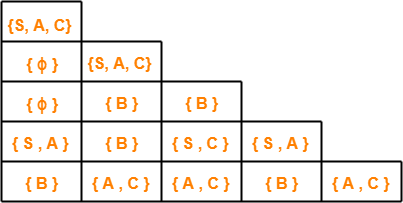


Results From Triangular Table-


The following important results can be made from the above triangular table-


Result-01:


  • There exists total 4 distinct sub strings which are members of the language of given grammar.
  • These 4 sub strings are ba, ab, aaba, baaba.
  • This is because they contain start symbol in their respective cell.


Result-02:


  • Strings which can not be derived from any variable are baa, baab.
  • This is because they contain ϕ in their respective cell.


Result-03:


  • Strings which can be derived from variable B alone are b, aa, aba, aab.
  • This is because they contain variable B alone in their respective cell.


Get more notes and other study material of Theory of Automata and Computation.

Watch video lectures by visiting our YouTube channel LearnVidFun.
Algorithm To Decide Whether CFL Is Finite

Context Free Language-


Before you go through this article, make sure that you have gone through the previous article on Context Free Language.


We have discussed-

  • Context free language is generated using a context free grammar.
  • Each context free language is accepted by a Pushdown automaton.


In this article, we will discuss a decision algorithm of CFL.


Algorithm To Decide Whether CFL Is Finite Or Not-


For a given CFG, there exists an algorithm to decide whether its language is finite or not.


Step-01:


Reduce the given grammar completely by-

  • Eliminating ∈ productions
  • Eliminating unit productions
  • Eliminating useless productions


Also Watch- How To Reduce Grammar?


Step-02:


  • Draw a directed graph whose nodes are variables of the given grammar.
  • There exists an edge from node A to node B if there exists a production of the form A → αBβ.


Now, following 2 cases are possible-


Case-01:


  • Directed graph contains a cycle.
  • In this case, language of the given grammar is infinite.


Case-02:


  • Directed graph does not contain any cycle.
  • In this case, language of the given grammar is finite.


Also Read- Algorithm To Decide Whether CFL Is Empty


PRACTICE PROBLEMS BASED ON DECIDING WHETHER CFL IS FINITE-


Problem-01:


Check whether language of the following grammar is finite or not-

S → AB / a

A → BC / b

B → CC / c


Solution-


Step-01:


The given grammar is already completely reduced.


Step-02:


We will draw a directed graph whose nodes will be S , A , B , C.


Now,

  • Due to the production S → AB, directed graph will have edges S → A and S → B.
  • Due to the production A → BC, directed graph will have edges A → B and A → C.
  • Due to the production B → CC, directed graph will have edge B → C.


The required directed graph is-


Clearly,

  • The directed graph does not contain any cycle.
  • Therefore, language of the given grammar is finite.


Problem-02:


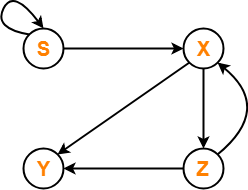
Check whether language of the following grammar is finite or not-

S → XS / b

X → YZ

Y → ab

Z → XY


Solution-


Step-01:


The given grammar is already completely reduced.


Step-02:


We will draw a directed graph whose nodes will be S , X , Y , Z.


Now,

  • Due to the production S → XS / b, directed graph will have edges S → X and S → S.
  • Due to the production X → YZ, directed graph will have edges X → Y and X → Z.
  • Due to the production Z → XY, directed graph will have edges Z → X and Z → Y.


The required directed graph is-


Clearly,

  • The directed graph contain cycles.
  • Therefore, language of the given grammar is infinite.


Next Article- CYK Algorithm


Get more notes and other study material of Theory of Automata and Computation.

Watch video lectures by visiting our YouTube channel LearnVidFun.
Algorithm To Decide Whether CFL Is Empty

Context Free Language-


Before you go through this article, make sure that you have gone through the previous article on Context Free Language.


We have discussed-

  • Context free language is generated using a context free grammar.
  • Each context free language is accepted by a Pushdown automaton.


In this article, we will discuss a decision algorithm of CFL.


Algorithm To Decide Whether CFL Is Empty Or Not-


If we can not derive any string of terminals from the given grammar,

then its language is called as an Empty Language.

L(G) = ϕ


For a given CFG, there exists an algorithm to decide whether its language is empty L(G) = ϕ or not.


Algorithm-


  • Remove all the useless symbols from the grammar.
  • A useless symbol is one that does not derive any string of terminals.
  • If the start symbol is found to be useless, then language is empty otherwise not.


Remember

The language generated from a CFG is non-empty iff the start symbol is generating.


Example-


Consider the following grammar-

S → XY

X → AX

X → AA

A → a

Y → BY

Y → BB

B → b


Now, let us check whether language generated by this grammar is empty or not.


The given grammar can be written as-

S → aabb

X → aX

X → aa

A → a

Y → bY

Y → bb

B → b


Clearly,

  • The start symbol generates at least one string (many more are possible).
  • Therefore, start symbol is useful.
  • Thus, language generated by the given grammar is non-empty.


L(G) ≠ ϕ


NOTE-


If L(G) = { ∈ } i.e.

  • If the language generated by a grammar contains only a null string,
  • then it is considered as non-empty.


Next Article- Algorithm To Decide Whether CFL Is Finite


Get more notes and other study material of Theory of Automata and Computation.

Watch video lectures by visiting our YouTube channel LearnVidFun.